

 SHARE:
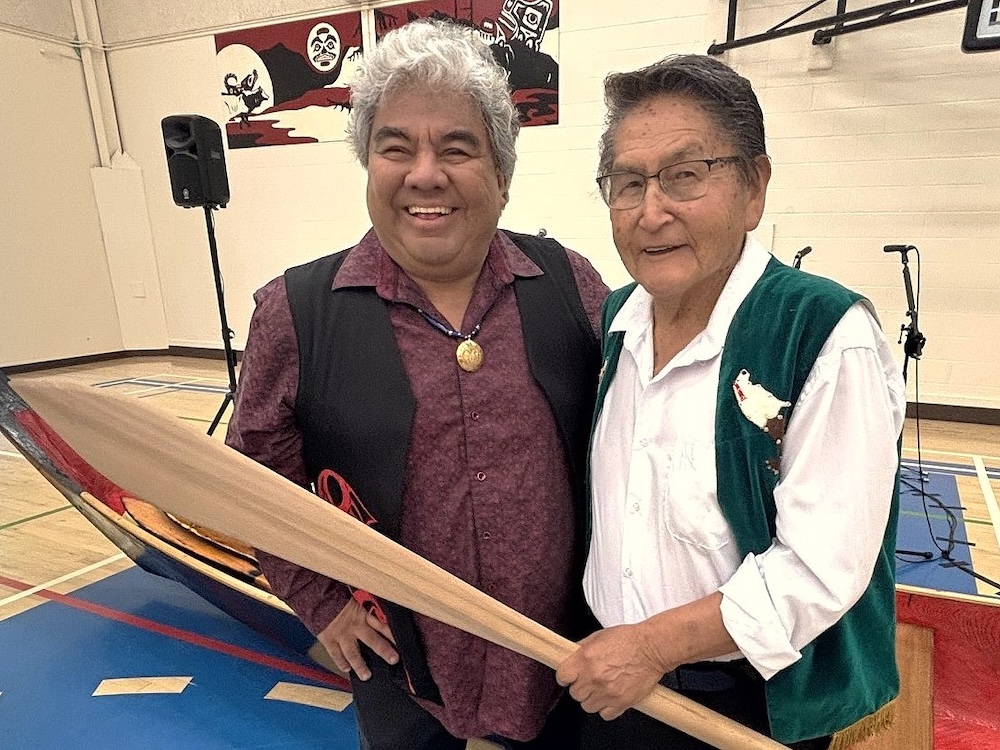
“These canoes are incredible allies and friends. There’s a lot of spirit in these canoes.”
So said ƛaʔuuk (Gisèle Maria Martin) near the conclusion of a gentle and sometimes emotional ceremony on National Indigenous Peoples Day, a gathering to mark the long, hard, intertwined pathways of resistance taken by two leading British Columbia First Nations.
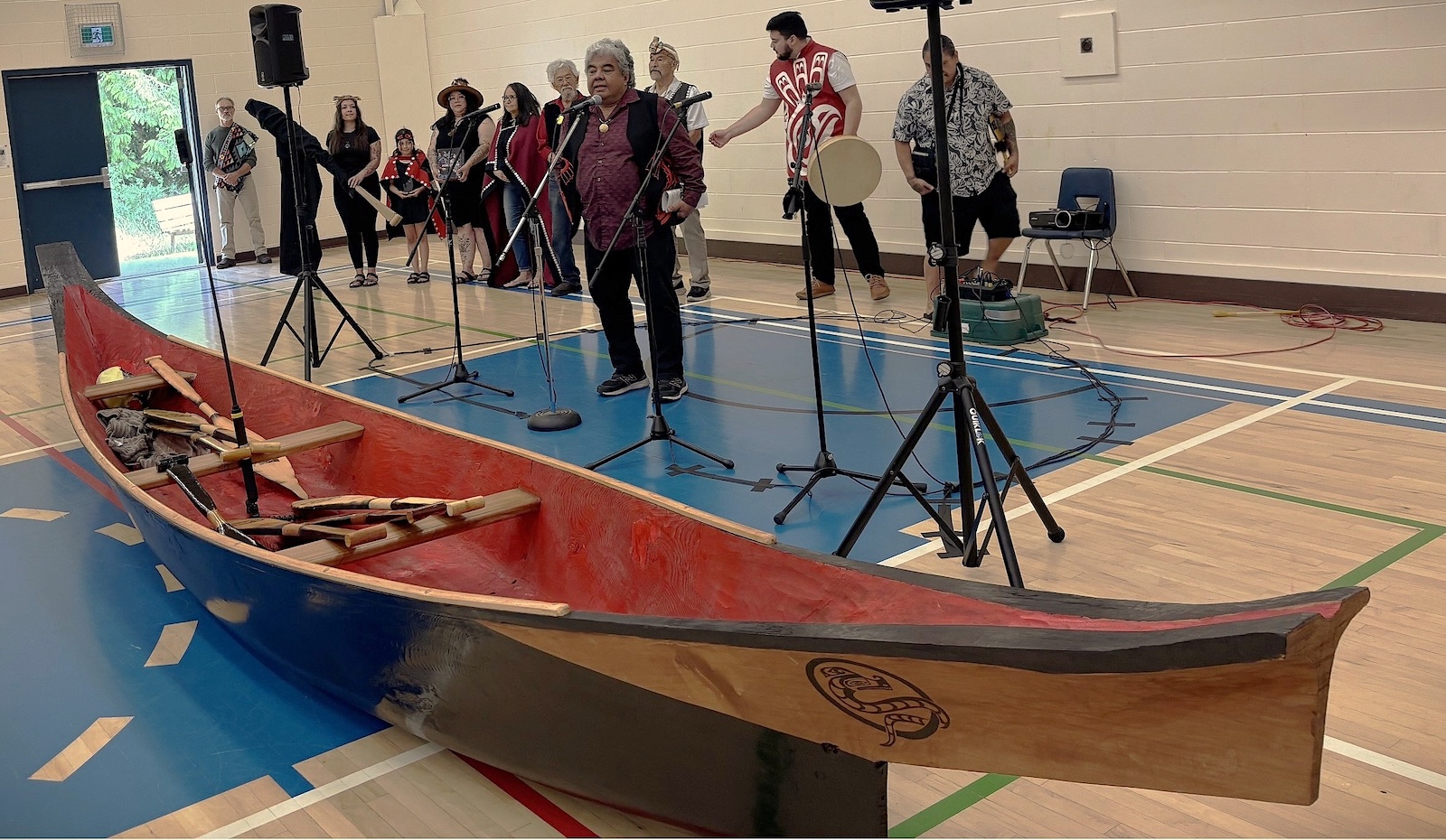
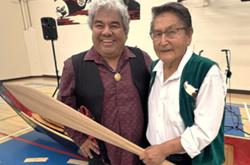
Martin is a member of the ƛaʔuukʷiʔatḥ (Tla-o-qui-aht) First Nation whose ḥaaḥuułi, or traditional territory, includes the west coast village of Tofino, in Clayoquot Sound. At the town’s Wickaninnish Community School gymnasium, she stood before a crowd of about 200 people who had come to witness the gifting of a cedar dugout canoe from her nation to the X̱aayda (Haida) Nation.
The canoe, Martin said, was a manifestation of both nations’ “intergenerational care of the forest.” She spoke as her father, renowned canoe carver Tutakwisnapšiƛ (Joe Martin), looked on approvingly.
So did Joe Martin’s uncle, n̓up̓itačiƛ (Moses Martin), who had commissioned the canoe to gift to the Haida, and in particular to Kilslaay Kaajii Sding (Miles Richardson), in recognition of the Haida’s leadership and solidarity back in the 1980s, when Moses Martin and his Nuučaanuł (Nuu-chah-nulth) community took a stance against clearcut logging in their territory — and won.
(The Nuu-chah-nulth are a grouping of 14 Vancouver Island First Nations, three of which — the ƛaʔuukʷiʔatḥ and their aaḥuusʔatḥ (Ahousaht) and hišqʷiʔatḥ (Hesquiaht) neighbours — are situated in whole or in part in Clayoquot Sound.)
Back in the 1980s, both the Queen Charlotte Islands (as they were then called) and Clayoquot Sound were becoming internationally recognized hot spots for their opposition to B.C.’s historically powerful logging companies, whose clearcutting of old growth forests in some of the most spectacular ecosystems on Earth was being challenged not just by environmentalists, but by First Nations upon whose land they operated with impunity but not permission.
The nations’ resistance at the time was unprecedented. All-powerful logging interests basically ran the province and — backed by the provincial government and the courts — easily swatted away the colourful mischief of environmentalists as just another cost of doing business. But they were about to find out that First Nations, after decades of marginalization and suppression, were awakening to a form of collaborative soft power that would change the face of British Columbia, literally and figuratively, forever.
The battle to make Meares Island a ‘tribal park’
In Clayoquot Sound, having already defaced several valleys, the companies were pressing hard to expand their operations. One place they were determined to log was wanačas hiłḥuuʔis (Meares Island), which then, as today, offered Tofino not just spectacular forest views, but the source of its fresh water.
When plans to log Meares were vehemently opposed locally, the province mandated a Meares Island planning committee, supposedly to accommodate local input. In 1983, after two years of contentious deliberations, the committee — heavily stacked in favour of logging interests — recommended that 90 per cent of Meares’ 8,000 hectares of forests be logged. It suggested that cutting the remaining 10 per cent be deferred for 10 years. That lit a fire of outrage.
The three Indigenous communities in Clayoquot Sound had, over the years, formed an uneasy alliance with a number of environmental groups that wanted to put an end to clearcutting of old-growth forests throughout B.C. The planning committee’s overreach had the effect of solidifying the collaboration between Indigenous and non-Indigenous communities to stop industry in its tracks at Meares Island.
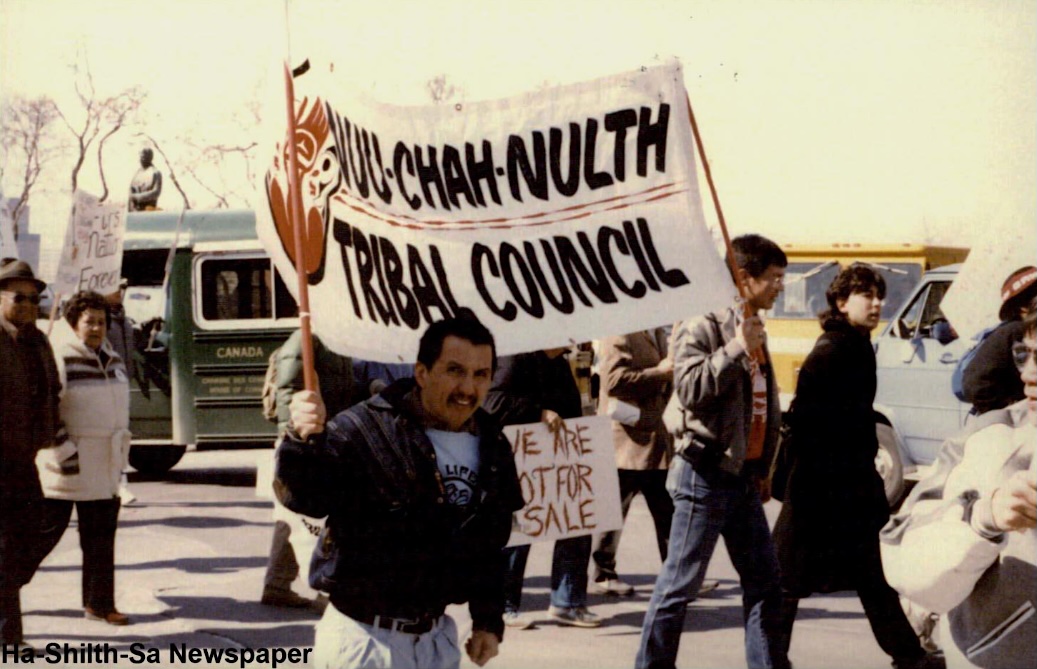
Moses Martin was in the first of what would be many terms as Elected Chief of the Tla-o-qui-aht First Nation. He remembers that time as “quite hectic.”
“We source all our water from there.... On top of that, there were many issues like our reliance on seafood around the island,” he says. “So the work began in searching for ways to protect all of those things, things we still rely on today.”
In faraway Xhaaidlagha Gwaayaai (Haida Gwaii), MacMillan Bloedel and other so-called “majors” and hired contractors were rapidly laying waste to huge swaths of old growth there, to the growing dismay of both Haida and non-Haida people on the archipelago.
A recently reorganized Council of the Haida Nation, getting nowhere in its own negotiations with “senior” governments in Victoria and Ottawa to lessen the assault on its resources, flexed its local authority in two ways: it filed a formal land and sea claim to all of Haida Gwaii and, in 1981, unilaterally declared most of the west coast of Graham Island, 150,000 hectares of lush coastal old growth, to be a tribal park. It was called Duu Guusd.
“All we were ever talking about was being who we are on our own lands,” Miles Richardson said on Sunday. But that subversive idea was to have enormous ripple effects, and some of those ripples reached the shores of Clayoquot Sound.
Moses Martin and others heard on the bush telegraph about this idea of what was essentially a rogue tribal park and wanted to know more. Miles Richardson and another emerging Haida leader at the time, Guujaaw, “went [to Tofino] at the urging of our people and sat in strategy sessions with [Tla-o-qui-aht] leaders,” Guujaaw once told me.
“It’s worth going back to the original designation of Duu Guusd,” Guujaaw said. “It started with, Let it be known...,’ and we gave that to the Nuu-chah-nulth and they used it almost word for word on Meares Island.”
To wit, they said: “Let it be known as of April 21, 1984, we the Clayoquot Band, do declare Meares Island a Tribal Park.” Their first of many demands was “total preservation of Meares Island based on title and survival of our Native way of life.”
“Miles and many of his community members joined us in this gym to witness and support us on that momentous day,” Moses Martin recalls. The declaration was signed by two hawiiḥ (Hereditary Chiefs), George Frank and Alex Frank Sr., in front of more than 1,000 people at an Easter spring festival in Tofino.
A momentous ruling
The following month there was a noisy protest in downtown Vancouver outside MacBlo’s corporate offices. On Meares itself, plans were afoot to occupy Tsis-a-kis (Heelboom Bay). Joe Martin, his two brothers and their father, the late Robert Martin Sr., set up camp there, carving three canoes in four months, waiting. Meantime, protesters marched on the B.C. legislature in October, but in vain. The following month, as winter was setting in, MacBlo got its licence to log on Meares. Five days later its loggers attempted go ashore with their chainsaws. They were repelled.
Thus did the second tribal park in the world become home to “the first logging blockade in Canadian history,” according to longtime wilderness campaigner Paul George.
Two days later, MacMillan Bloedel filed a B.C. Supreme Court claim for damages against the Meares protesters. Four days after that, the Tla-o-qui-aht and Ahousaht nations countered with their own court action, claiming that the province’s approval of the company’s logging plans was invalid, and seeking an injunction that would halt any logging “until the issue of ownership is settled.”
At the time, all these manoeuvres were untested. Neither the Duu Guusd nor the Meares Island declarations had any standing in western law or policy. While they aligned with Haida and Nuu-chah-nulth laws, respectively, those laws were not recognized by Canada either — and they certainly weren’t recognized by industry. Nor were the companies accustomed to being counter-sued; they assumed their complaint would stick.
Predictably, the Tla-o-qui-aht and Ahousaht demand for an injunction was denied. But then a momentous thing happened. Their appeal to the B.C. Court of Appeal was allowed in March 1985, and an injunction against industry, against logging on Meares Island, was issued. It was as unprecedented as it was unexpected.
At last week’s celebration, Miles Richardson delighted in recalling the decision, and quoted from memory the words of the appeals judge Peter Seaton: “I cannot think of any native right that could be exercised on lands that have recently been logged.”
Meares Island remains unlogged to this day. (For good measure, so too does Duu Guusd.)
“Thank you for your leadership, for making these changes in our country,” Richardson told his hosts on Sunday.
On Haida Gwaii, the reciprocal effect of the Nuu-chah-nulth decision was to help build the Haida’s confidence that they might succeed in their own monumental battle against forestry companies for whom Meares was a setback, whereas Haida Gwaii remained ripe for the picking.
Although not for long. Emboldened in part by both the blockade at Meares Island and Justice Seaton’s subsequent decision, the Haida famously stood their own ground on Lyell Island a year after the Meares blockade. In that confrontation, 72 Haida citizens, including Hereditary Chiefs and Elders, were arrested for forming human blockades to logging. Eventually, South Moresby would become the Gwaii Haanas National Park Reserve and Haida Heritage Site, officially co-managed by the Haida Nation and the Canadian government. The Haida have since been recognized as having full rights and title to Haida Gwaii.
“We’re writing our own law as we speak,” Richardson said at the celebration, to loud applause. “You helped show the way.”
Richardson praised the Nuu-chah-nulth’s recent work to continue championing tribal parks by creating Canada’s first Indigenous Protected and Conserved Areas Innovation Centre at the Naa’Waya’Sum Gardens, formerly the Tofino Botanical Gardens. He singled out Hai’multhnay Eli Enns for helping create a global movement that, “in many senses, is building a canoe for the young ones, for future generations.”
The Tla-o-qui-aht have also established an innovative program, Tribal Park Allies, that enlists local businesses in the region to contribute a one per cent ecosystem service fee to help pay for ecosystem restoration, environmental monitoring initiatives, infrastructure development and social programs within the ḥaaḥuułi — basically, to honour the fact that the (over)tourism economy that filled the vacuum left by logging is itself dependent on the good grace of First Nations for keeping the place largely intact.
At one point among all the mutual male admiration, to amused applause, Moses Martin’s wife čaamatukʷis (Carla Moss) jumped up and called time on so many men talking. She invited the muksy̓iḥtin t̓atuus t̓aquumł, collectively known as the Tla-o-qui-aht Rock Stars, to sing renditions of songs that honoured mothers, children and, in one song, the victory won in 1993 after another famous round of human blockades in Clayoquot Sound that became known as the “war in the woods.”
Moss recalled the bravery of mothers who were threatened with having their children taken from them by the RCMP if they dared blockade. It was an emotional moment that ensured not all eyes in the hall were dry at the recollection of the struggle, much of it inspired by the courage of women Elders in the hall, Indigenous and non, to hold the ground against powerful corporations and their government enablers.
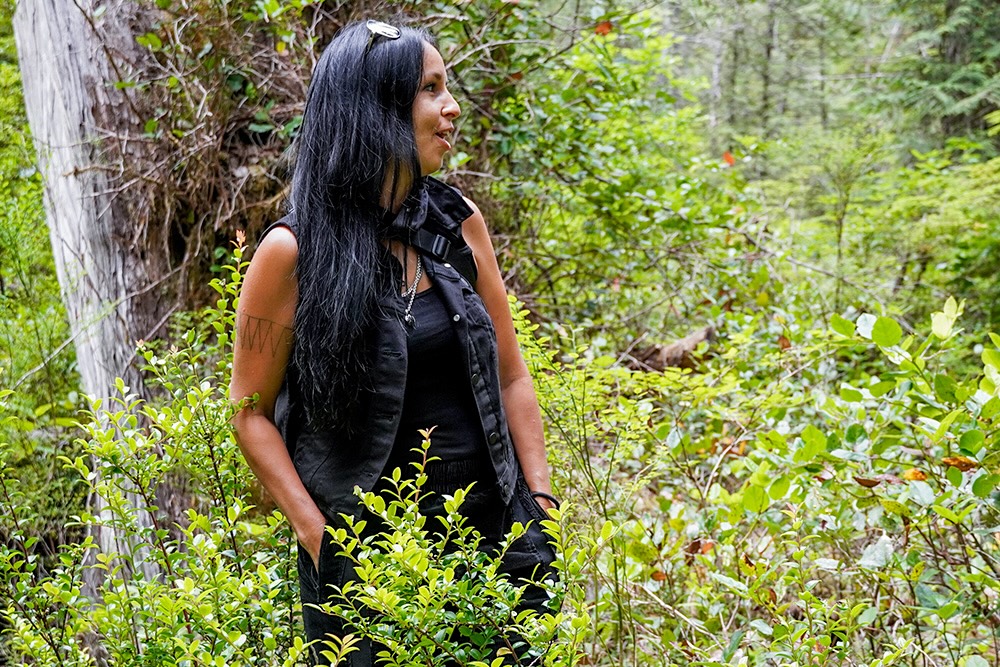
The audience was peppered with veterans of battles won and lost, their nostalgia for those times of powerful solidarity and collaboration turning to melancholy when reminded by Gisèle Maria Martin, recently elected to the Tla-o-qui-aht council, that “there’s still so much to do. Fish farms. Mining. Logging.”
The latest incursion: 30 government-approved permits for Imperial Metals to explore for gold in Tranquil Creek, another designated tribal park in ƛaʔuukʷiʔatḥ ḥaaḥuułi. Twenty-two drill sites, six trenches, three helipads, all approved over the clear objections of the Tla-o-qui-aht First Nation.
Moses Martin, now retired from politics and teaching his Indigenous language to a new generation of ƛaʔuukʷiʔatḥ resisters, wearily agreed that “we have to meet these challenges again, by putting ourselves forward and saying, ‘No, you can’t have that in our homeland.’”
But on this, not just National Indigenous Peoples Day but the summer solstice and Father’s Day, too, there was reason to rejoice, to take a breath, to step out of the ring for a precious few hours — and there was a canoe to give away to allies and friends.
‘The trees are still standing’
In a gift exchange, the Haida delegation presented Moses Martin and Eli Enns carved cedar paddles, and to Joe Martin, an argillite carving of a wolf. To the Haida, Moses offered up his songs to “use if your heart so moves you.”
The canoe, meanwhile, was offered as an apology from Moses, because back in 1984 when he and his people did declare the total preservation of Meares Island, “that day was so busy and so huge, I forgot to acknowledge and thank them,” the Haida, for their part in bringing the declaration into being.
Miles Richardson insisted that, for his part, no apology was necessary.
But Moses gently demurred. “I asked my nephew, Joe, and my son, Mike, to carve a canoe and they did, Haida style, to present to you and your community, Miles. Canoes have carried our people and our treasures in and out of each other’s homes for over 10,000 years. For you and your people, this one carries our apologies and our gratitude. With that, our victory is also yours because you walked with us through that challenge.
“Now, 42 years later, the trees are still standing.”
Outside, a gorgeous summer evening was being enjoyed by thousands of tourists. Meares Island shone brightly, the waters of Clayoquot Sound were calm, all seemed well with the world.
But it’s not of course. There’s the threat of new oil and gas pipelines to the north, all in the name of our so-called “national interest.” The logging of old growth in British Columbia goes on, against science and common sense. So too the proliferation of open-net salmon farms. And now, perhaps the loudest echo from our rapacious past — a gold mine, of all things, in a sacred place.
In a time when there is a palpable backlash against Indigenous rights, it is worth remembering that so many of the places we savour, so many of the views we enjoy, the fresh water we drink, the clean air we breathe, the places to “be who we are” as humans — so much of that we owe to the sacrifice and the resistance of people who have gained the least and suffered the most from our incessant demand for more. ![[Tyee]](/design-article.thetyee.ca/ui/img/yellowblob.png)
Read more: Indigenous, Environment





Tyee Commenting Guidelines
Please note that email notifications for replies are not currently working due to a software issue which may be resolved in a future update.
Comments that violate guidelines risk being deleted, and violations may result in a temporary or permanent user ban. Maintain the spirit of good conversation to stay in the discussion and be patient with moderators. Comments are reviewed regularly but not in real time.
Do:
Do not: