



 SHARE:
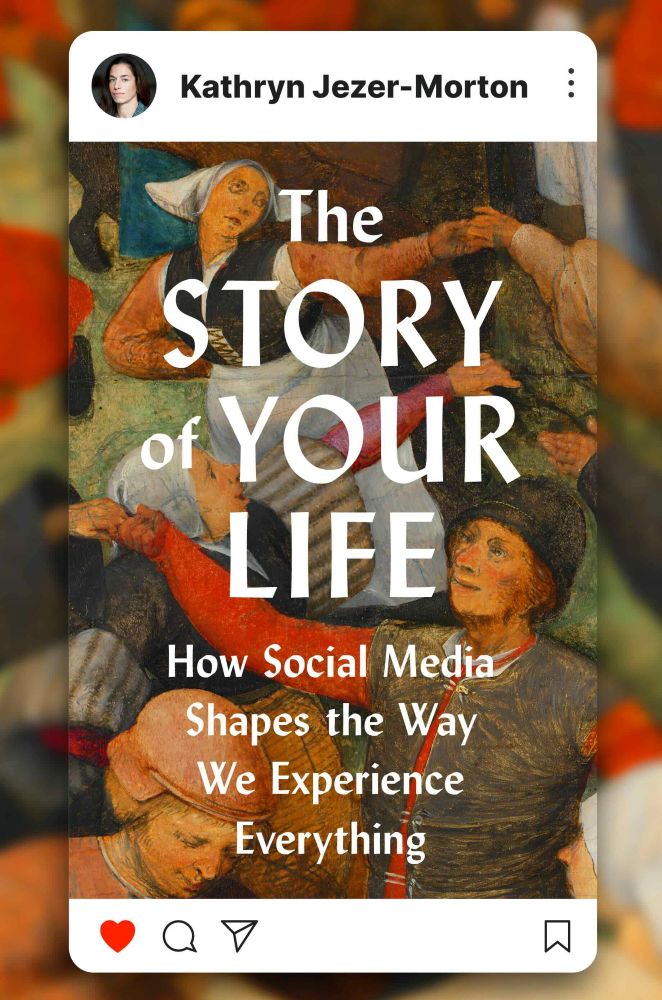
The Story of Your Life: How Social Media Shapes the Way We Experience Everything
Kathryn Jezer-Morton
Viking (2026)
My son was born in 2017, long before before Elon Musk acquired Twitter, and algorithmic advertising and AI slop began changing the face of the internet. This was a period when many people still used social media to keep in touch with their friends and family — people they knew, and even liked, in real life.
In those blurry early newborn days, my husband did what many new dads did: he rose from the hospital-issued gym mat where he was sleeping on the floor to grab his smartphone and upload a carousel of new baby photos to social media. He tagged both of us in the post and told everyone we were okay. Then he probably changed a diaper, ran an errand and fell back asleep.
Neither of us expected the volume of likes, comments and text messages in response to the announcement. People came out of the woodwork to congratulate us. In a hospital stay that carried the bizarre, divorced-from-reality quality of living on a bus, I’d never experienced anything like this massive swell of affirmation, beaming into our room from our phones.
In the weeks and months that followed, I’d post pictures of our baby every time I sought that same sense of comfort, connection and validation. There are snaps of my baby awake at 3 a.m., of him napping blissfully the next day, of us going to the park or to visit friends or to the beach.
Looking back on those days through the lens of Montreal-based sociologist and essayist Kathryn Jezer-Norton, who writes a column about family and digital life for the Cut, I can now see what I was doing then with more clarity. The immediacy of feedback that brought so many of us to social media in the first place, and which continues to keep us there, was supercharged around the positive news. I posted a great deal about my baby because here, finally, was a reality of my life that garnered all manner of warm and supportive comments.
Jezer-Morton’s new book, The Story of Your Life: How Social Media Shapes the Way We Experience Everything, is out this month through Viking, and it arrives at a welcome moment in the social media life cycle.
Many longtime users are becoming more discerning with what they post, some are jumping ship altogether, and others are increasingly skeptical about the brain rot clogging the feeds.
Even so, social media continues to have a grip on our lives. “Whether we prefer to admit it or not, social media is where our history lives now, and the platforms have shaped how that history is told,” Jezer-Morton notes.
She approaches the book with a refreshing sense of inquisitiveness that lacks the moralistic handwringing often present in non-fiction books about the social web. Instead of asking whether we should be using social media at all, Jezer-Morton asks deeper questions that meet her readers and extremely online interview subjects where they are.
The Story of Your Life is structured as a collection of essays that blend sociological interviews and memoir. With humour and nuance, Jezer-Morton invites readers to consider what’s missing when social media becomes the central organizing structure for talking about, understanding and ultimately experiencing our lives.
She writes about how the structure of online interactions venerate specific kinds of life stories over others. The posts that receive the most audience engagement are those that follow an upward narrative trajectory: a big reveal, a grand gesture, a special accomplishment.
“Emotional capitalism rewards self-reliance and self-actualization. It also requires individuals to perform emotional wellness in order to take their place in their social group,” Jezer-Morton writes.
“The public fora of social media provide the perfect place to do this. Our vacation pics prove that we’re solvent and full of fun! Our updates about our kids show our diligent commitment to their well-being!”
But what about the hard stuff? Social media platforms don’t typically afford users the space to sit with ambivalence, unhappiness or shame. These parts of the human experience generally get flattened or negated in a fast-moving space where the razzle-dazzle of upward momentum gets the most attention.
The formative years of my twenties and early thirties ran alongside the growing use of social media from the 2000s through the 2010s. For me, those years were punctuated by sudden deaths, suicides and life-changing health crises that defied narration. It felt crude, even invasive, for me to post about these events. Instead of saying anything, I simply deleted Facebook.
It’s not an uncommon pattern.
“The emotional range of the space is structurally limited, which then limits our opportunities as consumers of media to encounter interesting, challenging or otherwise evocative representations of human emotion,” Jezer-Morton writes.
When people do share hardships on social media, the platforms are tilted towards limited responses: a tidal wave of sympathy, Jezer-Morton notes, is usually what comes after a disclosure of personal difficulty: “flat, formulaic platitudes from our far-flung networks, which are certainly well-meaning but not necessarily helpful or insightful,” she writes.
“Yet it’s not so much the repetitiveness of the response to hard times that’s limiting; it’s the very impossibility of exploring states of ambivalence, or confusion, or longing, on these platforms at all.”
Jezer-Morton is also curious about the cumulative effects of engaging this way across different seasons of life — many of us are scrolling through our feeds several times a day in search of something, anything, to lift us out of the daily grind.
I started using Instagram in 2015, when I was newly dating the person I married a year later, when my life felt more stable and easier to transmit in a tidy world of photo grids featuring group selfies and snapshots of aesthetically pleasing meals, cute pets and vibey houseplants.
“We don’t go looking for our friends’ deepest truths on social media. But it’s nonetheless startling to realize just how rare it is to encounter sincere frailty and doubt in these spaces where we spend so much of our time,” Jezer-Morton writes.
“When we don’t see stories about shame or ambivalence, we never learn the language for understanding these universal human experiences.”
Humans are smarter than machines
I’ll pause here to note that my current text threads and social media feeds are rife with shame and ambivalence, frailty and doubt. Often while laughing at oneself in some way. After all, isn’t a gem of friendship the space it creates to share hardship, which helps it become more bearable?
The Story of Your Life is commendable for its good-faith engagement with social media users who post gender reveals, “go live” at parties and upload inspirational quotes in stylized text to Facebook. But the unseriousness of internet culture, and particularly the way that many of its younger users are in on the joke, goes largely underexplored.
Absurdist humour is a coping mechanism for many people to contend with social media’s more pernicious qualities. We can see this most clearly in the realm of the freewheeling group chat, where people get silly, laugh together and one-up each other with increasingly outlandish memes and stories.
In an August 2026 essay for the New Yorker, Hanif Abdurraqib praised the group chat for the space it creates for vulnerability, humour and real-life connection.
“Their central function, especially as I and the other members have grown older, is as a reminder that we’re thinking of one another, and as a way to keep the others up on the comedies and tragedies of our daily lives. Here, a photo of a baby or a meal or a sunset. Here, a shirt that made me think of you. Here, the draft of a poem that we’re all thrilled to read,” Abdurraqib writes, of the two long-running group chats that form the backdrop of his life.
“The conversation is sometimes absurd, and sometimes salacious, but I’ve come to cherish it as a sturdy and rich world that hangs on the edge of the wider collapsing one. I fall into it and remember that even if I fail in a great number of things, on any given day, I can love my friends well just by finding something they love and saying, ‘Look, I saw this and I thought of you.’”
These are groups, he notes, whose members are not always speaking directly to one another. This is where the magic originates: the group-chat format brings people together into a community where a steady sense of connection throughout the ups and downs of daily life takes centre stage. With this, the hardships of the wider world become more workable and less overwhelming.
There is respite, Adburraqib writes, in the “wonderful ordinary” documented in the chats: a toddler’s birthday, a nice lunch out, and of course, the many smaller complaints and triumphs that shape a day. “The world comes into focus through the commentaries we offer one another on each small movement,” he wrote.
Those movements are precious because they are small. They may be too insignificant to post to social media. They’re perfect group chat material not because of their largess, but because of their intimacy.
My son is older now, and my compulsion to document his life on social media is long gone. What’s left is the quotidian stuff that feels best when it is shared between friends and family, not with a bigger audience.
Here’s where the group chat comes in. A friend shared Abdurraqib’s essay with me in one group chat. Inspired, I shared it in another. After a dog walk, my friend texted me her VIFF selections for this fall; we agreed to go to one of the screenings together, and another friend will join us too. I didn’t post about any of this. And I feel just fine about that. ![[Tyee]](/design-article.thetyee.ca/ui/img/yellowblob.png)
Read more: Media, Science + Tech












Tyee Commenting Guidelines
Please note that email notifications for replies are not currently working due to a software issue which may be resolved in a future update.
Comments that violate guidelines risk being deleted, and violations may result in a temporary or permanent user ban. Maintain the spirit of good conversation to stay in the discussion and be patient with moderators. Comments are reviewed regularly but not in real time.
Do:
Do not: