


 SHARE:
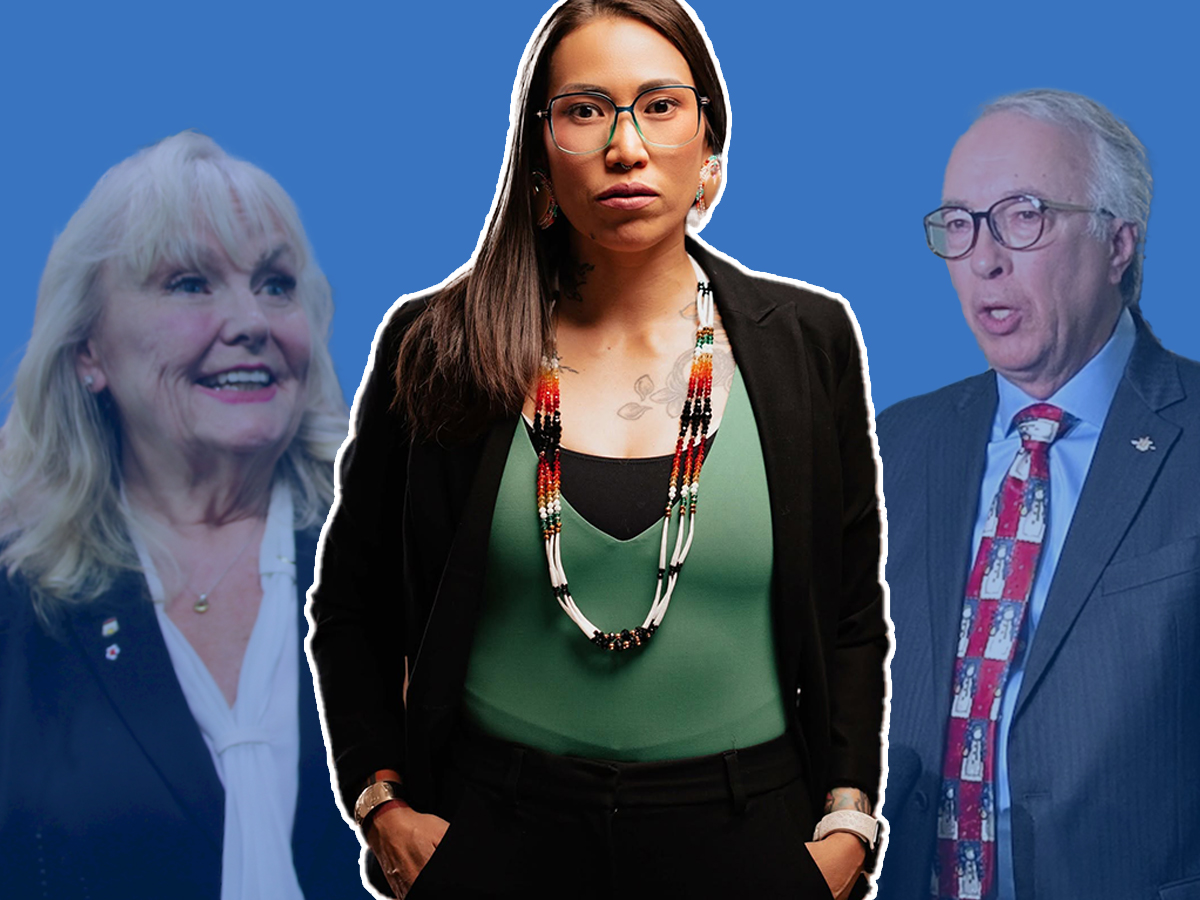
Former Conservative Party of BC MLA Áʼa:líya Warbus says she became increasingly uncomfortable with how her now-former party was describing Indigenous land title issues under the leadership of Kerry-Lynne Findlay.
Warbus, who resigned from the party Monday, previously served as house leader under John Rustad and was the Conservatives’ most prominent Indigenous voice in the legislature. Before her election in 2024, the Chilliwack-area MLA had worked for an Indigenous governance organization in the Fraser Valley; her father is former lieutenant-governor Steven Point. Warbus is a member of the Stó:lō Nation.
In an in-depth interview with Tyee senior editor Tyler Olsen, Warbus said she had been growing increasingly uncomfortable with the way the B.C. Conservatives were using Indigenous land issues as a “wedge.”
Before her election, Warbus spoke about her desire to affect policy-making in the province as an Indigenous woman, even though she might be considered less conservative than others in her party. But she said a recent vacation illustrated how the party’s focus had strayed from the everyday concerns of residents and prompted her to ask herself: “What legacy ultimately do I want to stand on?”
She said that under Findlay’s leadership, issues that traced their roots to Canada’s Constitution and still-unsettled land claims were being conflated with matters of race.
“There are certain ways to frame these things, and it takes [out] the division and the heat,” Warbus said. “Even if there’s going to be a presumed amount of racism that can inevitably happen, I don’t want to be the one that’s stoking the fires of those tensions.”
The following interview has been edited for length and clarity.
The Tyee: You were at a kayaking competition, and by the time you returned, several other Conservative MLAs had left the party. Then you ended up resigning. You recently told columnist Rob Shaw that seeing your daughter in a ceremonial dance played a role in your thinking. Can you unpack how that happened and the influence of that experience?
Áʼa:líya Warbus: It’s more about what it does to step away from the chaos that politics can sometimes be, and even work. It’s about what it means to reground myself in the things I love, the people I love, the community I love, recharging my own batteries to be able to reconnect with myself. That’s the feeling that I was trying to share and explain with Rob. We all need to do that, right? Some people call it unplugging, some people call it retreat, some people just call it rest.
For me, there were some moments where I actually had an opportunity to reflect. My values are not the same as every other person in caucus, every other person in Chilliwack, obviously. But at the core of those values is family, community, belief — and by belief I mean some people have culture, some people have faith, some people have Buddhism, and some people might call that spirit.
And that brings a lot of clarity. I just needed that perspective to step away and to look and, through my daughter, see the importance of our future generations, and remind myself that’s what we’re all here for. That’s what the work inevitably is about. And what legacy ultimately do I want to stand on?
I’m not here forever, and it may be a very short time, especially if I sit as an Independent indefinitely. Because we’re seeing party politics, and that’s just how it works, and that’s generally what the public understands. But for the time that I do hold a position, I’ve sworn to represent my constituents the best that I can.
My constituents care about big-ticket items, and in their lives, that is affordability, being able to pay their rent, send their kids to good schools. Young families want to know how they’re going to build a life. Maybe they’re thinking about starting a business. Being able to get good jobs. For the seniors that I meet with, they want to know there’s a place for them that they’re going to get reliable health care and, when the time comes or if the time is on their doorstep, that there’s proper care homes and places where they don’t have to think about being a burden to their children.
Just regular everyday people stuff that we all deal with, regardless of what our cultural connection to the material is. That’s kind of what I was getting at. Although it may be my culture that grounds me in being able to feel and think and see that clearly, it still brings me to the broader picture that affects us all.
Had you been considering your options before the last week of political chaos?
I think we’re all doing that. Maybe not as consistently and as seriously as when the pressure was mounting within that two to four weeks’ span. But there was a lot that I was seeing throughout the time, from [when] the leadership contest ends and a new leader comes on. That is a time for a caucus in supposed collaboration with the leader to find itself once again, and that’s the period that we were in. And throughout that three-month span, we just felt like we were departing further and further, and we were doing less and less in terms of the collaboration piece, and those conversations around “This is our chance,” right, to come together.
So yeah, those thoughts were continuing to get more and more serious.
You said some of the atmosphere around Findlay was becoming ‘highly race-based.’ Can you unpack what you mean by that?
I think a lot of that stuff is out there in the public already.
There have been a ton of conversations that have happened — reconciliation is an example, but it’s not the only example. You know, it has policy and legislation attached to it, and how do we have those conversations without making it about division and us versus them?
What I continue to see is that that wedge is being drawn harder and faster, and being used as the mechanism to get people to pay attention and to weigh in, and I just don’t think that that’s fair. I don’t think that’s fair to the public, who needs concise, clear information, who should be making decisions based on knowledge and facts, and then you leave that up to the public to come up with how they feel about what they’re presented with in a really truly transparent and accountable way. I just felt like the approach was not working, and that it wasn’t the same approach that I ethically would take when it comes to communication with the public about some of these policy conversations that are coming up around reconciliation. And that’s just one example.
When people talk about race and Indigenous communities, reconciliation, the one thing that I don’t agree with is saying that something might be race-based, right? You have to separate that out of the conversation when you’re talking about title, because title is about rights and title under Section 35, and that actually has to do with title that has not actually been settled within British Columbia, and those are collective rights. That’s not race-based rights.
Those are collective rights based on the land question, and the queen’s promise and legal cases that are going back decades now. There are certain ways to frame these things, and it takes the division and the heat [out of it]. Even if there’s going to be a presumed amount of racism that can inevitably happen, I don’t want to be the one that’s stoking the fires of those tensions.
Some of the emotional rhetoric was tied to the Cowichan decision and the United Nations Declaration on the Rights of Indigenous Peoples policy discussions, and started to ratchet up a lot last year, actually before Findlay was elected leader. Were you worried at that point about the direction of the discourse?
I’m always worried. I’ve been worried since facing some of these conversations as early as elementary school, just to put it really bluntly, I’m always worried because, again, I go back to this simple equation: it’s us versus them, and that’s not [how we solve this].
How did you see the Conservative Party of BC and your role in the party? Were you thinking that you would be a moderating influence, or did it cross your mind that some might point to you and use you as a justification for rhetoric or policies that they were espousing?
I’m always working to be a positive, democratic and informative force in these conversations, regardless of where I sit in the legislature, and sometimes the pushback can be harder than other instances.
Everybody has their own experience with the laws and legislation that are attached right now to things like the Indian Act, or even some of the newer legislations that are tied into rights and title and adjacently so — because of the unsettled title claims that are all over B.C. right now. Environmental assessment may be one of them. And the Heritage Conservation Act, those things, right? Again, for me, what I’m looking to do in my position is always to use all of the tools, all of my expertise, all of my knowledge, to be a positive and democratic force in these conversations, because that’s what we should be doing as leaders.
Peter Milobar was attacked during the leadership race because his spouse is Indigenous and works at a First Nation. Do you think it’s still possible to bridge divides between moderating forces and then hardline conservatives, who really seem to be active online and have very clear thoughts on Indigenous issues and reconciliation that seem at odds with those who are taking a more nuanced stand? Do you think it’s still possible to bridge that divide?
I have to be hopeful. You know, without at least a promise to keep working towards that, we should all just kind of like give up and go home right now. So I’m always hopeful for that. But that’s all of our job, right? As community, as citizens, as people, is to work to bridge the divides that we have, not just in that conversation, but in every other instance.
There’s a huge divide right now between where opposition sits on some policy and legislation with government, right? That’s our job, and that’s why the system is set up the way it is. Because regardless of who you are, if you hold power, you should have accountability to the people that put you there. But I’m always hopeful, and I have to remain hopeful, especially if I’m asking people to put their faith in me.
When we spoke two years ago, I wanted to talk at that time in part because it seemed like things could get awkward in the future because your perspective seemed to not align with other Conservative candidates on issues like sex and gender education in schools, and reconciliation. Looking back at where the party has gone, do you think there was some naiveté from the party, from Conservative MLAs, from yourself, or from all of us, that this coalition could hold itself together long-term?
To call it naive is a bit of a stretch, in saying that we can guess at what the future holds, and we shouldn’t try something because we don’t think it will work, right?
Giving anyone an opportunity to be working together rather than apart, again, that’s what we should be doing and encouraging people to do as leaders. Whether it works or not, we can only see that by going through it, and it’s an exercise.
Clearly now we see that exercise is more difficult than perhaps we’re prepared for at this moment in time. I’ve known a lot of leaders throughout my lifetime, and a lot of leaders that I love and look up to, and who mentor me to this day, and a lot of times, they’re leading because they’re ahead of people. They’re ahead of people in the way that they think critically, the way that they see strategy, the way that they see the direction we should be going as people. And sometimes they’re too far ahead in their thinking, and they just can’t get people to get there because that’s just the nature of the beast.
When it comes to deciding whether to join a new party or continue sitting independently or whatever the next options are that will arise in front of you, how does your experience with the Conservative party factor in to those future decisions?
It’s all about where people can come together, and those decisions aren’t solely up to me. How can any movement organize itself under a few key principles: to agree, and disagree, on the percentages that don’t align with absolutely everybody. Again, I’m not in charge of that, but I am actively a part of that, and it kind of goes back to the beginning again.
It’s being hopeful that can formulate itself because otherwise, if we just continue to be divided and tear each other down and not able to collaborate for this reason or another, then how can we go and face British Columbians and ask them to have the opportunity to govern? Because, reflecting on the system that we have, that’s typically what it takes. It takes a group of people who say we are going to sit together and make decisions as a group, and we’ll hold the majority of seats in the house, and this is your government, for good, bad, better, worse.
To say it’s all bad? No, because it’s reflective of the times that we’re in globally. It just feels like there’s a lot of tension right now everywhere, and I want to be part of the solution. I want to be a part of a strong group of people that sits around at one table and decides to work together. But how that formulates is anybody’s guess at this point in time.
We have to ask ourselves right now: What am I contributing? Is it towards the positive or is it towards the negative? And for myself, personally, as a leader, am I in the right place at the right time? Is the best thing for me to do to help that overall goal and that overall picture to continue on in the position that I’m in?
I don’t answer those questions on my own. I answer them in collaboration with my constituents and my supporters, and all of that is going to come to fruition. It has to.
As I move into full session, I have one goal and one goal only, and that is to represent my constituents, bring forward the issues that are important and critical for them, and sit in strong opposition of the government, and I think the rest of the pieces will fall in place.
Do you feel a little more free in some way?
I actually do, and it's not purely just the party and the brand. It's getting away from chaos. No one can work under those conditions. I feel solid and good about my decision, and that I can, independently, at least for the moment, work towards where I think the next best move for myself as an MLA and Chilliwack-Cultus Lake — in collaboration with my constituents — is going to be in the coming weeks. ![[Tyee]](/design-article.thetyee.ca/ui/img/yellowblob.png)
Read more: Indigenous, BC Politics







Tyee Commenting Guidelines
Please note that email notifications for replies are not currently working due to a software issue which may be resolved in a future update.
Comments that violate guidelines risk being deleted, and violations may result in a temporary or permanent user ban. Maintain the spirit of good conversation to stay in the discussion and be patient with moderators. Comments are reviewed regularly but not in real time.
Do:
Do not: