


 SHARE:
The provincial government’s deadline for achieving universal $10-a-day child care in British Columbia is just three years away.
But the province is not going to reach this goal by 2028, according to advocates and the former minister of state responsible for child care. It won’t even be close.
“I think we’re delayed two, three years minimum,” Katrina Chen, who was B.C.’s minister of state for child care from 2017 to 2022, told The Tyee.
Meeting the 2028 deadline is not the government’s current focus, Education and Child Care Minister Lisa Beare told The Tyee.
“What we’ve been focused on, as a government, and what we’ve always been focused on, is the key pillars of our ChildCareBC plan,” she said.
“That’s affordability, access, inclusion, and quality child care, and we want to make sure that we do that.”
The $10-a-day spaces are just one “tool in the tool box” to achieve these pillars, Beare told The Tyee, alongside the Child Care Fee Reduction Initiative, paid to providers to reduce their monthly fees; the Affordable Child Care Benefit, a monthly payment directly to low-income families that can bring fees down to $0 a day; and the Aboriginal Head Start program, run in conjunction with the First Nations Health Authority and the Aboriginal Head Start Association of BC to provide no-fee, culturally relevant child-care programs for Indigenous kids.
“We support families who need it the most in ensuring they have affordability benefits, meaning they could pay up to no dollars at all,” said Beare.
Since the $10-a-day program was officially launched in 2018 by the NDP government, the province has created 41,000 new child-care spaces, according to ministry data.
That’s fewer than the 65,000 new spaces the NDP initially promised would be created by 2022.
By the ministry’s own count, there are currently 24,900 child-care spaces at or below $10 a day in the province, with another 16,000 spaces funded but not yet open, for a total of nearly 41,000 new spaces.
According to Sharon Gregson, spokesperson for the Coalition of Child Care Advocates of BC, which collaborated with the Early Childhood Educators of BC on the $10aDay campaign, there are more than 600,000 kids in B.C. aged 0 to 12.
Not all of those kids will need child care, and the type of child care kids might need is different — school-aged children don’t need full-day care during the school year, but they may need care before or after school hours.
Still, Gregson said, by the numbers, there are only enough $10-a-day spaces for less than three per cent of those kids.
The coalition relaunched its $10-a-day advocacy campaign at the end of June in response to B.C.’s slow progress.
This year’s budget showed a small increase in child-care funding to $865.8 million from $865.2 million, but no funding increase in the 2026-27 or 2027-28 fiscal years.
“Which in effect is a cut,” Gregson said, “and no new targets and timelines from the ministry beyond what’s in their current federal agreement.”
The federal-provincial child-care agreement, from 2021 to 2026 with $9.2 billion in federal funding, was recently extended for another $5.38 billion over a five-year period.
The agreement called on the province to create 12,500 $10-a-day spaces and reduce average fees for child-care spaces for kids five and younger to $21 a day by the end of 2022. They also had to open 40,000 new regulated child-care spaces for kids six and under by 2027-28.
A new report from the Canadian Centre for Policy Alternatives casts doubt on B.C. reaching another federal goal, however, of an average $10-a-day child-care fee for children under six by April 2026. The report singles out Richmond, in particular, as currently having an average $46-a-day fee for infant child care and a median of $39 a day for preschool-aged care.
The provincial subsidies for child care outside of the $10-a-day program don’t change with inflation or as providers’ fees increase, Gregson said, with fee increases capped at three per cent annually.
In addition to the existing $10-a-day spaces, the ministry said another 144,000 B.C. child-care spaces receive subsidies that reduce fees to an average of $19 a day. The 2017 provincial average was $47 a day.
But the original government plan for $10 a day saw the additional subsidy “tools” like the Child Care Fee Reduction Initiative and the Affordable Child Care Benefit as temporary until the reduced fee program became universal, Chen, the former minister of state for child care, said.
“We’ve lost the original vision,” she said, adding the wage grid and funding model were to be implemented after the first three years, followed by expansion of the $10 a day to a universal flat-rate fee in the final five years of the decade-long plan.
Ninety-six per cent of all licensed child-care spaces are receiving some kind of subsidy in B.C., Beare said, saving families $2.8 billion since 2018.
The Tyee asked how many families are paying more than $19 a day, but the ministry doesn’t track that number.
$10-a-day rejections
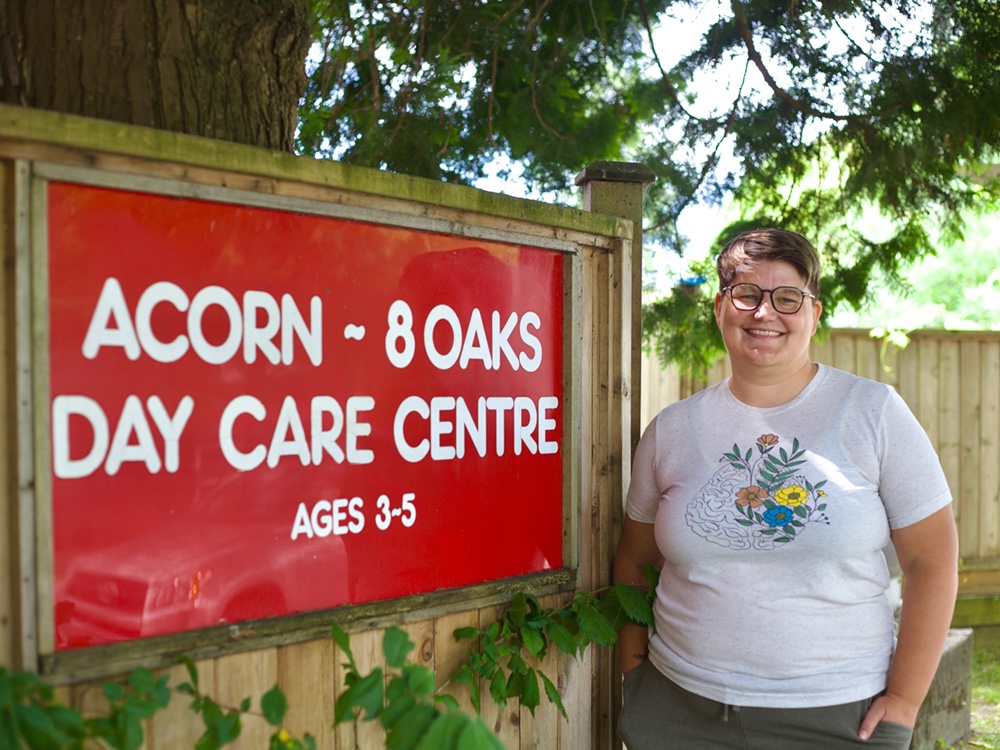
Until she finished daycare last year, Julie Tye’s five-year-old daughter had a subsidized spot at the Acorn Daycare located in their Vancouver housing co-op. The subsidy brought Tye’s child-care fees down to about $1,000 per month.
Before that, Tye’s daughter shared a nanny with another child, which is the current setup for Tye’s two-year-old son until he starts at Acorn next month. The nanny share costs about $3,000 per month for four days a week.
Without the provincial government subsidy, according to Acorn Daycare’s website, Tye would have paid anywhere from $218 to $545 more per month.
But even at a discount, Tye and their co-parent are still paying about $43 a day.
Tye’s neighbour, Dan Straker, also had his kids enrolled at the non-profit Acorn Daycare, where he also served as chair of the daycare’s board until this past spring.
Earlier this year Straker filed Acorn’s third application to the province to become a $10-a-day site. The application was rejected.
“The letter that was sent didn’t list any reasons, it just said, ‘You have not been selected,’” he said, adding he reached out to the Coalition of Child Care Advocates of BC’s Gregson for her thoughts.
Straker said Gregson pointed to Acorn’s proximity to other $10-a-day child-care centres in the city as one possible reason.
Some municipalities fare even worse for $10-a-day spots than Vancouver. In nearby Delta, home to just over 108,000 people, there’s only one $10-a-day child-care site in the city: an in-home centre with space for just eight kids.
Straker’s kids, now 3 1/2 and 5 1/2 years old, have both been in some form of child care since their first birthdays.
His eldest was at an unlicensed child-care centre until she got into Acorn. His youngest was in a nanny-share arrangement for a year and a half before starting at Acorn last year.
Straker doesn’t understand why B.C. went with a pilot $10-a-day program versus a subsidized flat fee for all child-care spaces, like Quebec has with its $7-a-day program and Alberta has with its $15-a-day program.
Especially when the B.C. government’s own 2020 audit revealed some parents with $10-a-day spots reserved more child-care hours than they needed so they had flexibility in case of emergencies.
This effectively shut out other families who could have used those unused $10-a-day child-care hours.
Asked whether some B.C. parents are still reserving $10-a-day child-care hours they don’t use, Minister Beare did not answer the question directly.
“This is why we need to increase spaces so that every family who needs it has access to it,” she said, adding that the ministry will be making an announcement this fall about school-based before- and after-school child-care spaces.
Winning the $10-a-day lottery
The odds of getting a $10-a-day spot in B.C. depend on where you live.
According to an online tool created by the Coalition of Child Care Advocates of BC, Metro Vancouver residents have a one-in-10 chance of scoring a $10-a-day child-care spot.
The odds are better in Kootenay Boundary and northern B.C., where it increases to one in six, but much worse in the Fraser Valley, where the odds are one in 31.
There’s very little data on how many Indigenous people have access to the program, said Karen Isaac, executive director of the BC Aboriginal Child Care Society.
“What we do know is of the 334 centres being funded as $10 a day, 11 are operated by an Indigenous non-profit or an Indigenous government,” she said. The model isn’t necessarily a fit for First Nations, she added.
The province, federal government and First Nations people are currently negotiating over their tripartite memorandum of understanding towards developing a First Nations-led and -overseen early childhood learning and child-care system.
“One of the challenges with $10 a day, too, is that there has been a lack of fulsome consultation to determine even whether that model fits for First Nations,” Isaac said.
Straker and Tye both advocate immediately implementing the reduced flat-fee rate of $10 a day for all child-care centres in the province.
Or, if universal $10-a-day child care is still far away, reserve existing $10-a-day spots for Indigenous families and low-income families, to ensure that only the families in the greatest financial need are accessing them.
“Somebody could speculate that parents that are more well resourced and have more time at their disposal are the ones that are able to access a lot of these $10-a-day spots, because it takes effort to apply to these daycares and keep track of them,” Straker said.
Straker would know. Last month he and his partner found out they’d won the lottery: their youngest child was accepted into a $10-a-day child-care centre for five days a week.
Child care is ‘economic stimulus’: Gregson
Gregson doesn’t have faith the province would continue to pursue universal $10-a-day child care if they introduced income testing for existing spots.
Plus there are different ways to measure a family’s child-care needs beyond their household income, Gregson said, including mental health issues and parents wanting to grow their careers and retire with a pension.
“The solution is not to make this a small, targeted program,” she said. “The solution is to grow it, so that all families who need it have access. The same way we think about kindergarten.”
Chen told The Tyee it was important to initially start the $10-a-day program as a three-year pilot in order to establish that it would work for parents, child-care providers and the B.C. economy as a whole.
And it did.
“In just three years of our pilot, every $1 invested had $2.50 economic return,” said Chen.
The initial three-year pilot also gave Chen and government staffers time to craft the provincial child-care legislation that built B.C.’s current child-care landscape.
The COVID-19 pandemic and recently announced U.S. trade tariffs did slow the financial growth of the program, however, as the government spent money on other priorities, Chen said.
But it gave Chen and her office the opportunity to work on updating the child-care legislation. She tried to introduce changes such as universal access to school-based child care and a wage grid for early childhood educators through a private member’s bill in 2024.
But the bill did not make it beyond the first reading.
When asked if B.C. was moving towards implementing a wage grid, Minister Beare pointed to the province’s $6-per-hour wage top-up. That top-up has brought the median wage for early childhood educators up to $29 per hour, Beare told The Tyee, adding that the number of early childhood educators in B.C. has grown by 13 per cent since 2023-24.
But a government top-up is not a wage grid, Gregson said, and unlike a legislated wage grid, the top-up could be reversed by the government at any time.
The financial benefits of well-funded child care are no longer theoretical, Gregson added.
“When government last year invested $865 million into child care, their return was $1 billion in direct government revenues, and an additional more than $4 billion that positively impacted the economy overall,” she said.
“This is economic stimulus.” ![[Tyee]](/design-article.thetyee.ca/ui/img/yellowblob.png)
Read more: Rights + Justice, Education











Tyee Commenting Guidelines
Please note that email notifications for replies are not currently working due to a software issue which may be resolved in a future update.
Comments that violate guidelines risk being deleted, and violations may result in a temporary or permanent user ban. Maintain the spirit of good conversation to stay in the discussion and be patient with moderators. Comments are reviewed regularly but not in real time.
Do:
Do not: