


 SHARE:
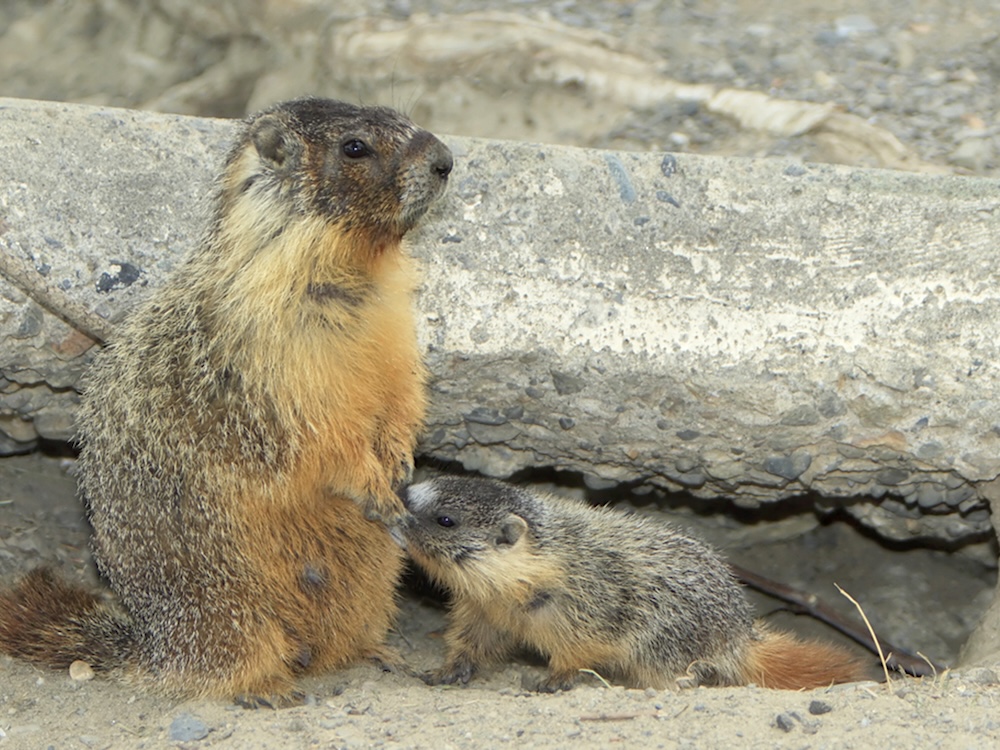
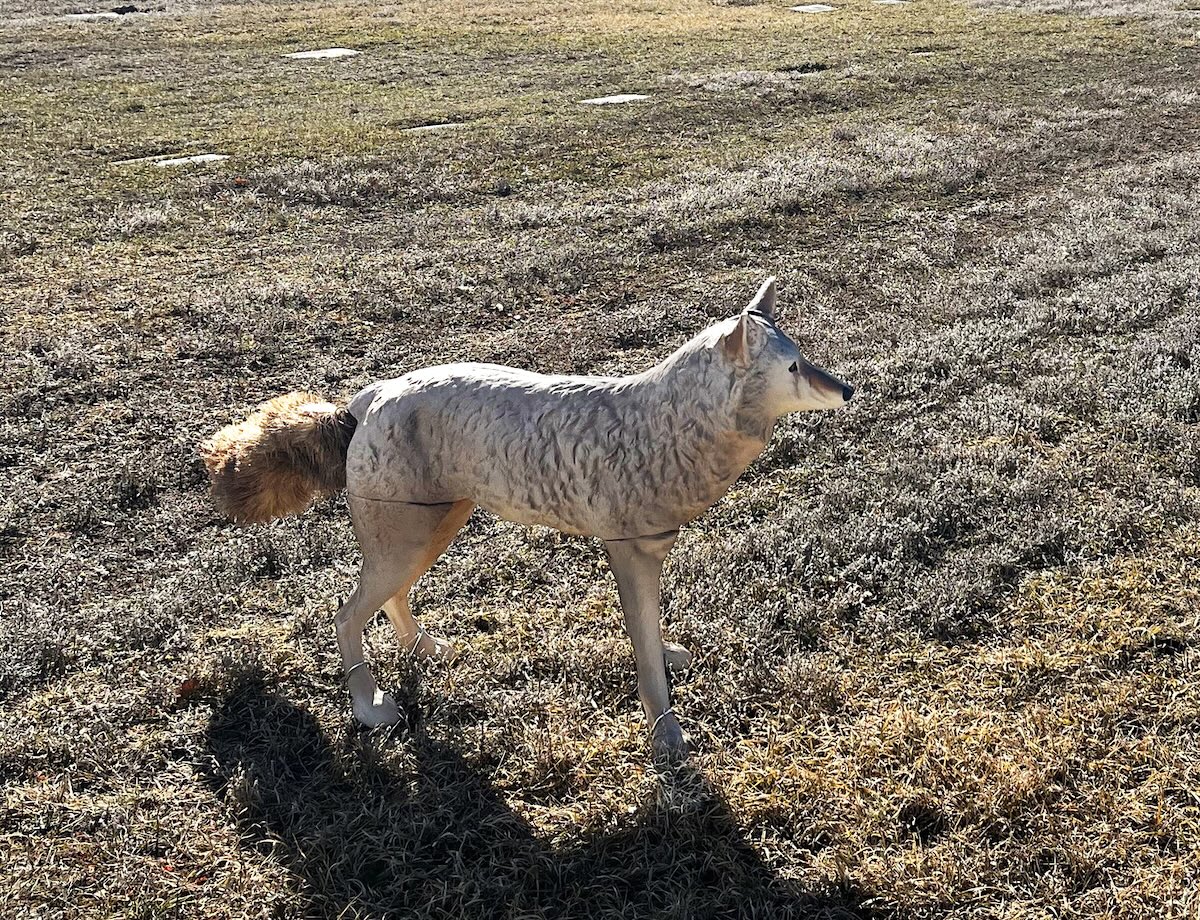
Merritt loved its marmots. The rodents were considered a mascot in the small city, located in B.C.’s arid Nicola Valley. Then the cute little animals started copulating in the cemetery, damaging gravesites and disregarding the fake coyotes put out to act as deterrents.
Now, officials have decided some of them have to go. After a failed attempt at spraying coyote urine around the graveyard, the city is set to spend $10,000 to trap and relocate the rodents.
The city wants to see an end to the rodent-related cemetery vandalism — and rumours that marmots are digging into caskets.
Merritt’s cemetery marmots are the latest wild animal population to dig up trouble after finding a happy home in a human-created habitat. As rodents, geese and ungulates have multiplied in some towns — and as human development has encroached on their territory — an assortment of complex challenges have emerged.
Although human-bear interactions tend to receive the most attention in British Columbia, most communities follow an established approach to reduce conflicts, focusing on decreasing the availability of trash and other common bear attractants.
But every animal is different, and as B.C. communities seek to reduce wildlife conflicts without resorting to culls, they’re learning on the fly what works and what doesn’t.
Grave-robbing critters?
The Merritt cemetery sits on a hillside overlooking Merritt and the Nicola Valley. A historic section of the cemetery is mostly gravel and features large grave markers. On the gently sloping hillside beside it, an expansive grassy plot is home to rows of widely spaced grave markers — including that of my own grandfather.
It’s a bucolic setting for families of the deceased. And it’s also become increasingly popular with marmots, who prefer wide-open flat terrain that provides good vantage points to watch for predators.
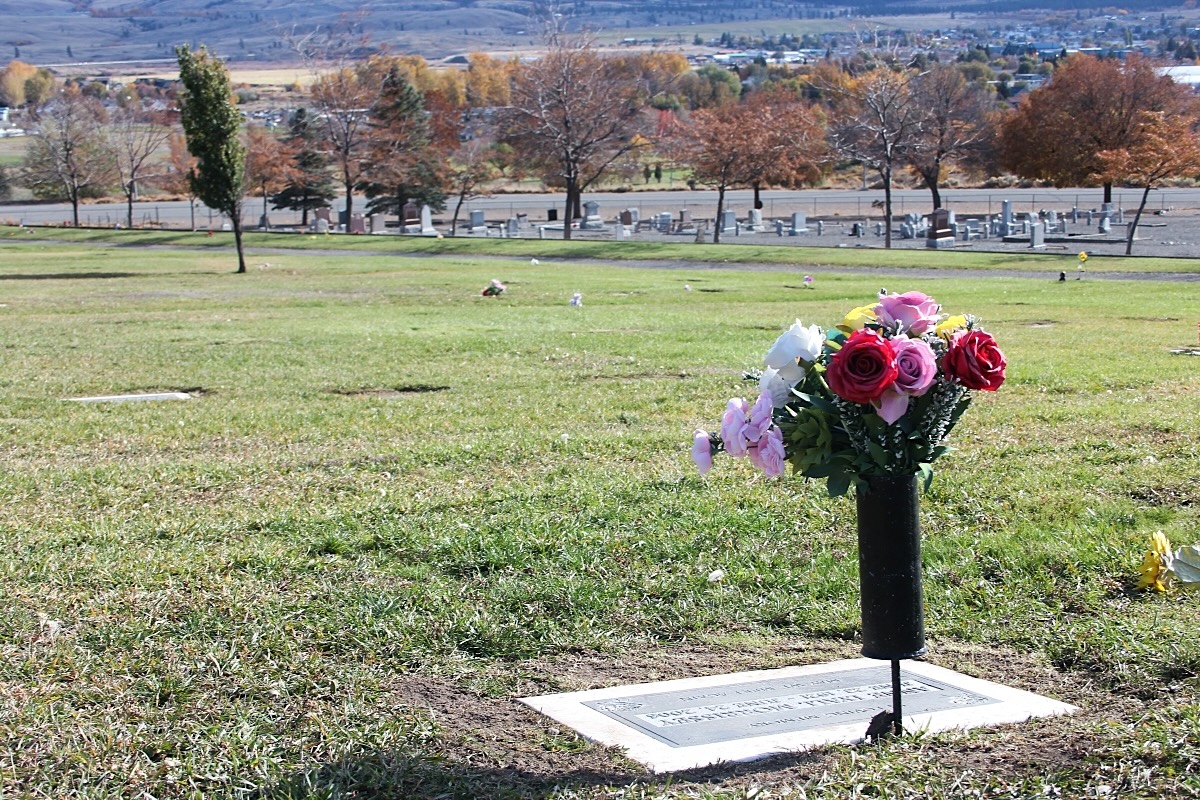
But in recent years, the cemetery colony has created headaches for city staff, groundskeepers and some cemetery visitors. Staff say marmot holes have compromised the stability of grave markers and columbariums, and damaged plantings around the site.
When Mayor Mike Goetz visited the cemetery in July, he said, he spotted dozens of the rodents around the site’s columbarium, a small wall with individual compartments for urns.
“I went up there the other day to have a look at the columbarium and the planting and the benches, and it was a stampede,” he told his colleagues during a meeting that month. “There must have been 30 of them that just bailed as soon as I got there.”
Goetz and other city officials regularly field complaints about the marmots. Some residents have even suggested the marmots may have actually taken to robbing graves.
“We’ve heard rumours of one or two of them with bones in their mouth,” a staffer told Merritt council in July. “Not sure if they’re rumours or reality, or if it’s just a twig.”
None of those grave-robbing allegations have been substantiated, a city spokesperson has since told The Tyee. But the digging around the graves was enough to prompt the city to seek ways to reduce the marmot damage and costs.
On community Facebook pages, some have suggested culling the rodents to reduce their population. But Merritt staff and council didn’t spend much time on that possibility.
“We’re not going to do anything nasty to the marmots,” Goetz said at the outset of the July meeting.
Vancouver Island marmots are protected by the Species at Risk Act, while the B.C. Wildlife Act applies to all marmots.
In an email to The Tyee, a Merritt spokesperson wrote, “We’re not marmot experts,” when asked for an interview on the marmot challenges.
Merritt’s marmots seem to be a relatively new concern for the city’s cemetery. The Tyee was not able to find any record of the municipality having to address rodent issues in the graveyard before this year. Mostly marmots have been a source of fun. In 2012, members of the TV society in nearby Logan Lake created “The Marmot Channel” for April Fools’ Day. They ran shows like “This Hour Has 22 Marmots” and “The Marmot Tyler Moore Show.” And just last year, residents voted a marmot to be the community’s mascot.
At its July meeting, Merritt council expressed uncertainty about the precise protections afforded to yellow-bellied marmots, the most common type of marmot in the city. Goetz suggested that sterilization or extermination wouldn’t be possible given provincial rules. Documents from the BC SPCA included in a staff report to council say that yellow-bellied marmot populations can be controlled through lethal means, although the SPCA discourages that approach.
In an email, a Ministry of Water, Land and Resource Stewardship spokesperson confirmed that property owners can kill marmots to protect their property. Capture or killing of marmots must, however, be done humanely. However, the right-to-kill only extends to property owners and their close relatives. Pest control companies require permits to trap and kill wildlife, the ministry says.
At the suggestion of staff, Merritt council endorsed a plan to spend up to $10,000 to hire a local trapper to seize and relocate some of the cemetery’s marmots. The BC SPCA discourages relocation because many marmots end up either dying or returning to the place from which they came. Cynthia Whyte, Merritt’s chief administrative officer, warned that the trapping would likely need to be repeated in coming years.
“It’s unlikely we’ll get them all so there will still be marmots breeding in the cemetery,” Whyte said.
The city’s website says it will investigate other potential options, such as “disrupting sightlines, installing fencing, and active monitoring.”
Aggressive deer
Merritt’s marmot challenge echoes — but has not yet reached the scale of — the issues that many B.C. communities are encountering with growing urban deer populations. Although human-deer conflicts aren’t new, the way communities react to negative interactions between wildlife and people has evolved. Culls, which were once both backed by residents and funded by the provincial government, are now rare. But no other population control strategy has fully replaced the killing of urban deer.
Last year, Tasha O’Krane found herself battling for her young puppy’s life after it was attacked by a large female deer in the middle of Penticton.
O’Krane had been training her labradoodle Poppy as they traversed a narrow walkway in the centre of Penticton. As O’Krane focused on Poppy, an object suddenly appeared in the periphery of her vision.
“I looked up and the deer was right in front of my face on the other side of a four-foot chain-link fence,” O’Krane told The Tyee. O’Krane picked up Poppy and tried to escape via a nearby ditch, but the deer was agitated and lunged towards the pair.
With her home nearby, O’Krane decided that Poppy would do better on her own while she occupied the deer’s attention.
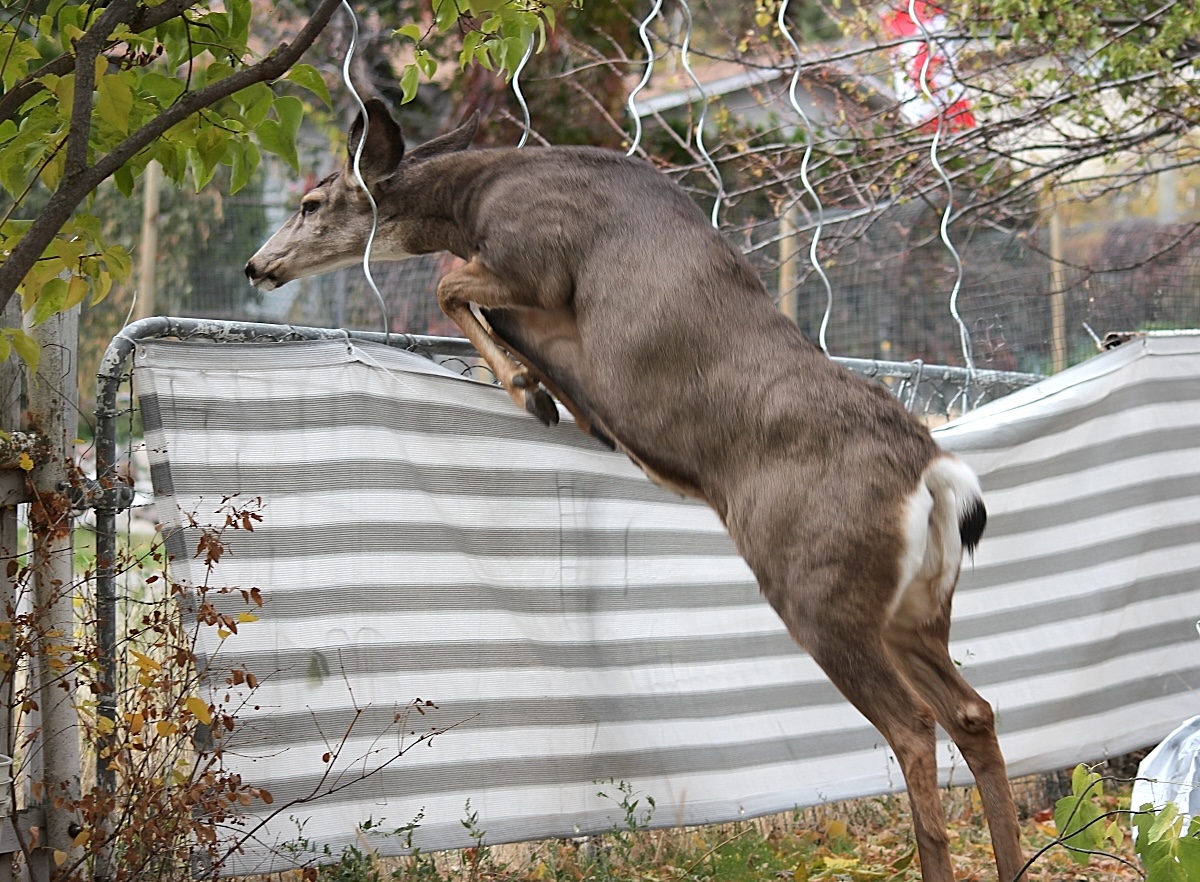
“I let her go but the deer jumped the fence like it was a curb and was on her in four or five strides,” O’Krane remembers. “It stomped her and tried to kill her, rearing up and pounding down.”
Eventually O’Krane threw a cinder block at the deer, which caused the animal to retreat long enough so she could grab her injured puppy. O’Krane thought her dog was dead, but Poppy clung to life. She eventually survived broken ribs and a bleeding liver, with a surgeon in Vancouver inserting pins and plates into her legs.

The incident wasn’t a one-off. Reports of aggressive deer attacking pets and humans have been occurring for years.
Residents in Penticton have long been warned to keep pets on leashes and be wary of protective does or rutting bucks. After years of taking a hands-off approach — and rejecting a proposed cull in 2019 — the city decided this fall to form a committee to consider solutions to the wildlife conflicts. But, as in Merritt, there is no obvious, cheap or simple solution.
Goose poop
With culls of wildlife discouraged by wildlife advocates, unpopular with many residents and of questionable long-term effectiveness, contraceptives are now a humane option favoured by communities looking to limit geese populations in B.C. communities.
The Canada goose might be iconic, but it is hardly loved. The birds can be aggressive and semi-frightening. But even if they’re rarely dangerous, the real challenge is all their waste, and the fact it often ends up on beaches and green spaces humans value.
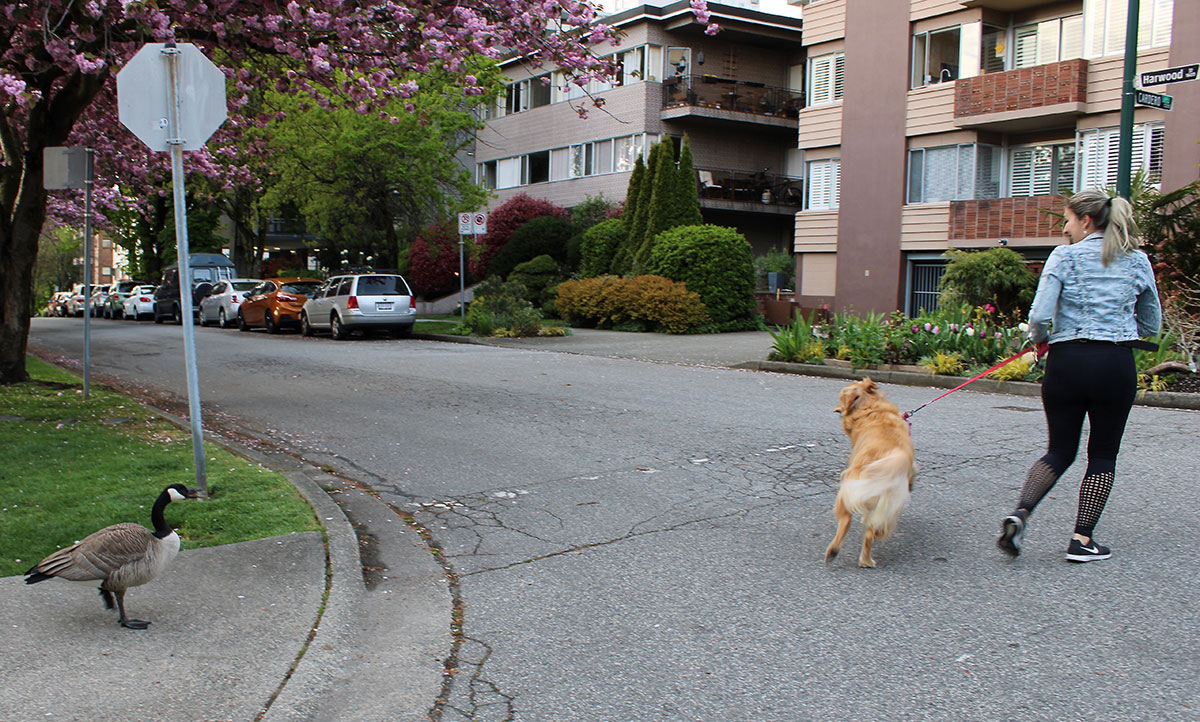
As geese populations have ballooned in many B.C. parks, communities have looked at ways to trim “cobra chicken” numbers.
The geese proliferate in parks and local lakes not just because the province has fewer non-public wetlands than a century ago, but because of deliberate choices with long-term results.
A half-century ago, local conservationists were worried that hunting was decimating local geese populations. To address the problem, they imported Canada geese from Ontario in the 1970s. The program worked too well: the incoming geese mated with local waterfowl, and the resulting hybrid has thrived across the Lower Mainland.
Over the last decade, communities across British Columbia have developed their own contraceptive programs, where city crews or volunteers visit geese nests in the spring and addle — essentially shake — eggs to prevent them from hatching. Over time, the programs limit the growth of geese populations without needing to exterminate living animals. But they must be repeated regularly.
Contraceptives for deer?
Deer, of course, don’t lay eggs. But the theory behind egg addling — hands-on contraception — sits at the core of what may be B.C.’s widest-ranging and scientifically ambitious effort to control a local animal population. And officials may hear this week whether it has a future.
Across the province, deer populations are increasing due to a variety of factors. Cities provide refuge from the predators that keep deer populations in check in the wild. And lush, irrigated yards full of deciduous plants provide nutrition that has likely boosted reproduction rates among deer, according to recent research from University of Victoria ecologist Jason T. Fisher and his team of scientists studying the deer in the Oak Bay and Esquimalt areas.
By tagging deer and using wildlife cameras, the scientists estimated that the deer population in the affluent suburb of Oak Bay municipality was potentially five times as dense as that in the more natural Sooke Hills area.
Fisher’s project was part of a larger, years-long effort in Oak Bay to study the effectiveness of putting local deer on birth control. The study has now concluded, and a pending provincial government decision on its future is likely to be closely watched by officials in Penticton and elsewhere considering their own wildlife challenges.
Years ago, Oak Bay tried to cull its deer population, but the program met with bad publicity and community disquiet.
The cull’s ignominious end sparked the creation of a local wildlife society and renewed the need for an alternative. Oak Bay’s residents still wanted deer to stop eating their flowers and bushes. But they didn’t want to kill them.
Contraceptives seemed to offer a potential solution. With backing from both the municipality and the province, and funding from a range of sources, the Urban Wildlife Stewardship Society contacted Fisher, who runs UVic’s ACME Lab, a research group focused on finding solutions to large-scale conservation challenges.
The issue was a bit outside Fisher’s typical study, but he was drawn to the fact that it sought to address a problem in his own backyard — and would involve capturing and interacting directly with wildlife.
“I took it on mostly to satisfy my own curiosity, but also I thought it would be fun to do,” he told The Tyee. But he said he wasn’t sure exactly whether the society’s hope — that contraceptives could control Oak Bay’s deer population in a humane way — would bear itself out.
“I really had no idea which way it would go, to be honest with you.”
In 2018 and 2019, the team captured and injected dozens of does with immuno-contraceptives in Oak Bay. Those does, and a smaller control population that was not given the contraceptive, were collared. Over the ensuing years, the does were given booster shots with a dart gun.
Wildlife cameras were used to monitor the deer and track which ones appeared with fawns each spring. In 2021, Esquimalt, a suburb on the opposite end of Greater Victoria from Oak Bay, also signed on to the program, allowing Fisher and his team to study contraceptives in a different environment.
Earlier this year, the scientists published a comprehensive report on the program’s success. Fisher and his team wrote that the contraceptives were broadly successful, with far fewer fawns born to those that received them.
Of course, once the does stopped getting their birth control, reproduction rates increased. As with addling the eggs of Canada geese, that means that for an immuno-contraceptive program to be successful, it would need to be repeated at consistent intervals, inevitably at a cost to local governments.
Increasing tolerance, adjusting human behaviours
Oak Bay’s deer study also reduced the animosity some locals felt for their deer neighbours, Fisher told The Tyee.
“Once they had unique collars on them, they realized that was ‘Alice’ just going by over and over and over again,” he said. “They quickly came to realize that it’s not 500 deer in Oak Bay. It’s actually about 120.”
As people came to recognize their local deer, Fisher said, they became more tolerant of them. They even began taking photos to send to the deer team.
“The rhetoric completely changed from animosity to a level of care and interest and attraction,” Fisher said.
The study suggested expanding the immuno-contraceptive program to a regional level and repeating it every five years.
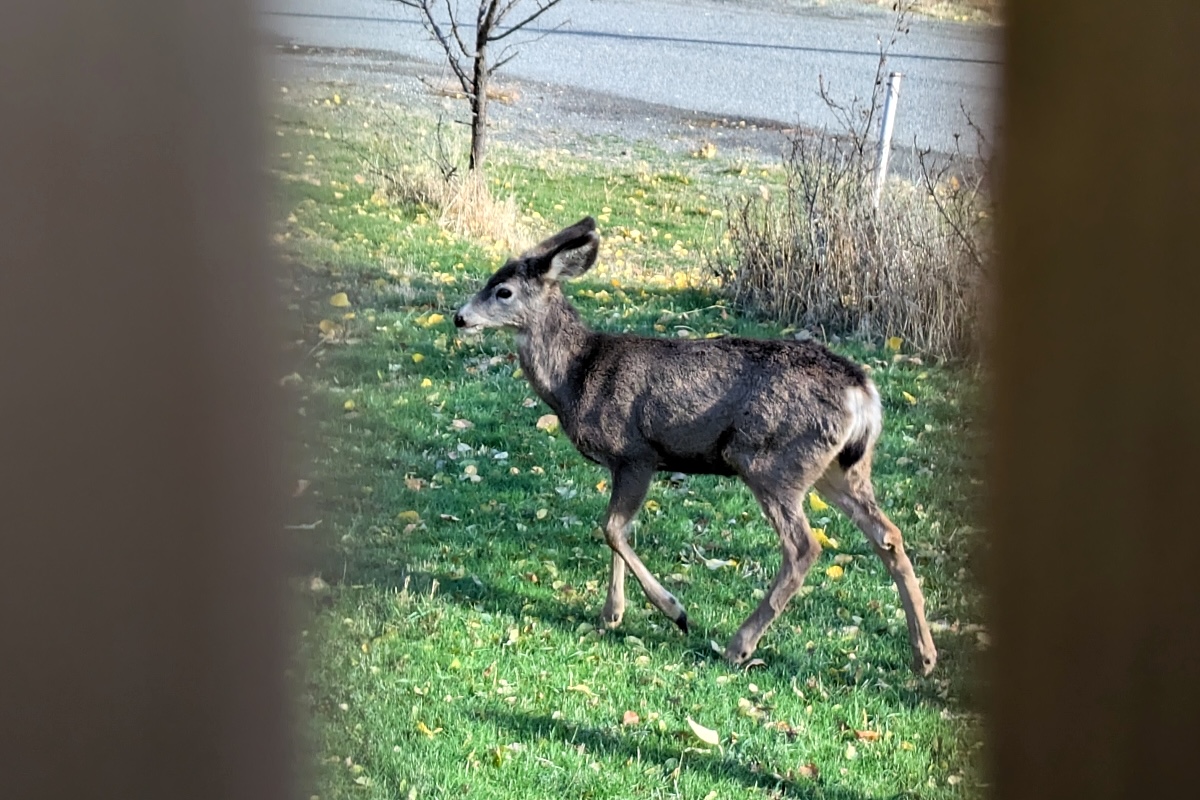
Just as with bears, cities and residents can also adjust their rules and behaviours to reduce deer conflicts, Fisher said. Bylaws that limit the heights of fences and preferences for deer-friendly shrubbery can increase deer conflicts. Allowing and encouraging people to create more deer-resistant properties can reduce the chances of negative encounters.
No marmot birth control
In July, as Merritt councillors considered a solution to their marmot complaints, they discussed the potential of sterilizing marmots, and the availability — and legality — of rodent birth control. The discussion ended with the mayor and Whyte, Merritt’s chief administrative officer, suggesting sterilization was off the table because it wasn’t an approved practice in British Columbia.
In its email to The Tyee, the Ministry of Water, Land and Resource Stewardship said marmot sterilization projects “would be evaluated on a case-by-case basis.” That suggests the province needs to authorize any rodent contraception plan Merritt might develop, although the ministry was not able to confirm that by the time of publication.
So the city instead hired its trapper. Officials have not yet heard how many marmots he has caught and relocated.
On one recent sunny October day, I visited the cemetery with my mother and son. The wind whipped across the exposed field as my mother searched for her father’s final resting place. A handful of flowers swayed in the breeze.
There were no rodents in sight. I couldn’t help feeling a little disappointed. While I didn’t want the emotional complications that would come with marmots digging up my grandfather’s grave, I also don’t mind the idea that life continues in the same places we are laid to rest. Those two feelings are probably at odds with one another, and there lies the challenge for Merritt and many other B.C. communities.
If one can’t expect rodents to respect the dead or deer to love puppies, the only solution may be to make communities a little less welcoming to the handful of wildlife species who love cities. ![[Tyee]](/design-article.thetyee.ca/ui/img/yellowblob.png)
Read more: Environment










Tyee Commenting Guidelines
Please note that email notifications for replies are not currently working due to a software issue which may be resolved in a future update.
Comments that violate guidelines risk being deleted, and violations may result in a temporary or permanent user ban. Maintain the spirit of good conversation to stay in the discussion and be patient with moderators. Comments are reviewed regularly but not in real time.
Do:
Do not: