


 SHARE:
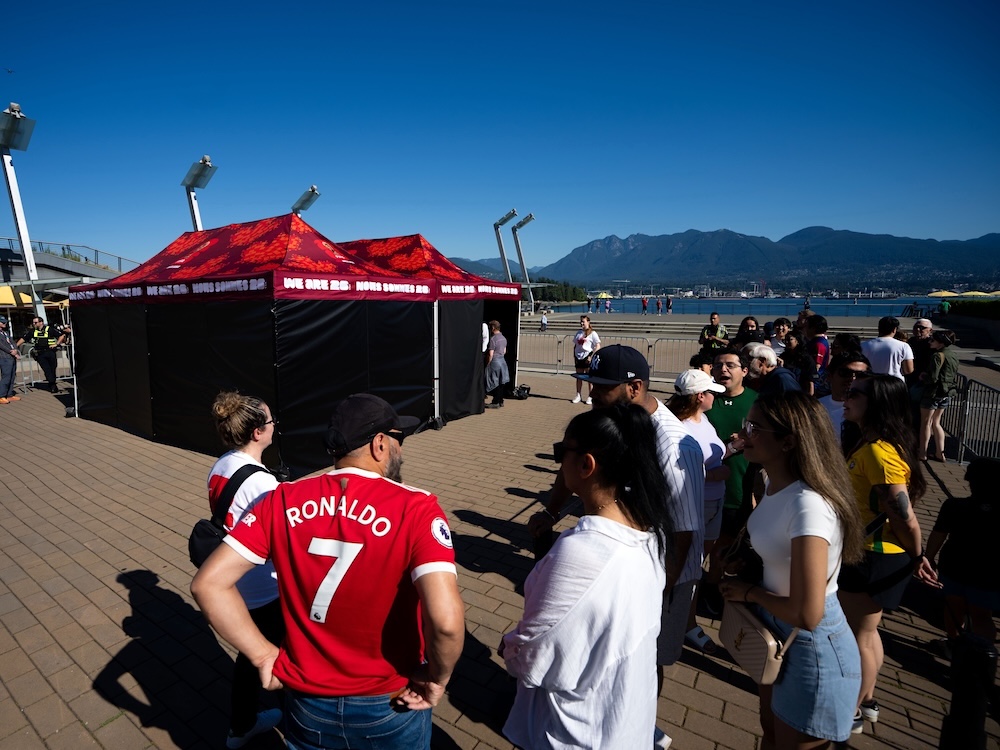
With fewer than three months to go before Vancouver hosts its first World Cup match, and the estimated 350,000 tourists expected to come with it, the city’s host committee has released a draft of its human rights action plan.
But critics say the plan is too vague and needs to go back to the drafting table if it’s going to be an effective harm reduction tool for the human rights violations that come with hosting a major sporting event.
It also falls short of what other FIFA host cities have prepared — and several non-profit groups are now preparing their own resources to address what they say are shortfalls in Vancouver’s human rights plan.
Shortly after the draft plan was released on Feb. 19, a coalition of non-profit organizations representing the interests of marginalized communities, including people living in poverty or experiencing homelessness and substance use issues, issued a press release expressing their disappointment with the document.
This includes Pivot Legal Society, the BC Civil Liberties Association and the BC Poverty Reduction Coalition, which criticized the draft for relying on existing federal, provincial and municipal laws, bylaws and frameworks instead of thorough consultation with affected communities. They say the plan also doesn’t have enough information about what will happen to address human rights violations.
Despite attempts to meet with the committee dating back to June 2024, the coalition of organizations said they did not meet with the committee until hours after the draft was released.
“One thing that’s clear is the World Cup is going to be held here; it’s not something anybody can change,” said Jerome Igbokwe, staff counsel for the BC Civil Liberties Association, adding both visitors’ and residents’ rights should be respected.
“But people who live in the city should be prioritized. At the end of the day, that should be everyone’s concern: how are we treating the people who are here?”
The coalition of organizations spelled out their criticism of the human rights plan in a press release:
“The Plan as a whole is riddled with weak, empty language like the City ‘will continue’ or ‘will monitor’ — as opposed to ‘will implement,’ ‘will scale up’ or ‘will fund,’” it reads.
“In a profound contradiction, the Action Plan recognizes that FIFA brings an increased risk of harm to Vancouver’s residents, and yet promises nothing to effectively mitigate it.”
Vancouver let off the hook
Because Vancouver was a late entry as a candidate, unlike the other 21 host city candidates for the 2026 Cup, it was not required to complete human rights stakeholder consultations and produce a final report for FIFA as part of its candidacy.
These reports from potential host cities helped FIFA draft its own World Cup 2026 Sustainability and Human Rights Strategy and World Cup 2026 Human Rights Framework for the host cities and FIFA itself to follow.
Vancouver was instead asked to sign a “pre-defined human rights commitment” and share the list of organizations that would be represented on a “human rights stakeholder committee,” as well as the terms of reference for the committee, which is supposed to lead engagement on the city’s human rights plan.
In comparison, Toronto, another host city candidate for the games, had to undergo a FIFA human-rights-centred evaluation in 2021, in addition to stakeholder engagement and reporting.
Vancouver was allowed to bypass this process in part because of its reputation of being a progressive city when it comes to human rights, said Igbokwe.
The draft action plan includes a nearly four-page-long list of non-profit community service providers; government ministries, departments and committees; universities; lawyers; communications experts; and human rights authorities the action plan committee met with before releasing its draft.
But it states the action plan is not a legally binding commitment on the part of the city or FIFA, but a “public demonstration of good-faith efforts and the exercise of human rights due diligence.”
Details missing
Last November, the city’s host committee answered city council’s questions about temporary bylaw changes within the “game zone,” a two-kilometre radius around BC Place in downtown Vancouver, and the Pacific National Exhibition in northeast Vancouver.
At the time, committee members told council there would be no FIFA-related “street sweeps” or increase in bylaw officers enforcing rules preventing people from sheltering outside during the daytime, including throwing away their belongings.
“The language of the bylaw leaves it up to individual officers’ discretion as to what does and does not constitute an offence, and to issue tickets as they see fit,” said Laura Macintyre, a staff lawyer with Pivot Legal Society.
“I think they would define getting people off the street, removing signs of what they would call ‘public disorder’ — public drug use — as actually central to their contractual requirements to FIFA... to present a clean, beautiful, welcoming environment.”
The committee staff also told council how “vulnerable people” are treated within the game zone would be covered in the human rights plan.
The plan defines vulnerable groups specifically as people living in the Downtown Eastside, people experiencing homelessness and populations that are disproportionately Indigenous people.
The draft plan’s details for protecting this population are vague, noting Vancouver Police Department members will “receive advance training concerning de-escalation strategies, diversity and cultural awareness,” while FIFA’s safety and security team will ensure they follow all “relevant requirements, laws and policies aimed at the protection of vulnerable groups.”
Elsewhere the plan says the city will work with community organizations to help serve vulnerable populations.
But there are no details on what organizations would be included, how they can help and whether they will receive additional resources to take on these new tasks.
“The human rights plan could provide at least some additional protection and/or redress in the event that discretion is misused,” said Macintyre. “But this human rights plan does not do that.”
Redress and remedy
If a person’s human rights are violated in relation to the city’s World Cup hosting duties, the plan has outlined resources for “redress”: call or use the 311 app; report via the FIFA online portal for non-emergency violations; or file a complaint with the BC Human Rights Tribunal.
“This Action Plan will be updated as the operational details surrounding this mechanism takes further shape,” the draft reads.
There are no details on additional resources for 311, a service Vancouverites typically use to report a broken bike rack or a pothole on their street, to accommodate this additional responsibility of logging human rights complaints.
“My understanding is that 311 is currently nowhere near equipped to house those sorts of violations, and is not an accessible portal for many people, including people without access to technology,” said Macintyre.
The wait times for compensation for the tenant relocation and protection policy are prohibitively long already, she said, while the BC Human Rights Tribunal’s current wait times are between five and seven years.
“A centralized system for reporting human rights abuses would be the first thing I would ask for,” Macintyre said, adding people should be able to report violations in person at pop-up 311 stations, as well as by phone or online.
“There needs to be some public education or some public awareness raising about that mechanism, whether it’s 311 or a new mechanism.”
Igbokwe from the BC Civil Liberties Association said Vancouver should take a page out of the Dallas human rights plan redress section, which includes avenues for complaints about police, child exploitation and trafficking, environmental damage, fair housing violations, hate crimes, lack of accessibility, and violations or crimes by city workers, as well as for connecting to consular services for visitors from other countries.
Dallas’s plan also includes creating a reference guide for legal aid services and supports, and setting up its own internal process for receiving, triaging and referring out human rights complaints.
“Dallas keeps saying something like ‘We have already produced a tool kit that will inform police officers of people’s right to free expression.’ It’s a specific action,” Igbokwe said.
“If you use words saying ‘We will monitor, we will do this,’ it’s difficult for someone to know whether you’re actually doing those things.”
Vancouver is not Russia or Qatar, Igbokwe acknowledged, two recent World Cup host countries that have global reputations as human rights violators.
“But there are some issues that still exist here. If you add 350,000 people, those issues are going to be exacerbated,” he said.
For example, Igbokwe wondered if air-conditioned daytime shelter will be provided for people experiencing homelessness during potentially some of the hottest months of the year. What steps will be taken to assist workers who aren’t receiving fair compensation? For potential victims of trafficking?
Macintyre has similar questions. She said the city has already told the coalition not to “get our hopes up” about their ability to secure safe, clean and air-conditioned daytime shelter spaces.
Major-event harm reduction
The Tyee requested an interview with an action plan committee member, but no one was made available. Instead, a spokesperson for the City of Vancouver sent a prepared statement and responded to followup questions sent via email.
“The City understands that major sporting events can raise concerns, especially in communities already facing significant social and housing challenges,” reads the statement, which goes on to note the seven soccer matches happening over a two-month period will be a much smaller endeavour than the 2010 Winter Games.
“We acknowledge that some advocacy groups would like the FIFA World Cup 2026 to be leveraged as a catalyst for new and ongoing investments in housing, shelter and social supports. While the city agrees these are urgent issues that require significant investment from senior government and partnership with the city, ongoing solutions to these complex circumstances extend beyond the scope of hosting these seven matches and beyond what municipalities alone have the resources or jurisdiction to solve.”
The BC Poverty Reduction Coalition was invited to engage with the draft committee in June 2025, a city spokesperson said, but the non-profit was unable to attend. The Tyee has reached out to the coalition for confirmation.
But the city will continue engaging with the province and “community service providers” to refine and add to the action plan until the final version comes out in May, the city said. The final plan will be included in Know Before You Go and Essential Information sections of the city’s FIFA World Cup website, too.
It was also important not to duplicate existing services, the city noted, adding that while 311 is a potential outlet for reporting a human rights abuse, people will also have access to services including but not limited to 911, VictimLinkBC, and the B.C. Racist Incident Helpline.
Misting and water stations, as well as cooling centres in community centres, will continue to be provided as usual for people vulnerable to the heat, the city said, while it is also looking into the potential for holding outdoor supports in the Downtown Eastside on the seven game days.
Temporary washrooms will be located outside “event-related locations” during game days, it said. As well, the city said it will be engaging with non-profits to help address concerns outside the stadium area, such as friction between locals and visitors, gender safety and sex worker safety.
There won’t be any new funding, the city noted, but staff expect non-profits that already provide services funded with city and provincial dollars will also be operating as usual on game days.
Igbokwe and Macintyre are both skeptical that holding a major sporting event like the World Cup or the Olympics, as Vancouver did in 2010, is possible without violating human rights.
For example, the city is pushing to complete the temporary infrastructure required to run the games and game-adjacent events like public concerts and watch parties.
“When you are trying to build something within a very short duration, it means that there is a likelihood that you are going to employ someone who some of the contractors are going to try and take advantage of,” Igbokwe said.
Instead, Pivot and the BC Civil Liberties Association believe a good human rights action plan provides harm reduction and mitigation for the inevitable pain the preparation and execution of these events will cause.
While neither organization would elaborate on their plans, they both indicated they are working on developing their own resources and capacities to address human rights violations related to the games.
“I’m very hopeful that the city is going to take some of the criticism that we have so far... let the city know about, and improve this action plan,” Igbokwe said.
“Some part of me knows that the city may not do much. So we have some other things that we are preparing some of the ways that we can still support people who are unsheltered, people who are likely to be interacting with the criminal justice system or the city bylaw enforcers.” ![[Tyee]](/design-article.thetyee.ca/ui/img/yellowblob.png)
Read more: Rights + Justice, Sports





Tyee Commenting Guidelines
Please note that email notifications for replies are not currently working due to a software issue which may be resolved in a future update.
Comments that violate guidelines risk being deleted, and violations may result in a temporary or permanent user ban. Maintain the spirit of good conversation to stay in the discussion and be patient with moderators. Comments are reviewed regularly but not in real time.
Do:
Do not: