


 SHARE:
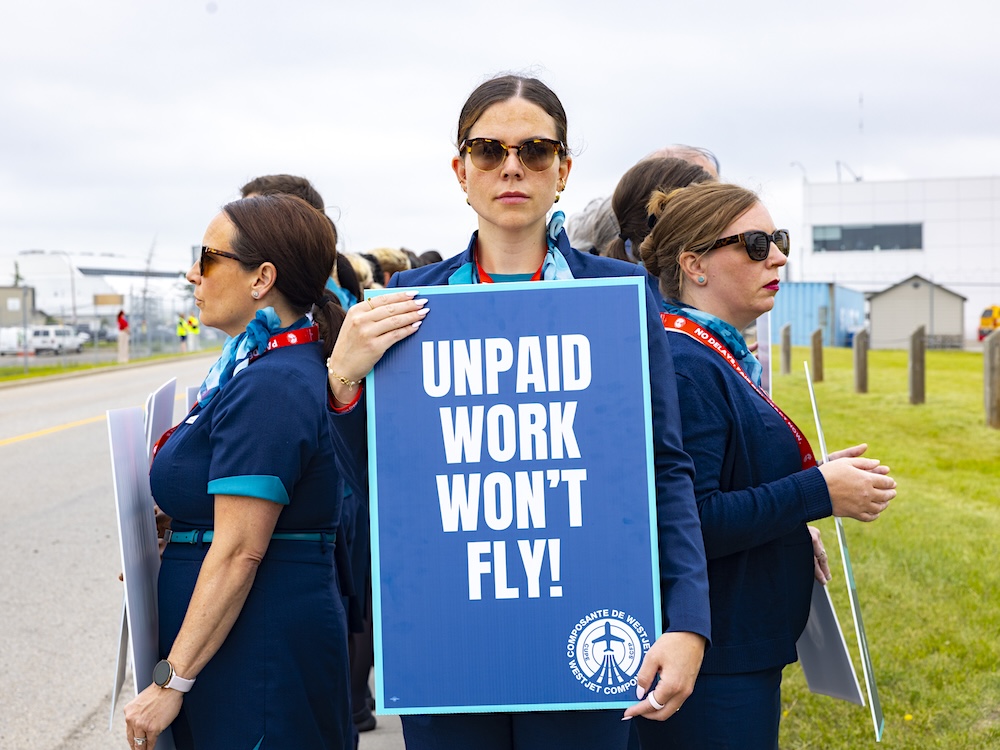
Every time you board a WestJet flight, the flight attendants helping you aren’t being paid for that time. They’re paid only for what the industry calls “block time” — the period from when the plane leaves the gate to when it arrives at the next one.
Boarding, pre-flight briefings, safety and security checks, adjusting overhead bins, deplaning, layover waits and delays are all considered “ground time” — necessary work that WestJet treats as unpaid labour. According to the flight attendants’ union, CUPE 8125, a typical month sees them working up to 35 unpaid hours.
On July 15, WestJet flight attendants voted 99.4 per cent in favour of a strike mandate, with 97.3 per cent of CUPE 8125 members participating. About 4,400 mainline flight attendants could legally walk off the job as soon as Aug. 2, just ahead of the August long weekend, though either side would have to give 72 hours’ notice before a strike or lockout.
For years, consumers have complained about deteriorating service and price gouging by an airline once beloved as a folksy western Canadian upstart. Founded as a regional airline in Calgary in 1996 by Clive Beddoe, Mark Hill, Tim Morgan and Donald Bell, WestJet began reinventing itself in 2013, evolving from a low-cost carrier into a global airline. It was restructured again after its 2019 acquisition by private equity firm Onex.
But while passengers have felt it in legroom and checked bag fees, flight attendants have suffered more. Some workers say they’re living in poverty due to stagnant wages and unpaid overtime.
“The reality is a lot of us are in credit card debt,” says Chantal Weeks, a WestJet flight attendant of nine years. “I’ve gone to the food bank.” She says some flight attendants live out of their cars.
Even Kymberly Shindler, who has been with the company for 24 years and is considered senior, says she’s struggling to pay her bills. “Maxing out my credit card has become normal.”
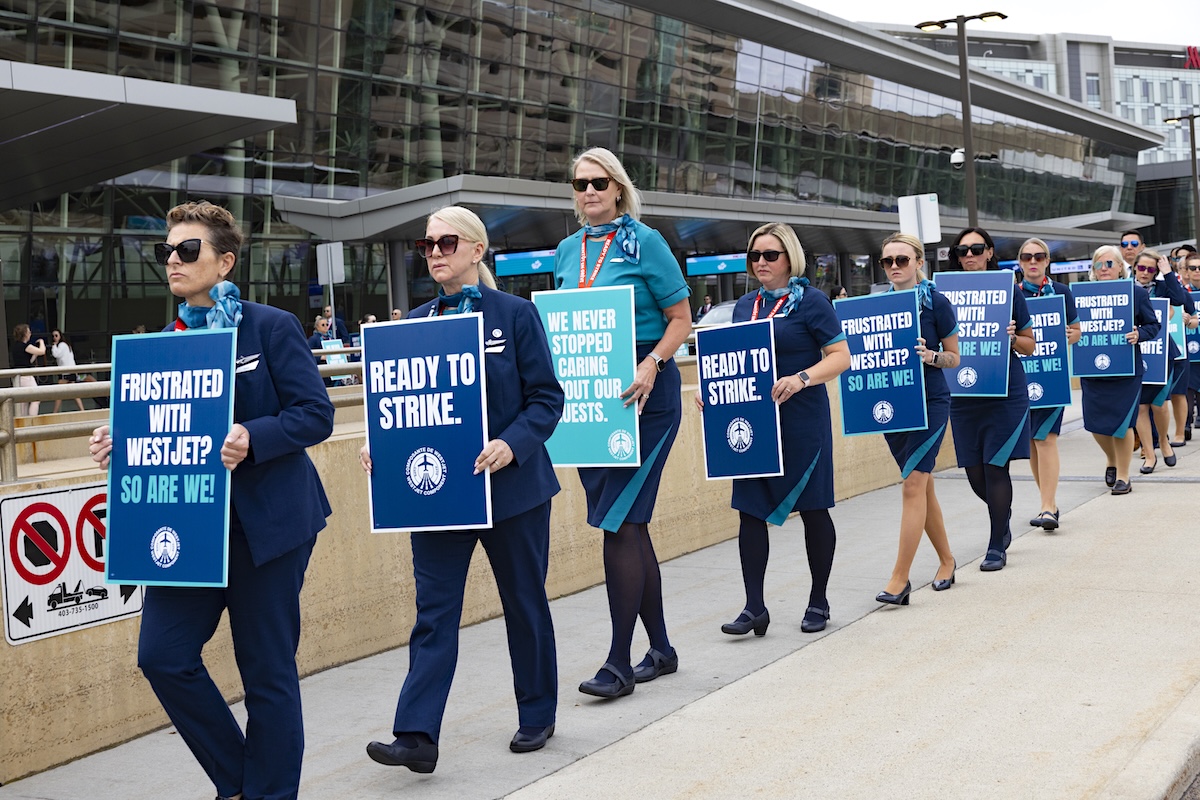
It wasn’t always this way. Before WestJet moved to block pay, flight attendants were paid a regular hourly wage from the time they reported for duty until they were released at the end of the crew’s flight schedule.
The company later adopted a block-time system, tying flight attendants’ pay to credit hours rather than the full duty day. Shindler says the change was partly meant to bring flight attendants in line with the pilots’ pay structure, and at the time, the trade-off was easier to accept: the credit-hour rate worked out to roughly three times minimum wage.
WestJet also still felt like a company that treated employees as owners. Flight attendants earned a livable wage, and profit sharing topped up their income with biannual dividends. “You didn’t have to use that profit share to live,” says Shindler. “We were paid appropriately.”
In 2004, when the company was struggling financially, Beddoe, the CEO, even went without a salary.
“It was all about the people,” recalls Shindler, who watched WestJet grow from a scrappy western Canadian low-cost carrier into a global airline serving more than 100 destinations.
But as WestJet expanded, Shindler says, the old bargain began to change. In 2013, the company launched Encore, a regional carrier serving smaller communities, with the same uniforms but smaller planes, lower wages and different work rules. To Shindler, it felt like a signal: “The appreciation for us seemed to become less. We were being easily replaced.”
Flight attendants began efforts to unionize for the first time in company history on the heels of Swoop, WestJet’s ultra-low-cost carrier, which launched in 2018 with lower wages and different work rules.
Then came Onex, the private equity firm that bought WestJet and took it private in 2019; workers say the airline’s old employee-first bargain gave way to stripped perks, tighter cost controls, restructuring and weaker job security.
Onex is now angling to take WestJet public again, and the leaner the airline looks on paper, the better the story it can sell investors — but for flight attendants, that story has meant stagnant wages, stripped perks and unpaid ground work at the exact moment inflation has made every unpaid hour harder to absorb.
Inflation, stagnant wages and longer ground time have changed the math on the credit-hour pay rate for block time. What was once roughly three times minimum wage is now less than double, and on many duty days, flight attendants can effectively end up earning less than minimum wage.
The vote puts WestJet flight attendants on the same path Air Canada’s flight attendants took last year. Also represented by CUPE, they walked off the job seeking many of the same things WestJet flight attendants are now demanding: pay for unpaid ground work and compensation that keeps up with inflation.
Just hours after the strike began, the federal government intervened and ordered workers back to work. CUPE responded by posting on X that Ottawa was “crushing flight attendants’ Charter rights” by forcing arbitration.
With WestJet flight attendants now holding an overwhelming strike mandate, Shindler worries Ottawa could once again step in before workers have a real chance to use the leverage a strike is supposed to provide.
“If I had a message for the federal government, it would be to allow the executives of these large companies to be held accountable,” she says. “Allow them to explain why 4,000 flight attendants are stepping up and saying we're not paid properly. Seek out the answers and don't get involved.”
Learn more on CUPE 8125’s website at EndUnpaidWork.ca. ![[Tyee]](/design-article.thetyee.ca/ui/img/yellowblob.png)
Read more: Labour + Industry
This article is part of a Tyee Presents initiative. Tyee Presents is the special sponsored content section within The Tyee where we highlight contests, events and other initiatives that are put on either by us or by our select partners. The Tyee does not and cannot vouch for or endorse products advertised on The Tyee. We choose our partners carefully and consciously, to fit with The Tyee’s reputation as B.C.’s Home for News, Culture and Solutions. Learn more about Tyee Presents.










Tyee Commenting Guidelines
Please note that email notifications for replies are not currently working due to a software issue which may be resolved in a future update.
Comments that violate guidelines risk being deleted, and violations may result in a temporary or permanent user ban. Maintain the spirit of good conversation to stay in the discussion and be patient with moderators. Comments are reviewed regularly but not in real time.
Do:
Do not: