


 SHARE:
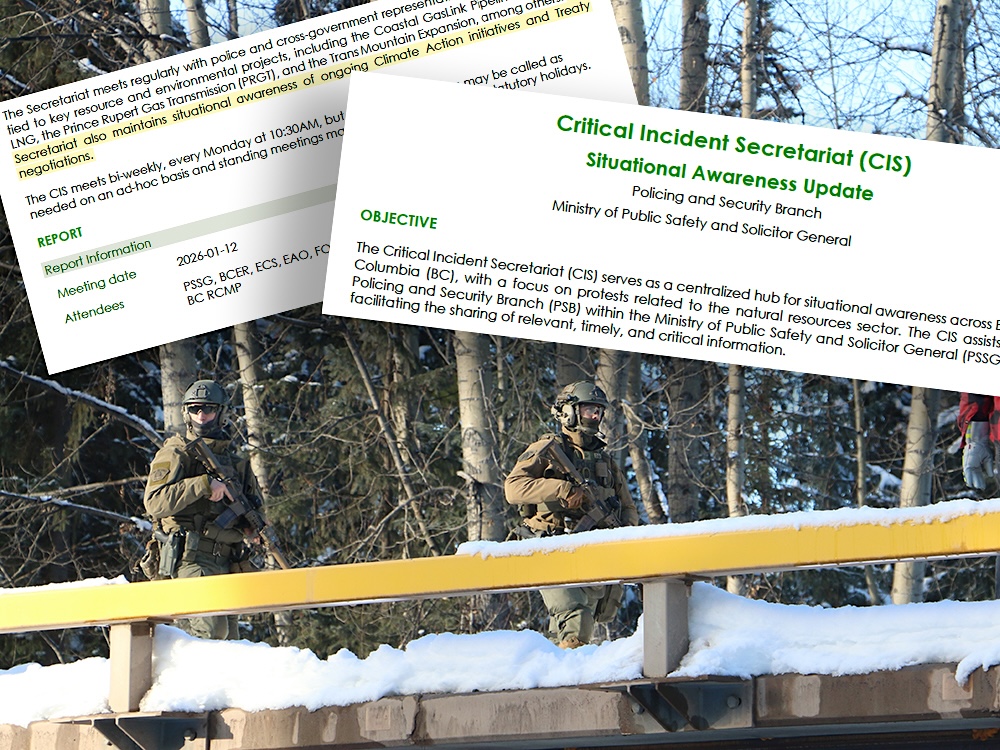
A B.C. government group that works with police to monitor protests against the natural resource industry has also been keeping tabs on First Nations treaty negotiations and climate action initiatives, according to an internal document.
The Critical Incident Secretariat is a biweekly meeting that brings together several provincial ministries, resource sector regulators and a controversial RCMP protest-policing unit called the Critical Response Unit — British Columbia, also known as CRU-BC.
In a Jan. 12 meeting report obtained by The Tyee through a freedom of information request, the RCMP reported that “CRU-BC Intel” is actively monitoring opposition to two liquefied natural gas projects — the Eagle Mountain-Woodfibre Gas Pipeline and the Prince Rupert Gas Transmission line — as well as protests against old-growth logging on Vancouver Island.
But the report indicates that monitoring is not limited to protests.
“The Secretariat also maintains situational awareness of ongoing Climate Action initiatives and Treaty negotiations,” the January update says.
Staff Sgt. Kris Clark, a senior media relations officer with the BC RCMP, said in an email that CRU-BC “does not monitor treaty negotiations.”
“Instead, CRU-BC is briefed during Secretariat meetings by other ministries that are directly involved in those discussions,” he said. “In turn, CRU-BC provides updates to the Secretariat regarding current enforcement actions and any anticipated protest activity that has come to our attention through open source intelligence monitoring.”
CRU-BC gathers information, at least in part, through “online activity,” according to the RCMP’s contributions to the Jan. 12 update.
The report says the Critical Incident Secretariat “serves as a centralized hub for situational awareness” about protests against the natural resource sector. It assists B.C.’s policing and security branch, which falls under the Ministry of Public Safety and Solicitor General, through the sharing of “relevant, timely, and critical information.”
When contacted by The Tyee, B.C.’s Public Safety Ministry declined to say which climate groups or treaty negotiations it monitors and whether they are linked to protests or illegal activity. It also refused to explain how the secretariat’s work monitoring protests overlaps with treaty negotiations.
Instead, a ministry spokesperson wrote in an email that the province “fully respects freedom of expression and the right to peaceful, lawful, and safe protest.”
“Police investigations and enforcement activities are conducted independently under the Police Act, without government direction or interference,” the spokesperson wrote, adding that incidents included in the updates are “based on a threat assessment that considers factors such as scale, location, duration, and potential impacts on public safety, employees, and critical infrastructure.”
When pressed for details about which groups the ministry monitors and the link to treaty negotiations, a spokesperson wrote that the secretariat “does not monitor specific groups or initiatives” but supports “situational awareness and co-ordination across government.”
“In some cases, this may include awareness of broader contexts, such as major projects or negotiations,” the spokesperson wrote. “This is not based on the nature or focus of a group or initiative, but on a general assessment of potential risks.”
The spokesperson said that information gathered by the Critical Incident Secretariat is “drawn from lawful and appropriate sources, including publicly available information and established government and law enforcement channels.” Personal information is never disclosed, according to the statement.
Aislin Jackson, policy staff counsel with the BC Civil Liberties Association, said that even if the province and police aren’t sharing personal information within the secretariat, “it does not mean that they’re not collecting it or using it internally.”
Jackson added that “broad and vague surveillance” without transparency around how information is gathered and used can impact freedom of expression and dampen participation in the democratic process. Jackson described a “chilling effect” that can be created by surveillance and its use by CRU-BC.
“There’s a real adverse effect on people, not just on their ability to engage politically, which is really important in a democracy, but also in their ability to be free in their own minds and in their own thoughts.”
Jackson added that modern treaty negotiations, which are legal processes between First Nations and the provincial and federal governments meant to settle outstanding land claims, don’t tend to coincide with protests.
“It’s not clear or obvious that the treaty negotiations would really give you any intelligence about any kind of actions that might end up taking place on the ground,” Jackson said.
BC Assembly of First Nations Regional Chief Terry Teegee noted that monitoring by the RCMP and government goes back decades. He pointed to recent CBC reports that revealed the RCMP surveilled and infiltrated dozens of Indigenous groups organizing for their rights between 1968 and 1982.
More recently, the National Energy Board co-ordinated with the RCMP and the Canadian Security Intelligence Service to monitor environmental and Indigenous groups opposed to the Enbridge Northern Gateway pipeline, which was proposed for northern B.C. more than a decade ago.
Teegee, who was Tribal Chief of the Carrier Sekani Tribal Council at the time, believes he may have been among those watched. He told The Tyee he wasn’t surprised to learn that the province and the police are monitoring treaty discussions.
“There is a history of surveillance, I suppose, and monitoring that Canada and police forces — perhaps CSIS itself — have been doing against First Nations people in this country for quite some time,” Teegee said.
He said that when First Nations challenge provincial or federal governments for their rights, “there’s always a pushback” but that the right to protest should be protected.
“Nobody wants to be spied on, monitored or surveilled, especially in regard to a democratic right to protest things,” Teegee said. “I think any citizen in British Columbia should be concerned about being monitored.”
Hundreds of pages of meeting reports released last year showed the Critical Incident Secretariat was keeping tabs on public statements from many environmental and Indigenous organizations.
Those groups included Amnesty International, the David Suzuki Foundation, several First Nations governments, a First Nations gathering called the Peace and Unity Summit, and My Sea to Sky, a group that opposes FortisBC’s Woodfibre LNG terminal under construction near Squamish.
In an interview with The Tyee, My Sea to Sky executive director Tracey Saxby said it is “deeply disturbing to see evidence of collusion between the government, industry and the RCMP to force through” fossil fuel projects.
“My Sea to Sky is a law-abiding, peaceful and non-violent organization. Our focus is on public information and advocacy and litigation,” she said. “We’re not doing anything illegal. We’re not doing anything wrong.”
Saxby said the news that the group was included in Critical Incident Secretariat reports confirmed her previous suspicions. She believes that a demonstration My Sea to Sky hosted in September 2024 that included prominent First Nations opponents of the Coastal GasLink pipeline caught the attention of authorities.
“That is the first time that I have personally experienced being followed by an RCMP officer,” she said. “It was deeply disturbing to witness how Indigenous land defenders are directly targeted by the RCMP.”
The Tyee has previously reported that the provincial government had violated its own privacy laws when it collected personal information related to Wet’suwet’en opposition to the Coastal GasLink pipeline project.
In that case, the information was collected by Coastal GasLink and provided to B.C.’s now defunct LNG Canada Implementation Secretariat, a branch of the Energy Ministry. The secretariat then shared the information with the Ministry of Indigenous Relations and Reconciliation as it was engaged in high-stakes negotiations with Wet’suwet’en hereditary leaders.
Months later, in the wake of the last significant police action on Wet’suwet’en territory, the provincial government quietly moved to “enhance the Critical Incident Secretariat (CIS) and its reporting structure” as part of its plans to tighten the response to protests in the province.
The secretariat, which was created in 2017, is funded by the Public Safety Ministry but has no public-facing presence on any B.C. government websites. It includes the RCMP, the Forests, Public Safety, and Energy and Climate Solutions ministries, the BC Energy Regulator and the Environmental Assessment Office.
In 2022, the RCMP’s CRU-BC, which was previously known as the Community-Industry Response Group, or C-IRG, was given a $36-million funding boost by the province as part of efforts to expand its mandate and make it a permanent part of the RCMP.
The unit is currently the subject of a systemic investigation by the RCMP’s watchdog, the Civilian Review and Complaints Commission.
In April 2023, the BC Civil Liberties Association was among dozens of Indigenous, legal and environmental groups that signed an open letter calling for CRU-BC’s disbandment, citing “the massive number of incidents of violence, assault, unlawful conduct, and racism” involving the unit. It said CRU-BC was established to “pacify Indigenous assertions of jurisdiction against industrial resource operations in the province of B.C.”
The BC Civil Liberties Association’s Jackson told The Tyee that, given concerns about the unit, transparency from government and RCMP regarding any surveillance is important.
“I think it’s pretty fair to say that, especially with the CRU-BC, there’s a very low level of public trust in those institutions,” Jackson said. ![[Tyee]](/design-article.thetyee.ca/ui/img/yellowblob.png)
Read more: Indigenous, Energy, Rights + Justice, Environment







Tyee Commenting Guidelines
Please note that email notifications for replies are not currently working due to a software issue which may be resolved in a future update.
Comments that violate guidelines risk being deleted, and violations may result in a temporary or permanent user ban. Maintain the spirit of good conversation to stay in the discussion and be patient with moderators. Comments are reviewed regularly but not in real time.
Do:
Do not: