

 SHARE:
At a time when British Columbia politicians are raising alarm about perceived threats to private property, a local history exhibit examines the continuing consequences of a massive but little-known land transfer made 140 years ago.
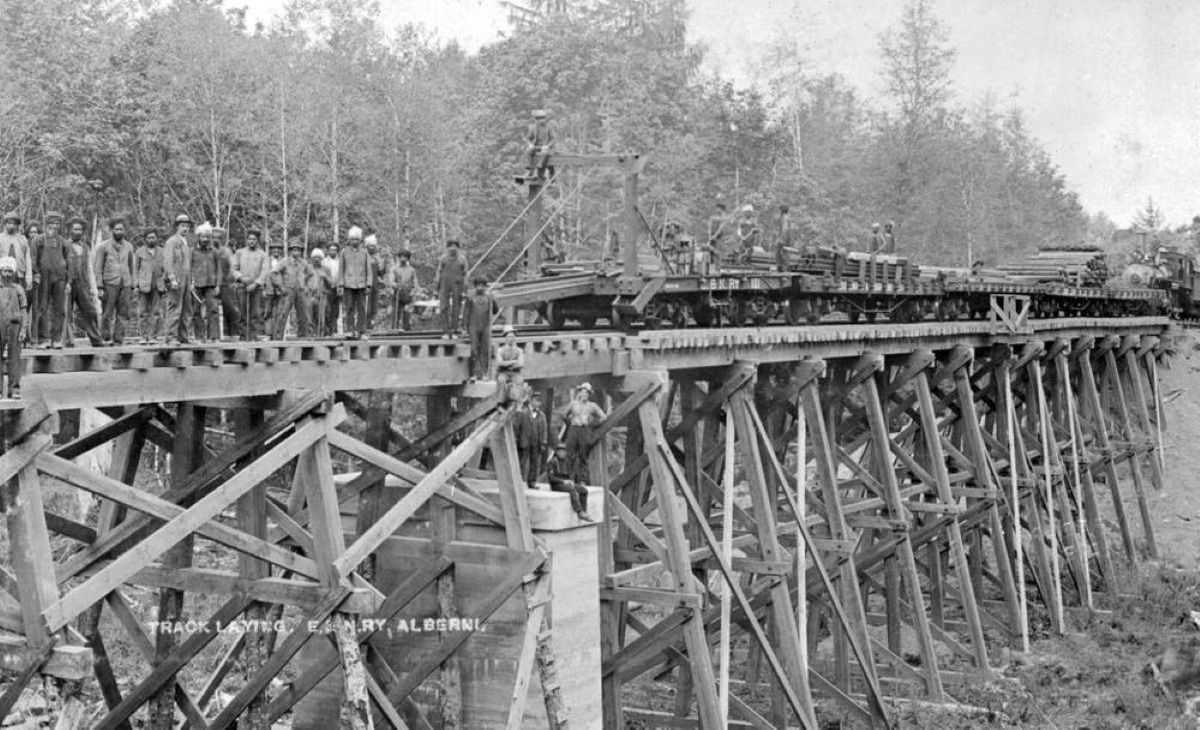
In the 1880s the B.C. and Canadian governments gave the Dunsmuir-owned Esquimalt and Nanaimo Railway Company 800,000 hectares on Vancouver Island as payment for building a 115-kilometre railway.
The land, given to the railway company without consent or consultation, was the territory of multiple First Nations, most of them Coast Salish and Nuu-Chah-Nulth, says Kelly Black, the president of the Vancouver Island Local History Society who led the development of The Great Vancouver Island Land Grab exhibit.
“What they saw was the rapid extraction of wealth in land from their territory with almost no benefits returning to them,” said Black. “The bigger question that the exhibit asks is, ‘Where do you, the person viewing this exhibit, where do you stand now that you’ve learned some things about it?’”
Black is an adjunct professor at Vancouver Island University who wrote his PhD dissertation on the legacy of the E&N land grant and his personal connection to it as a non-Indigenous person living on Vancouver Island.
There was a large team involved in producing the exhibit, he said, adding that the participation of the Hul'qumi'num Treaty Group and chief negotiator Robert Morales was key.
The land grant was about 25 per cent of Vancouver Island — a wide strip stretching from the current Capital Region to Campbell River that takes in Lake Cowichan and Port Alberni as well. Today that parcel largely remains private, much of it owned by forest companies, severely constraining the amount of land available for treaties or other public needs on the eastern side of the island. The railway last ran in 2011.
The amount of land granted for the E&N Railway was nearly 2,500 times bigger than the 324 hectares of the Tl’uqtinus summer fishing village on the south arm of the Fraser River in Richmond that a Supreme Court of British Columbia judge last year controversially found the descendants of the Cowichan Nation have Aboriginal title to.
It’s also more than 230 times the 3,442 hectares included in the K’ómoks First Nation treaty that passed through the B.C. legislature this spring amid controversy.
Robert Dunsmuir, the founder of the E&N Railway Company that received the granted land, made fortunes in coal mining, lumber and shipping and was B.C.’s wealthiest person when he died in 1889.
For Black, the E&N Railway land grant and its long-term consequences need to be a bigger part of the public conversation. “The exhibit asks people to take the information, to learn about what happened, and bring that forward and start talking about it with their friends and family and their neighbours, and their elected officials.”
The exhibit will be at the Nanaimo Harbourfront branch of the Vancouver Island Regional Library system until early August when it moves to the Cowichan branch. The Nanaimo Museum is handling bookings from other institutions, museums and community organizations interested in hosting the exhibit.
The interview has been edited for length and clarity.
The Tyee: Why did you want to create the display on the E&N land grant?
Kelly Black: As a historian of British Columbia I know that the land grant as an event is really not known by many people on Vancouver Island and in British Columbia. I grew up on Vancouver Island not ever knowing anything about the great land grab, or the E&N Railway land grab.
I grew up in Cobble Hill literally watching the train go by every day, but I had no clue that in order to build that rail line almost two million acres were given to the railway company, and so I wanted to raise awareness of this issue, as does the Vancouver Island Local History Society and the Nanaimo Museum, because we believe that the past impacts our present and when you look at land use matters and the First Nations rights and title on Vancouver Island, underlying a lot of those issues is the legacy of the E&N Railway land grant.
Why do you think people don’t know about it?
I think there’s a couple of reasons why most people have never heard of the great land grab. I think the first is this idea that private property in a place like British Columbia is a given. Encountering private lands in the form of private forestry lands probably does not seem out of the ordinary when you’re just riding your mountain bike along and suddenly there’s a gate.
I think as we’ve seen with the Cowichan decision, governments are showing they are very invested in maintaining this idea of the only way to do things is to have private property, and when we look at First Nations presence on the land we know that that is not the case. We know that there are other ways of being in the world and understanding land and ownership of land. And so I think that’s part of this reason that the land grant is not as well known.
Another reason is probably simply because if people don’t know about it then they can’t ask questions about it. For many First Nations that are impacted by this it wasn’t until the 21st century that they started really learning about how the way things were operating within their territories had to do with the land grab.
It’s been an understudied area of B.C. history, but also public policy. That is changing. There are people who work on this issue, who work on understanding the past, present and future of it, but that’s only happened more recently. It was just flying under the radar of most people until the last 20 years or so.
We’ve recently had all of these debates about the Cowichan decision and private property and politicians asserting private property has to be sacrosanct. When you have the E&N land grant in your mind and you're following the current debates around private property, what do you think?
We did not anticipate that the Tl’uqtinus Cowichan decision would come out right around when we were getting ready to launch the exhibit, and of course the exhibit was never planned to be one on the jurisprudence of Indigenous rights and title in Canada, however, we always knew that it was a relevant exhibit because the E&N land grant privatized First Nations territories at the stroke of a pen in the 1880s and nobody told them about it.
The phrase “the great land grab” first comes out in a publication from the Hul'qumi'num Treaty Group in the mid 2000s and in that pamphlet they explain that 85 per cent of their traditional territory was privatized by the E&N Railway land grant.
When you fast forward to the modern treaty process in British Columbia, private property is off the table. As the provincial government now is saying, nobody can touch private property.
This becomes problematic then when you look at the history of British Columbia, when you look at a lack of treaties being signed, a lack of consultation with the people whose land was taken for the land grant, when you look at the fact that British Columbia and Canada both essentially ignored their own stated approaches to the matter of settling First Nations rights and title.
So when we see the government in 2026 essentially doubling down on “private property is sacrosanct,” I’m curious to know if the government believes that when it comes to something like the E&N Railway land grant.
If you are a member nation of the Hul'qumi'num Treaty Group, most of your territory was made private, you cannot negotiate for it and the government says we’re not going to do anything about it. What choices are you left with other than to go to the courts?
That’s one thing that First Nations, Cowichan Tribes and others, have been saying that this situation is one that the government and successive governments that preceded them have created themselves, because they refused to engage with the problem that they created.
Suddenly the exhibit has become more relevant than maybe we ever thought it would, and if there are elected officials out there who’ve never heard of the great land grab we hope they’ll come see the exhibit and maybe ask does this “private property above all else” approach stand in the face of receiving information about the great Vancouver Island land grab.
I was interested in your observation that some of us continue to benefit from the E&N Railway land grant today. Who?
First and foremost, the people who are benefiting from the great land grab in 2026 are anyone who works for the provincial government of British Columbia, the federal government, or the Canadian military. The reason for that is because the pension plans of those government entities are invested in and own the forestry lands that were once part of the E&N Railway land grant.
Your average public sector worker in British Columbia and Canada has their retirement invested in the forest company that maintains the private property.
The other people who benefit from it are people who like to go out recreating. Now, there are significant issues people have regarding access to what is now Mosaic Forest Management lands, but was once the E&N Railway land grab. They put up steel gates so you cannot enter certain parts of the land, but they do have access to the land and people ride their mountain bikes, people go out and get firewood, people go mushroom picking.
So writ large, settlers in general since the 1880s have benefited from the great land grab. The difference today is instead of a railway company it’s a couple of forestry corporations owned by pension plans and literally people’s future is invested in maintaining private property and private forestry lands.
You said you hope the exhibit will generate questions for elected officials. What do you think needs to be put to them?
For me personally I hope that people will simply ask the question of their MLA and their MP, “Do you know about the great land grab? And if so, what does your government, or what do you as an MLA or MP, plan to do if anything about it?”
I think it’s time that politicians start having an answer to that question. What that answer is and whether or not we like the answer, that’s a different question, but for a long time it’s been possible to simply ignore it or not know about it and not have an answer.
Hopefully this exhibit prompts people to ask the question, but it also prompts the people that have the power to do something about it to start considering whether or not they should. ![[Tyee]](/design-article.thetyee.ca/ui/img/yellowblob.png)
Read more: Indigenous, Rights + Justice



Tyee Commenting Guidelines
Please note that email notifications for replies are not currently working due to a software issue which may be resolved in a future update.
Comments that violate guidelines risk being deleted, and violations may result in a temporary or permanent user ban. Maintain the spirit of good conversation to stay in the discussion and be patient with moderators. Comments are reviewed regularly but not in real time.
Do:
Do not: