


 SHARE:
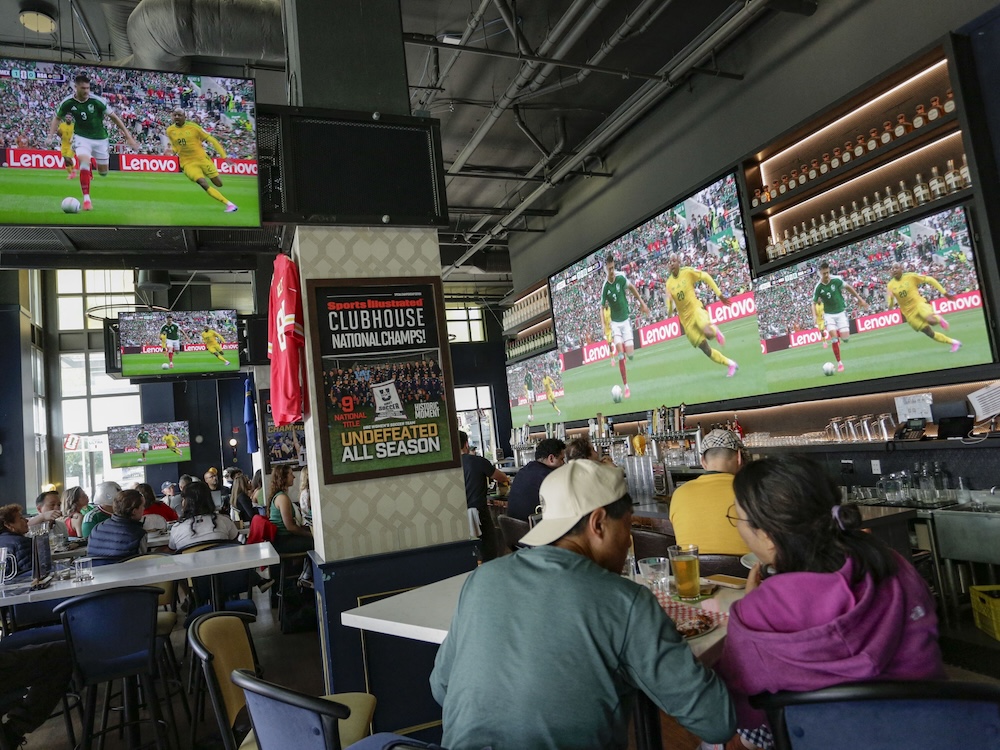
Kurt Johnson remembers leaving a bar in downtown Vancouver feeling like he’d just been robbed.
While he’s a fan of the Australia national football team, Johnson came to Canada in June to watch New Zealand play Egypt at BC Place as part of the FIFA World Cup. He said he could feel the world cup spirit as soon as he got off the plane and hopped on the SkyTrain.
“The entire atmosphere and vibes of everywhere we went really was awesome,” he said. “It was definitely what I expected from a World Cup city.”
Johnson speaks fondly of his time walking Granville street, heading to fan zones, and checking out the waterfront. But Johnson said every time he went to pay for a meal, he noticed a Canadian custom that was a little weird.
“In our culture, our staff are paid accordingly to begin with, so there's no requirement to tip,” he said. “It's a really awkward situation where you're standing there with a waiter or waitress you've got to press that button.”
He said at one bar, a card machine prompted him to leave a tip — even though gratuity was already included in the bill. Johnson didn’t realize until he’d already left.
“I double tipped,” he said. “I kind of laughed it off, but then I thought about it, and was like, ‘Hang on, they've just stolen from me’.”
And while the fiasco was a minor part of an otherwise great trip, Johnson said it underscored the Canadian tipping culture. He’s one of thousands of people who arrived in Vancouver for the FIFA World Cup — not all from countries where tipping is standard practice.
The influx of visitors has highlighted the differences between hospitality wages in Canada and places like Australia, where tipping is not obligatory and staff are paid a higher minimum wage. Johnson says for customers, the model takes the guesswork out of a night out.
Meanwhile, a labour researcher said the model means workers more reliably get fair pay.
“If there is a low minimum wage and workers are reliant on variable tips to earn a living this is not providing fair pay,” said Fiona Macdonald, policy director with the Centre for Future Work. “Human labour cannot be treated as a commodity that changes price at the whim of the market.”
But while the Australian model may provide more stability for servers, Milena Stanoeva with the industry association Restaurants Canada said it could mean higher menu prices.
"There's only so much that a restaurant owner on like three to five per cent profit margins can absorb without having to raise their own prices,” she said. “So it’s got positives and negatives.”
The FIFA World Cup has put a spotlight on hospitality staff’s pay. About a month before the first game, Vancouver hospitality workers protested their own working conditions and low pay as they braced for the games.
Stanoeva, senior director of public affairs and communications at Restaurants Canada, said that she’s seen people reflect on hospitality staff’s reliance on tips online.
“There's definitely different expectations coming in from other cultures, about how tipping should be handled,” she said.
In Switzerland, for example, tips are not obligatory, but guests may leave an approximately 10 per cent tip for excellent service. In New Zealand, it’s also not common to leave tips. Adjusting to Canada’s tipping practices can be tricky for visitors, said Vancouver city Coun. Lucy Maloney. Maloney previously lived in Australia, where she worked in hospitality.
“There are mixed messages because of Canada's proximity to the United States,” she said. “It can be pretty confusing and overwhelming for people that don't come from a tipping culture.”

In Australia, menu prices include tax and service charges. From back home in Sydney, Johnson said knowing the price of a meal up-front makes it easier to stick to a budget.
He said he’s heard the argument that tipping means better service, but he’s not convinced.
“I disagree with that,” he said. “I think you get just the same service, no matter if they're getting tips or not.”
Stanoeva said Canada’s tipping culture is influenced by a history of tipped workers making less than minimum wage in some provinces, she said. Quebec, for example, still has a minimum wage for tipped workers that’s lower.
Still, Stanoeva said Canadian tipping practices are changing. B.C. eliminated a lower minimum wage for liquor servers in 2021, and Ontario did the same in 2022.
She said the rising minimum wage has forced some restaurants to adjust their business plans to account for the increased cost in staff wages.
“It’s a big increase in labour costs over a short period of time, and especially a period of time that's been difficult for them to handle with the pandemic,” Stanoeva said. “But we have to adapt to the world of work.”
Stanoeva said tipping practices also make server jobs more competitive, giving some the ability to earn more than a restaurant wage.
“Canada also has this culture of gratitude where a lot of diners feel like they want to reward having a good experience and having a good connection with their server,” she said.
Despite rising wages in Canada, hospitality wages here are still significantly lower when compared to a jurisdiction where tipping is not customary. In Australia, the minimum wage rose Wednesday to AUD $26.44 per hour — or about CAD $26.04. Minimum wage in British Columbia is currently $18.25 per hour.
In Australia, hospitality workers also have their own minimum pay rates. For example, restaurant wait staff with some experience make AUD $27.08 per hour, with a $2.95 per hour bonus weekdays between 10 p.m. and midnight, and a $4.42 per hour bonus weekdays between midnight and 6 a.m.
The same level of server would also earn $33.85 hourly on Saturdays, $40.62 on Sundays, and $60.93 on public holidays.
Pay rates are determined nationally by the government in a national wage review, a process that includes both employers and unions. Baseline pay rates and industry-specific working conditions are published for each industry each year in a legal document called an “award.”
Macdonald with the Centre for Future Work said in an email these rates are considered ‘safety net” wages, and still allow individual or collective bargaining for better conditions. She said the review process has enabled unions to fight for better conditions in an industry with a lot of small employers, where collective bargaining is difficult.
“In a relatively low-paid industry, in which many workers are in insecure casual jobs and there has been considerable wage theft, it is unlikely that individual bargaining or small-employer enterprise bargaining would produce better outcomes for workers than the award does,” she said.
Macdonald said restaurants in Australia have long said it’s difficult to pay for workers, and that costs are passed onto customers. For example, some restaurants include a weekend surcharge.
Still, she said the Australian model means restaurant staff are paid fairly — and not at the whim of customers.
“The cost of employing staff is a cost of running a business,” she said. “If reliance on tips undermines workers’ rights to fair pay, then this is a problem.” ![[Tyee]](/design-article.thetyee.ca/ui/img/yellowblob.png)










Tyee Commenting Guidelines
Please note that email notifications for replies are not currently working due to a software issue which may be resolved in a future update.
Comments that violate guidelines risk being deleted, and violations may result in a temporary or permanent user ban. Maintain the spirit of good conversation to stay in the discussion and be patient with moderators. Comments are reviewed regularly but not in real time.
Do:
Do not: