


 SHARE:
Whether residents of Vancouver’s Downtown Eastside have been subjected to “street sweeps” because the city is hosting the FIFA World Cup depends on who you ask and how you define the term.
For Delilah G., a community researcher with the grassroots police watchdog organization Police Oversight with Evidence and Research, better known as POWER, a street sweep is when city workers and police “try to clear the public, the people that have no place to live, and trying to move them along any way they can.”
“It would be nice if they went about shit a different way, because this is the only neighbourhood they do that.”
Just minutes before meeting with Delilah G. and Jennifer McDermid, an academic researcher with POWER, The Tyee passed city workers and police in the 300 block of East Hastings Street handing garbage bags and bins to people sitting on the sidewalk, asking them to clean up their belongings.
POWER members, many of whom are residents of the Downtown Eastside, say that’s a street sweep.
They occurred more frequently during the World Cup games hosted in Vancouver between June 13 and July 7, McDermid told The Tyee. But they’ve been increasing in frequency as services for vulnerable community members have declined over the past two years, including the closure of PACE and reduction of WISH’s service hours.
“It’s the intentional and violent removal of people from a public space,” said McDermid. “It starts with removing people’s belongings, but it’s an attempt to move people out of public view.”
According to the City of Vancouver and the Vancouver Police Department, what POWER described is not a street sweep but regular, year-round municipal work to keep the streets, sidewalks and parks clean.
“This work is guided by a person-centred approach and includes engagement with individuals to comply with bylaws and pack down structures and belongings that obstruct access or create risks, such as fire hazards, impeded sidewalks, or blocked building egress,” said an emailed statement sent to The Tyee by a City of Vancouver spokesperson.
“Individuals are not required to leave an area, provided their belongings remain mobile and do not create safety or accessibility concerns.”
Last fall Coun. Mike Klassen asked city staff directly in a council meeting whether their FIFA World Cup bylaw enforcement included “sweeping vulnerable residents off the streets” within the two-kilometre Fan Zone around BC Place, where the matches are held. This zone includes the Downtown Eastside.
Karen Levitt, deputy city manager, responded the city would not sweep homeless or precariously housed people off the streets during the World Cup.
Levitt did say the city’s “teams” that work regularly in the neighbourhood, including to connect people with housing, would continue to work in the Downtown Eastside during the games.
“I, too, have heard concerns around increased street sweeps,” said Coun. Sean Orr, after Levitt finished speaking.
“But I guess we’re not calling it that.”
Sweeping people or keeping the sidewalks clean?
The Tyee contacted PIVOT Legal Society about police and city enforcement in the Downtown Eastside during the games.
Because much of the housing in the neighbourhood consist of one-room Single Room Occupancy suites and it has a lot of services for people experiencing homelessness, residents regularly congregate on the sidewalks. If they are experiencing homelessness, they often have all their belongings with them.
In an email to The Tyee, PIVOT Legal Society lawyer Laura Macintyre concurred with POWER’s definition of street sweeps.
PIVOT has deployed legal observers in the neighbourhood during the World Cup who have witnessed sweeps concentrated around the Hastings bus stop reserved for taking tourists to the FIFA fan zone, Macintyre told The Tyee.
“Their enforcement has been inconsistent,” she said. “Sometimes they have asked people to not sit on the streets or move along, sometimes they let them stay but ask them to condense their belongings.” she said.
People who leave their belongings unattended, even for a short period of time to go to the washroom, have lost them.
In the city’s emailed statement to The Tyee, a spokesperson said unattended belongings may be impounded for up to 30 days. People who lose their belongings this way can call 311 to get them back.
The spokesperson would not reveal where belongings are stored to protect owner privacy and the security of storage. But they said people who want their possessions back can arrange with city staff to meet, usually just outside the Cambie Street Vancouver Police Department headquarters, about three kilometres from the Downtown Eastside.
As well, the city has partnered with Aboriginal Front Door Society to provide temporary storage for people who have no place to secure their belongings, the city spokesperson added.
What PIVOT and POWER describe is the regular work of the city and police’s Integrated Response Team, the Vancouver Police Department told The Tyee, and is not related to the World Cup.
“City of Vancouver sanitation workers go up and down Hastings from Dunlevy to Cambie. The COV workers make contact with people and ask them to pack up belongings that are laid out for sale,” wrote Sgt. Adam Donaldson in an email to The Tyee.
“This initiative has been happening every day in its current form since 2022 and will continue after FIFA. It has no connection to FIFA. I worked in the DTES in 2012, and we did something similar back then as well. This team doesn’t just spend time on Hastings Street, it also goes elsewhere in the city.”
Games delivered, housing delayed
What’s indisputable is that four years after Vancouver was chosen as one of 16 World Cup host cities, the municipal, provincial and federal governments will have found up to a collective $740 million to cover the cost. At least $242 million of that money has been spent on security, which includes policing resources in the Fan Zone.
At the same time, the city recently renewed a year-long “pause” on approving new supportive housing construction earlier this year, with some exceptions. And despite passing a “zero means zero” budget that froze property taxes and was vague on where cuts would be made, last week city council asked staff to find nearly $5 million to keep Granville Street pedestrian-only all summer, as it has been for the World Cup.
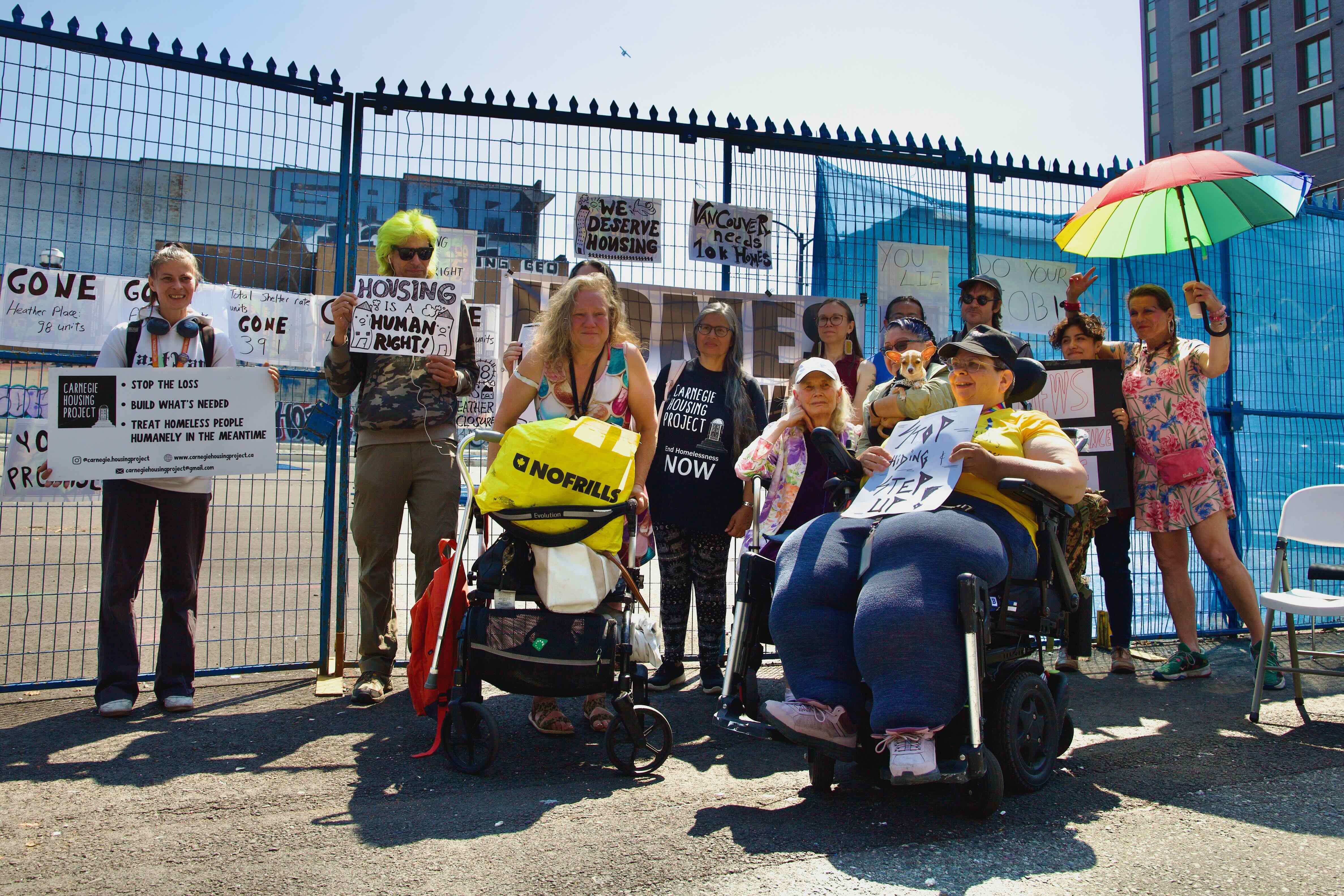
At a joint press conference at the empty lot at 301 E Hastings St. Monday, Downtown Eastside residents, the Carnegie Project, Vancouver Area Network of Drug Users (VANDU) and the BC Poverty Reduction Coalition called out the city, province and Vancouver Coastal Health for their failure to provide housing for an estimated 3,500-plus unhoused people.
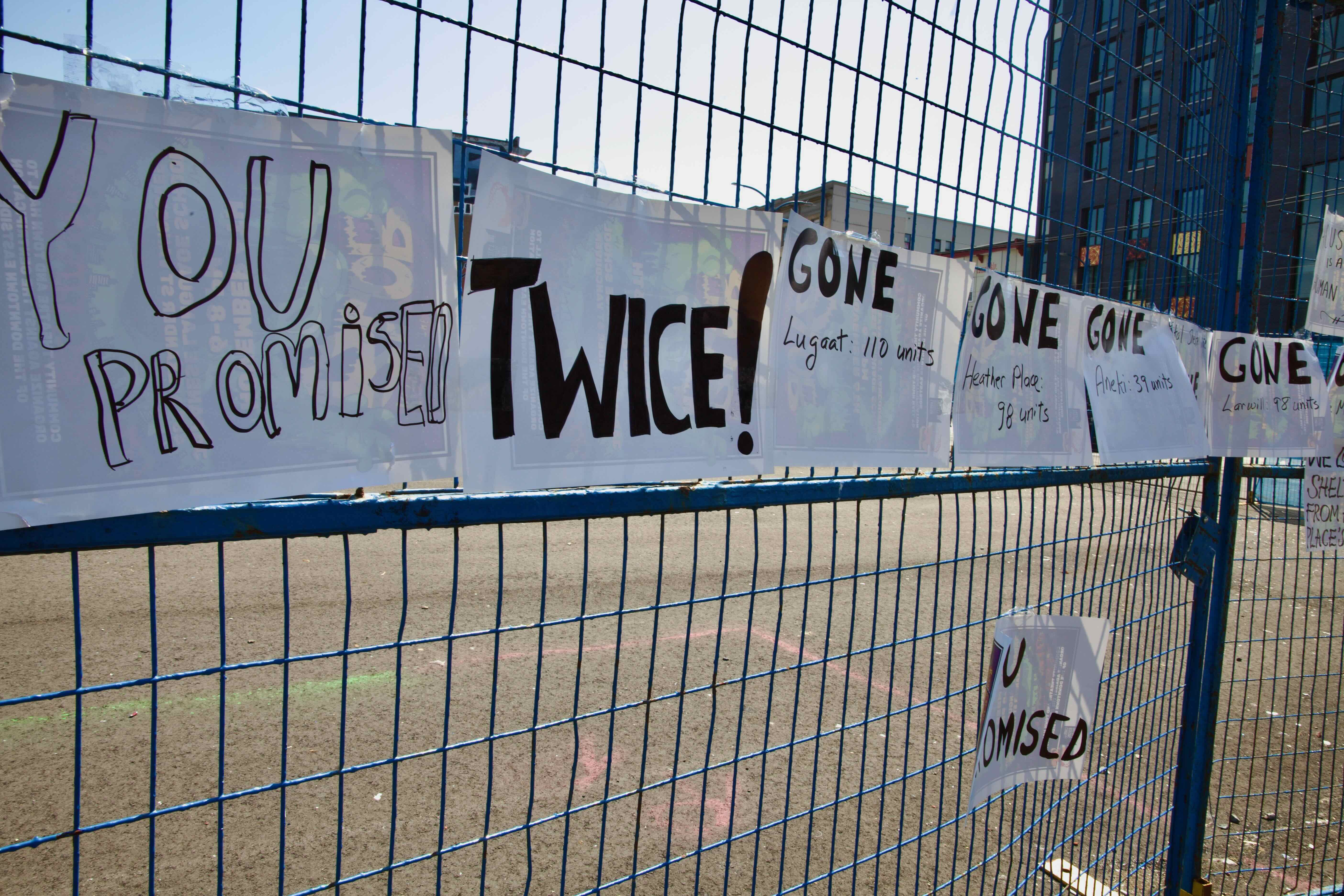
Eight years ago the city, province and health authority pledged to build a health centre and housing for 200 people experiencing homelessness on the lot.
At the press conference, the groups called for Vancouver to have 10,000 additional units of social housing at the shelter rate of $500 per month, starting with fulfilling the promised housing for 200 people facing homelessness at that location.
“The empty lot we stand in front of this morning, coupled with rising numbers of people experiencing homelessness, is indicative of the campaign of negligence all levels of government have enacted towards housing investment and the people who need housing,” said Chantelle Spicer with the BC Poverty Reduction Coalition.
Spicer cited the 2026 provincial budget, which saw the cancellation of the Community Housing Fund for new social housing projects, while increasing spending on policing and involuntary mental health and addictions treatment.
In an emailed statement sent to The Tyee, a spokesperson for the Ministry of Housing said they are still moving forward with housing and health centre plans at the 301 E. Hastings site.
“BC Housing is continuing to work with project partners to advance planning and design work for 301 E. Hastings St. and ensure that much-needed housing and health care is provided at this site in a way that works for Downtown Eastside residents,” the statement reads.
They did not provide a timeline. But the spokesperson noted between 2023 and last month, the province has delivered 1,443 new or renovated housing units in the Downtown Eastside. Another 375 units are expected to be finished later this year.
In their press release, the coalition of organizations advocating for more shelter rate housing noted Vancouver has lost 391 units of supportive housing in recent years, while they estimate the number of people experiencing homelessness has climbed to more than 3,500.
The city’s last point in time count in 2025 found 2,715 people experiencing homelessness. The city acknowledged this was likely an undercount.
The struggle for affordable and adequate housing was especially difficult for the coalition to understand when the province and city are boasting about the success and economic boost the international soccer tournament brought to Vancouver. The provincial government previously predicted $1 billion in additional GDP gain from hosting the games.
If the development at 301 E Hastings St. had been delivered, “it could have saved a lot of lives,” said Ryan Donnelly, one of the few remaining tenants of the Lugaat supportive housing building on Granville Street.
“Could have done a lot of good for a lot of people. Could have potentially changed the core of the Downtown Eastside.”
Having safe and adequate housing in the neighbourhood for residents would have prevented the need for street sweeps, too, POWER’s Delilah G. told The Tyee.
“They wouldn’t be on the streets, they wouldn’t be harassed as much,” she said. “Just the ability to be safe and secure.” ![[Tyee]](/design-article.thetyee.ca/ui/img/yellowblob.png)
Read more: Municipal Politics








Tyee Commenting Guidelines
Please note that email notifications for replies are not currently working due to a software issue which may be resolved in a future update.
Comments that violate guidelines risk being deleted, and violations may result in a temporary or permanent user ban. Maintain the spirit of good conversation to stay in the discussion and be patient with moderators. Comments are reviewed regularly but not in real time.
Do:
Do not: