


 SHARE:
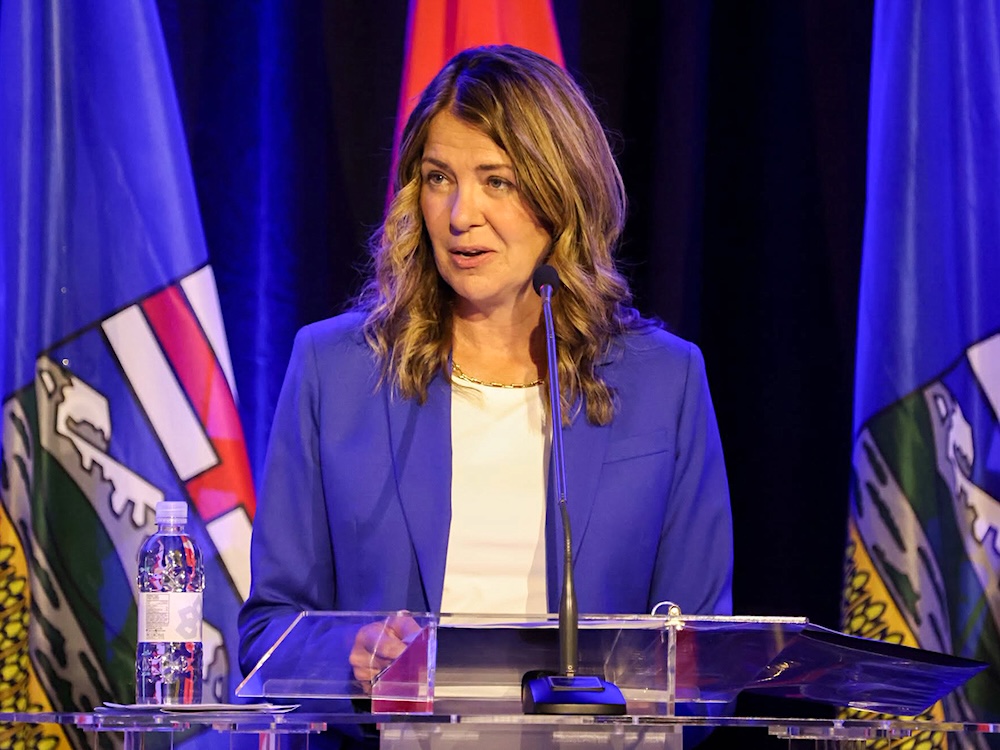
In February, prompted by a budget $9.4 billion in the red, Alberta Premier Danielle Smith launched a referendum asking Albertans whether they want the province to charge additional health-care and education fees to non-permanent residents — an immigrant group comprising refugees, international students, foreign workers and their families. Some have characterized Smith’s move as akin to the xenophobic “head tax” Canada charged Chinese immigrants in the late 1800s.
Although Alberta’s luck has shifted significantly since the beginning of the year, and the provincial budget now boasts a $2-billion surplus, the premier’s narrative has not changed.
On the last day of August, Smith took to her socials. “For every $1 of taxes a guest worker generates, taxpayers are covering $10 in services,” she wrote, a ratio she went on to characterize as “unsustainable.”
But the premier left important details out of her post: Who are the “guest workers” she’s referring to? What taxpayer-funded services is she talking about? How was the tax revenue generated by said “guest workers” calculated? And, more importantly, how does the resulting tax-to-services ratio compare relative to that of citizens and permanent residents?
To uncover the source and methodology behind Smith’s figures, The Tyee reached out to her office.
In an email statement, a spokesperson from the premier’s office said that the numbers presented on the referendum’s official website back up Smith’s claim.
“Per Albertareferendum2026.ca, we estimate that temporary residents living in Alberta cost the province over $1 billion annually in health, education and other social services. This number does not include capital costs for both school and health infrastructure. For example, the province is spending $8.6 billion to build and renovate more than 100 schools across the province. Therefore, when accounting for increased capital costs such as spaces for approximately 45,544 children of temporary residents, it is accurate to suggest that for every $1 of taxes a guest worker generates, taxpayers are covering $10 in costs.”
The problem? An essential variable in Smith’s equation — the contribution of non-permanent residents to provincial coffers — went unaddressed by the premier’s office.
Because provincial records don’t release data about personal income tax revenue amounts grouped by immigration status, this information isn’t easy to corroborate independently.
Smith has previously said that temporary workers produced $150 million in tax revenue in 2025.
When asked to elaborate on the sources and methodology used to calculate the numbers posted on the referendum website, which peg more than $1 billion in costs on provincial programs to non-permanent residents, Smith’s spokesperson referenced data obtained from Statistics Canada, school authorities and the Canadian Institute for Health Information, or CIHI.
“The estimated total cost of educating students with a temporary resident code over the past three years is calculated using the average cost of $12,000 per student and enrolment data for all students with a Code 5 by school authority. In 2025, there were 47,389 temporary resident students enrolled,” the spokesperson wrote.
“For health care, government reviewed direct costs they track and found that 1.27 per cent of costs was for temporary workers and international students. Based on CIHI estimate of $31.8 billion health costs in 2024, that is just over $400 million.”
These numbers, however, don’t back up Smith’s claim.
THE CLAIM: Non-permanent residents are a burden on the health-care system.
FACT CHECK: Because 270,943 non-permanent residents represented 5.5 per cent of Alberta’s population in 2024, the fact that their health-care expenditures amounted to just 1.27 per cent — a number provided by the premier’s office — of that year’s total suggests that refugees, international students, foreign workers and their families “are using health care proportionally less than the rest of Albertans,” Ben Atkinson, an independent economist and research consultant based in Calgary, told The Tyee.
THE CLAIM: For every $1 of taxes a guest worker generates, taxpayers are covering $10 in services.
FACT CHECK: According to Atkinson, if non-permanent residents in Alberta did in fact generate $150 million in taxes and cost taxpayers $1 billion in provincial services in 2025, “that means that $1 in tax revenue is correlated with $6.67 in spending on health care and education — not $10.”
The $8.6 billion budgeted to build the new schools that the premier’s spokesperson mentioned in their email can’t be used to estimate this ratio, as it’s an expense yet to be incurred. Additionally, the number of non-permanent residents in Alberta has steadily declined since its 2025 peak.
Between Jan. 1, 2025, and April 2026, the number of non-permanent residents in Alberta dropped by close to 36,000 people — from 296,949 to 261,031 — according to Statistics Canada’s estimate.
Atkinson also told The Tyee that the $6.67 gap between the income taxes non-permanent residents paid and the services received is a function not of their immigration status, but of their income.
“If Danielle Smith's tax revenue figure of $150 million is true, it is because workers are being paid so little that most of their incomes are not taxable,” he said.
If the income tax revenue referenced by the premier is correct, that means foreign workers earned an average of $31,310, as the basic personal amount in 2025 was $22,323, and an eight per cent rate was applied on the first $60,000.
“If we were to take the same numbers for Canadian citizens that work the same jobs as temporary residents, we would find that they also pay far less into the system than they get in return,” Atkinson said.
In the 2024-25 period, Alberta taxpayers contributed some $16 billion in income taxes to the provincial coffers. With health-care and education expenses surpassing $35 billion, it is fair to assert that for every dollar Albertans paid, they received just over $2 in health-care and education services.
In the same period, the gap between income tax revenue and health and education expenditures was bridged by over $66 billion in revenue from a myriad of sources, including $17.12 billion in bitumen royalties, roughly $3 billion in education property taxes and about $12.6 billion in federal transfers. Notably, the amount Alberta receives in transfers from the feds is based on the province’s total population, regardless of the immigration status of residents.
Above all, the contribution non-permanent residents make to Alberta goes well beyond the income taxes they generate.
Foreign workers and students pay rent, and therefore education and property taxes; they also buy cars, clothes and groceries and patronize local businesses for the services everyone in Alberta requires.
Non-permanent residents also fill labour gaps that enable employers to flourish, as reported by The Tyee earlier this year, while the tuition fees international students pay help keep Alberta colleges and universities afloat in the face of the provincial government’s cuts to post-secondary education.
A recent study commissioned by Global Affairs Canada, the federal agency in charge of consular and diplomatic relations, estimated that international students contributed more than $3 billion to Alberta’s economy in 2024.
“When they focus on income tax revenue,” Atkinson said, “governments ignore everything else that immigrants contribute to society and the economy, which makes us better off.”
What’s at stake?
The premier’s misleading narrative is not only causing grief to racialized communities across Alberta, regardless of their immigration status, but also undermining trust in government at a pivotal time.
“It really feels like folks are at a crossroads here,” said Avnish Nanda, an Edmonton human rights lawyer and spokesperson for Our Alberta Advantage, a non-partisan initiative launched earlier this year to push back against the Alberta government’s discriminatory narrative.
“People who have been here for multiple generations, or who have been here for decades, feel like something has really changed, that racism is coming from the very top of the government.”
A recent poll suggests that while only one in four Albertans supports the province’s secession from Canada, 60 per cent intend to vote in favour of charging non-permanent residents a fee to access education and health-care services come the Oct. 19 referendum.
“This referendum is what the United Conservative Party needs to remain in power,” Nanda said. “So even if separation doesn’t go through, her base will have something to feel like Danielle Smith delivered.”
Smith’s UCP government is failing to equip Albertans with the information they need to cast an educated vote come Oct. 19, said political scientist Lori Williams.
“The government’s referendum website is clearly promoting particular answers that they want on the referendum ballots, and they’re providing information to push people to a particular conclusion,” Williams said. “The problem is that it could erode trust.”
And trust is essential for governments to function.
“If the government is seen not to be listening to the people, trying to manipulate them or being deceptive in the information they provide,” she said, “that makes things worse not just for the government, but for the entire democracy.” ![[Tyee]](/design-article.thetyee.ca/ui/img/yellowblob.png)
Read more: Alberta









Tyee Commenting Guidelines
Please note that email notifications for replies are not currently working due to a software issue which may be resolved in a future update.
Comments that violate guidelines risk being deleted, and violations may result in a temporary or permanent user ban. Maintain the spirit of good conversation to stay in the discussion and be patient with moderators. Comments are reviewed regularly but not in real time.
Do:
Do not: