


 SHARE:
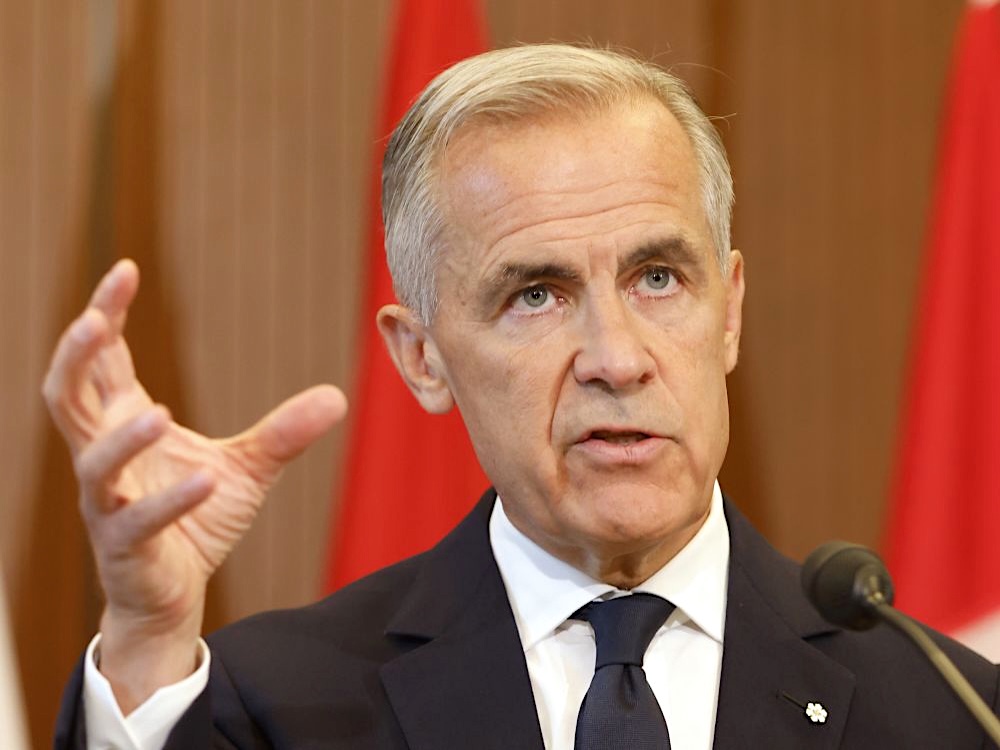
While it is a good thing that Prime Minister Mark Carney ultimately refused to sign an agreement with the United States, it is important not to mythologize that decision.
According to knowledgeable sources, if Donald Trump’s team had not added a couple of last-minute, absurd demands — including on bilingualism — Carney was on the verge of inking a bad deal for Canadians.
It is a position the prime minister should never have been in to begin with.
Carney was warned
As negotiations with the Trump administration dragged on and more details leaked out, a chorus of voices on “Team Canada” warned, in increasingly blunt language, not to give in to American demands.
These voices included premiers Wab Kinew of Manitoba and Susan Holt of New Brunswick, Mayor Matthew Shoemaker of the steel-industry dominated city Sault Ste. Marie, all federal opposition leaders and former Liberal trade minister Chrystia Freeland, as well as former Conservative leader Erin O'Toole.
Even former prime minister Justin Trudeau was quoted as saying his government drew strength from Canadians’ resolve to stand up to U.S. aggression and expected that the current government would be similarly guided, which sounded a lot like a hint for Carney.
So, yes, Carney deserves credit for ultimately refusing to sign. But consider what we almost gave away.
Carney and his negotiating team reportedly were very close to granting concessions on control over our critical minerals and oil and gas resources, digital policy, dairy supply management, dropping of retaliatory tariffs and returning U.S. alcohol to provincial liquor store shelves. There was also a widely speculated commitment to join Trump’s “Golden Dome” missile defence scheme and complete the U.S. F-35s purchase.
Together, these concessions amount to a capitulation on the protection of Canada's sovereignty.
Who has Carney’s ear?
After more than a year and a half of living with Trump’s America — its threats and unpredictability, its cruelty and ignorance — Carney should have known the folly of trying to appease an unpredictable bully. He should have at least been aware of his own citizens’ intolerance for further concessions.
This raises the question about who Carney is listening to most closely as he conducts negotiations: average Canadians or a tight circle of CEOs?
For more than a year, much of the business community — as represented by groups such as the Business Council of Canada, the Canadian Federation of Independent Business and the Canadian Manufacturers & Exporters — has been urging concessions in the hoped-for return to normal and “certainty.”
As national security expert Stephanie Carvin notes, however, “Canadian businesses must stop wishcasting for a world that no longer exists.” Instead, accept that “privileged access to the American market can no longer be the organizing principle of Canadian economic policy.”
Labour leader Lana Payne, whose Unifor members are on the frontlines of U.S. trade tactics, has also sought to inject some reality into the debate, warning against a trade deal at any cost, stating “there is such a thing as bad certainty.”
Meanwhile, Canadians’ repeated responses to public opinion polls have shown a steadfast unwillingness to concede to the bully, consequences be damned. And a new Angus Reid survey shows three out of four strongly support Carney’s decision to walk away.
Of course, real hardships will be faced by workers and businesses affected by Trump’s trade war. Still, Canadians and their political leaders must guard against projections of economic doom. While a recent Canadian American Business Council report estimated Canada could lose 102,000 jobs if the Canada-United States-Mexico Agreement ended, according to Statistics Canada, even with the existing economic uncertainty, Canada created nearly double that number of jobs (196,000) over the last year alone.
Even U.S. trade negotiator Jamieson Greer has said there will always be trade between the United States and Canada.
Where to draw the line
As was made evident again last week via new U.S. demands, our country is facing not an economic crisis but a political one. The government’s priority, then, should be not chasing a new trade deal with an unstable United States, but the preservation of a sovereign and distinct Canada.
Carney and his government should do the following:
- Shelve all talk of “deeper integration,” “fortress North America” or a “comprehensive economic and security relationship” with the United States, all terms Carney has used in the past.
- Move to aggressively detach Canada from reliance on U.S. tech firms, following the example of European countries, while maintaining the Online Streaming and Online News acts and revisiting the digital services tax.
- Start speaking out in defence of international law and its institutions, beginning with the U.S. attack on the International Criminal Court and its Canadian judge Kimberly Prost.
- Reject business demands to lower taxes in response to new U.S. tariffs, an inequitable, inefficient tool that would undermine state capacity to support directly affected workers and businesses while effectively maintaining public services and infrastructure.
- Listen to counsel from voices beyond the business community, and more regularly inform and engage Canadians on relations with the United States and the future of our country, including by, as many political scientists have advised, through the creation of a royal commission.
In addition to better informing and engaging with Canadians, the Liberal government should be thanking them more too. Notable in Carney's speech on Saturday was the extensive recapping of what he sees as his government’s accomplishments, with a particular number of references to himself — “I observed,” “I believe,” “I warned” — and only a brief reference to Canadians visiting national parks and buying Canadian.
In reality, it is the public leading the government in standing up to Trump. Canadians are doing this through individual travel decisions, product boycotts, displays of patriotism and signing grassroots petitions — such as one calling for U.S. Ambassador Pete Hoekstra to be expelled that has been signed by more than a quarter of a million people.
In many ways we are back where we were in January 2025. Our country is under attack by an increasingly fascist United States led by an unstable Donald Trump and the near-dystopian class of billionaires supporting him.
Yet Canadians have also reaffirmed our unity, strength, clarity of purpose and willingness to defend our sovereignty, democracy and distinct civic traditions.
Carney can unreservedly advance the fight, because Canadians have his back. ![[Tyee]](/design-article.thetyee.ca/ui/img/yellowblob.png)
Read more: Politics








Tyee Commenting Guidelines
Please note that email notifications for replies are not currently working due to a software issue which may be resolved in a future update.
Comments that violate guidelines risk being deleted, and violations may result in a temporary or permanent user ban. Maintain the spirit of good conversation to stay in the discussion and be patient with moderators. Comments are reviewed regularly but not in real time.
Do:
Do not: