


 SHARE:
When Zoya Reebye realized there was no space in her all-girls school to talk about issues impacting Black girls, Indigenous girls and girls of colour, the then-14-year-old founded a student club called Let’s Talk Women of Colour.
“I wanted a space to actually discuss how difficult it can be sometimes to be a woman of colour in a predominantly white or male space and use community discussion as a way to empower one another,” she said.
Reebye is now 17 and graduated high school in June, leaving the club to younger students to run.
But, with the help of a team of about 10 dedicated volunteers, Reebye has grown Let’s Talk Women of Colour into a non-profit organization that runs monthly “coffee chats” for teenage girls, including trans, Two-Spirit and non-binary teens, in Vancouver.
Gathering one to two times a month at a local coffee shop, the informal events begin with a presentation led by one of Let’s Talk’s members about the history, politics, philosophy, media literacy or sociology behind a topic in the news or on social media. The topics are up to the presenter, but they must intersect in some way with race and gender.
A recent discussion about the model minority myth and its origins in anti-Black racism, was sparked by the 2023 killing of 14-year-old Cyrus Carmack-Belton in the United States. The man who shot Carmack-Belton was charged with murder and acquitted by a South Carolina jury in June.
Another conversation about the hypersexualization of Black men and its impact on Black women started with an icebreaker activity where participants analyzed the differences between comments on Instagram videos of Black men in streetwear and white men in streetwear.
After each presentation, the group of a dozen or so young people engage in a facilitated discussion about their own related experiences.
“Our goal is to use community dialogue to equip more youth with the language and confidence to challenge injustice, and feel certain about themselves,” said Reebye.
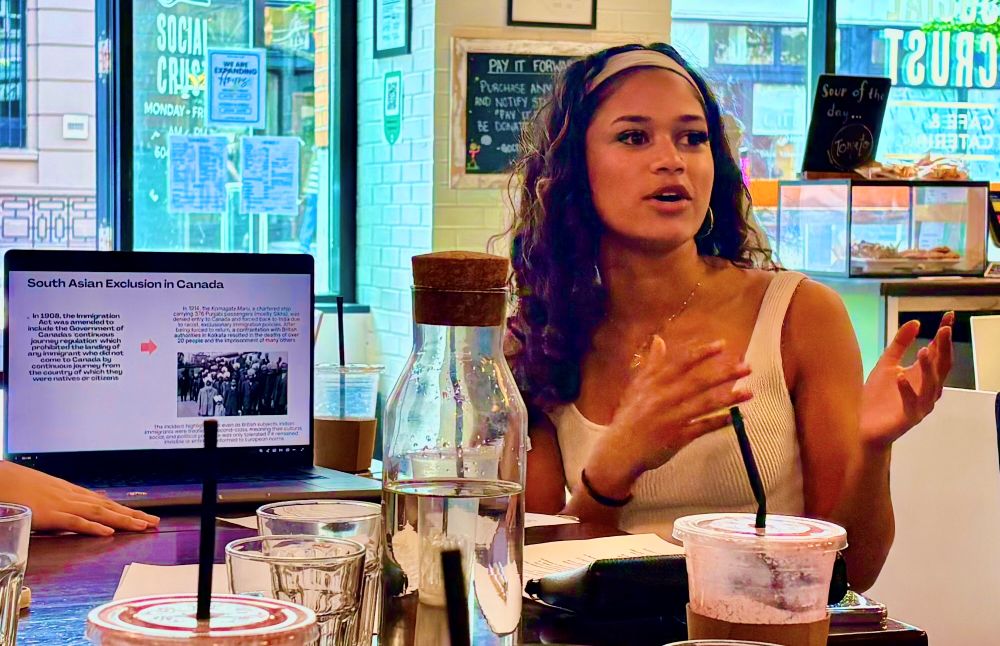
The discussions can get into university-level analysis. For example, the racism of necropolitics, a socio-political theory first described by Cameroonian historian and academic Achille Mbembe, was a recent topic.
But you don’t have to be an advanced scholar, or even interested in politics, to get something out of the conversations. “You can just be someone who is quite curious, who just wants to speak up about issues and help people feel seen,” Reebye said.
“We’ve had people who come in who just want to find a friend group or more people to be around. And they’ve left wanting to start their own coffee chats. That’s our goal.”
‘Real discussions that lead to real change’
You also don’t have to be a person of colour, Black or Indigenous, either, to participate, she added. Though being open to uncomfortable conversations and listening to others’ experiences without interrupting is a necessity.
Let’s Talk Women of Colour is not about having debates, Reebye told the Tyee. Instead, the non-profit focuses on fostering respectful conversations where young women and teenage girls know their voice matters.
“Society is very polarized, and our goal is to provide a safe space where all perspectives are valued and real discussions lead to real change,” said Amira Sharma, another Let’s Talk Women of Colour member.
Participants can suggest topics, and Let’s Talk is working on developing a framework to help attendees develop and lead their own presentations and discussions. The founders also hope to empower them to start their own chapters of Let’s Talk Women of Colour in their communities and schools, as has already happened in Calgary.
Before joining Let’s Talk, Sharma didn’t feel like she had the words to express her thoughts on issues involving gender and race. Now, almost a year after joining, she’s leading coffee chats.
When Reebye moves away for university this fall, with plans to start another Let’s Talk Women of Colour chapter in Toronto, Sharma will take over as co-team leader with another member of the Vancouver chapter.
“Since joining, my mental health has shifted and I’ve gained much more confidence,” Sharma said, adding talking to people her own age about these issues is key. “I feel more comfortable sharing my experiences because I know I will leave the discussion feeling heard and empowered.”
Let’s Talk Women of Colour has also held three intergenerational panel discussions to open these conversations to a wider audience, including boys and men.
The non-profit has partnered with other organizations like the Hogan’s Alley Society and the UBC Black Students’ Union on these panels, with topics like Empowering Arab and Muslim Women, and the Hypersexualization of Women of Colour.
Let’s Talk Women of Colour’s events are free to attend, and the Vancouver cafes they have partnered with, including Feast and Fallow and Oakberry in Kerrisdale, often offer participants discounts. Event listings and some past presentations are available on their Instagram account. ![[Tyee]](/design-article.thetyee.ca/ui/img/yellowblob.png)
Read more: Education, Gender + Sexuality











Tyee Commenting Guidelines
Please note that email notifications for replies are not currently working due to a software issue which may be resolved in a future update.
Comments that violate guidelines risk being deleted, and violations may result in a temporary or permanent user ban. Maintain the spirit of good conversation to stay in the discussion and be patient with moderators. Comments are reviewed regularly but not in real time.
Do:
Do not: