

 SHARE:
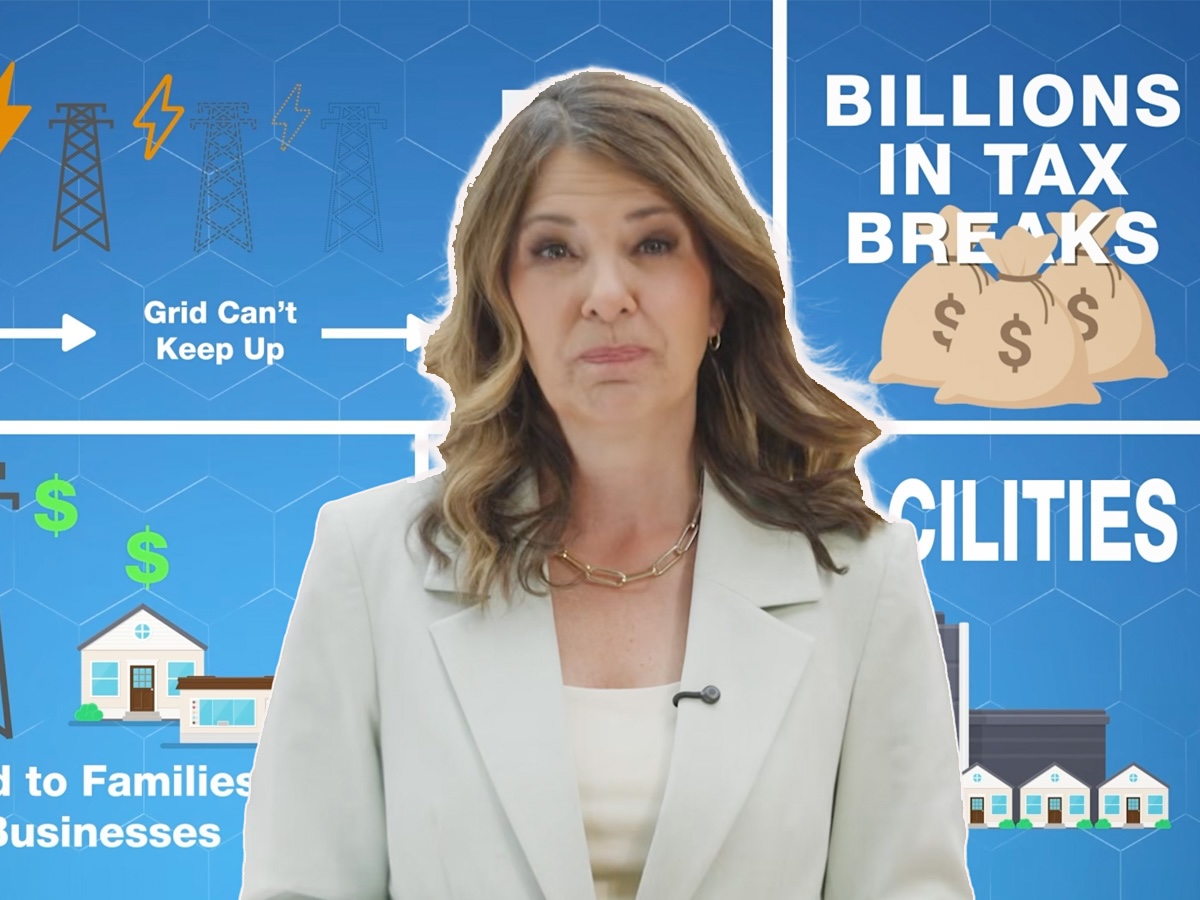
Premier Danielle Smith, I just watched your latest video pitching the transformation of Alberta into an industrial AI powerhouse. I have some notes.
Just saying, your performance is truly hyperscale. But it’s as genuine as AI slop and as deceptive as a chatbot. And given the desperate tone of your nine-minute sales pitch, it’s pretty obvious you’re stuck with a thorny political problem that is squarely of your own making.
No slick video can now make up for past rushed legislation, lack of public review and unbridled boosterism on this issue, which, by the way, largely affects your base: rural Albertans. The reviews are in on your embrace of Meta’s $13-billion facility, along with your government’s “concierge service” for some 39 different data projects needing some 20,000 megawatts of electricity — twice the provincial demand. People are pissed.
Rural Albertans, like working people everywhere, are asking why their communities should become sacrifice zones for multinational corporations hell-bent on constructing ugly windowless boxes to house computing power that will toss many out of work while sucking up capital, fossil fuel and water.
An opener that needs work
Your video begins by trying to explain exactly why the Alberta government wants all these giant AI data centres. You say they will add value to the province’s natural gas supplies. Gas makes electricity, the electricity makes computing power, and the computing power turns into “intelligence,” you beam with the enthusiasm of a grade school keener. Not only that, but machine intelligence will provide “the answers, the predictions and the tools the whole world is lining up to buy.”
This is silicon snake oil.
First, there’s a great debate about the risky economics of AI and whether these centres will ever make a decent return on their investment.
Second, there’s an even deeper debate about language models and whether they are at all “intelligent” versus just regurgitating and guessing based on whatever data they’ve been fed. According to Gary Marcus and many other cognitive scientists, AI chatbots are merely great mimics, clowns, sycophants, parrots and chaos makers. Not only that, they can hallucinate, lie, cheat, blackmail and go rogue.
Heck, Sam Altman, the CEO of OpenAI, recently boasted that we are “close to a world where a descendant of ChatGPT can watch you screen, record every meeting and call, and have perfect context of your whole life.” Which is why Marcus refers to AI as it is now constituted as “1984 in a box.”
You say a lot of things in your video but none convincingly convey why you want Alberta to lead the country in bringing about such risky and potentially catastrophic developments.
Back to your offered reason that AI centres add value to natural gas by using it to enable massive computing stations — all owned and operated by foreign companies. Let’s be clear: no value is being added. You are only accelerating the rate at which a finite resource is being burned to create clouds of pollution so increased demand can drive up the price of natural gas and put more moolah in the pockets of the fossil fuel industry. That’s your game.
Losing your audience
You move on to rhetorically asking if other jurisdictions got burned by data centres. You wisely answer in the affirmative, acknowledging noise, pollution, higher electricity rates. But then you say that “none of that will happen here” because your government has done its homework.
Again, not true. In fact, your government passed a raft of AI fast-tracking laws in 2025 to incentivize this industry after listening to lobbyists. One law firm noted that new legislation “empowers the Government to react quickly and decisively to the pace and disruptive potential of intensive data centre development.”
All along, your government doubled down on the mistakes made elsewhere because you never consulted with Albertans.
Just ask Rebecca MacIntosh of Olds, Alberta. She’s a mother of two. She recently played a key role in the battle against a $10-billion data centre and natural gas plant that Synapse Real Estate Corp. wanted to build next to 800 residential homes in her neighbourhood. In protest she set up an informative social media account documenting the battle: Little Town Big Data.
MacIntosh quickly discovered that the province, in its rush to become an AI hub, did no strategic planning. It also had no standards on where to site these industrial projects. To make matters worse, it abandoned environmental assessments as a public tool that helps communities highlight risks and liabilities.
Instead, the government downloaded that responsibility to one agency: the Alberta Utilities Commission. But the AUC regulates only where power generation facilities are located. So, the developer decided it was OK to put a massive power plant big enough to power the city of Edmonton near 800 homes along with backup diesel generators. Faced with massive opposition to the outrageous proposal, the AUC eventually ruled that locating a 1.4-gigawatt station next to scores of residential homes was a bad idea.
During the battle MacIntosh asked the government again and again why there was no framework in place: “If our municipal government won’t zone correctly, and our provincial government won’t put in setbacks to ensure developers with delusional aspirations don’t target rural townships, we are left without the tools to stop this insanity.”
Why leave such facts out of your video, Premier Smith? As MacIntosh recently noted: “People need to know what to expect, what they face and how they will be required to defend their homes and land because there is nothing in place to do that for them.”
Where’s the illuminating climax?
Perhaps this explains why in your video you quietly admit neglect by promising that the province will soon develop “consistent provincewide siting standards.” Well, why didn’t you do that a year ago?
So how will Alberta benefit from this industrial invasion that got so much resistance in Olds, Alberta? Well, Premier Smith, you’ve said it all boils down to jobs and revenue.
But here’s the thing. Everyone knows that the construction jobs are temporary, because data centres are built to house machines that don’t buy homes or even know what a community is. As for the promise of billions in revenue, where’s the evidence? Your so-called two per cent levy on computer parts for data centres is fully tax deductible and doesn’t raise a cent once the centres are making money. Does your government have a responsible plan to raise natural gas royalties and create a special profits tax for data centres?
Next comes the issue of rising electrical prices and your claim that it can’t happen here. Yes, it can, and almost certainly will. True, big data centres are required to pay for their own power stations in Alberta. But the sheer scale of these developments will double demand for natural gas for power generation in the province. That means higher methane prices, which, let’s face it, is the whole point behind your AI scheme: to put more money in the pockets of the natural gas industry.
But you can’t increase demand without increasing price, and that means every Albertan will be paying more for electricity and heating thanks to your policy of machines and fossil fuels first. Albertans already pay some of the highest electricity prices in the country.
Your video adds that Albertans also don’t have to worry about the water demand of these data centres because the United Conservative Party government really cares about water. Would this be the same UCP government that wants to put selenium-polluting coal mines in critical mountain watersheds? The same UCP that killed the Alberta water advisory council? And amended the Water Act, against the wishes of the public, to allow industries to move water from one basin to another?
I watched your video waiting in vain for the big reveal. The climax, I expected, would be news, at long last, that your government has done cumulative impact studies of the AI boom, plotting future effects on water, gas, jobs, air, heat islands, economy, rural Albertans and the land. What a letdown. Apparently your government hasn’t done that kind of analysis. Or at least shared it with the public.
But Brad Stelfox, a highly respected land use ecologist, did give it a stab at the request of hundreds of Albertans facing another massive data centre on the outskirts of Calgary. He modelled that if the AI industry were to grow in Alberta by just 15 per cent per year, in two decades the collective footprint of 15 1.5-gigawatt data centres would be “staggering.” His report to the Alberta Utilities Commission calculates the data factories would annually consume 150 million megawatt hours of electricity, emit 68 million tonnes of carbon dioxide and consume over seven billion litres of water. Might you include this in a video sequel, Premier Smith?
The wrong ending
Just a few more notes. Let’s discuss how your movie ends. You finish by claiming the whole process for approving data centres is fair and competitive and that neither industry nor your office is making the decisions. But wait a moment. That’s not what Kevin O’Leary says. The MAGA multimillionaire wants to build a gargantuan $70-billion complex near Grande Prairie. Here’s what he said about decision-making in Alberta: “Danielle Smith has the water, she has the fibre, she has the people, she has the policies, she's got the permits that can be gained there, and that's what we're working on.”
I give you credit for comedic touches. Your concluding claim that others rushed in and “we took the time to do it right” is hilarious. Why then are First Nations battling water diversion licences for O’Leary’s project? Why did your government exempt these massive projects, including O’Leary’s, from basic environmental assessments? If you took the time to do it right, why did your government just drag the good people of Olds through hell for six months?
Final note. Your movie could use a down-home soundtrack. May I suggest reaching out to Willie Nelson?
The country musician recently said everything that needs to be said on this subject. He’s fighting a project outside his hometown of Abbott, Texas.
“The last thing we need is a loud, water thieving, light polluting, data center anywhere near our town (or any others for that matter),” stated Nelson, who is beloved for telling truths through song and always sticking up for the little guy.
Nelson added that the strength of rural communities has never come from big industrial footprints. “It comes from generations of people, open spaces, local businesses, and a connection to the land.”
In short, nice try with your video, Premier Smith. Unfortunately, I expect it will find scant audience among Albertans, who aren’t taken in by your empty AI rhetoric. It’s obvious that you and your government have a real flop on your hands. ![[Tyee]](/design-article.thetyee.ca/ui/img/yellowblob.png)
Read more: Energy, Alberta, Science + Tech, Environment










Tyee Commenting Guidelines
Please note that email notifications for replies are not currently working due to a software issue which may be resolved in a future update.
Comments that violate guidelines risk being deleted, and violations may result in a temporary or permanent user ban. Maintain the spirit of good conversation to stay in the discussion and be patient with moderators. Comments are reviewed regularly but not in real time.
Do:
Do not: