


 SHARE:
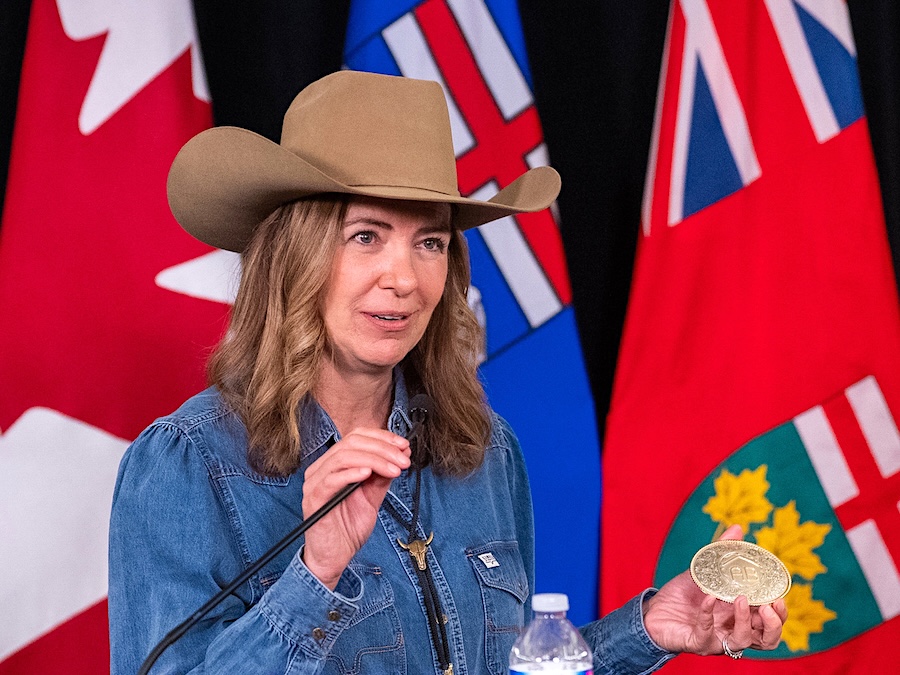
Sorry, folks, but encouraging lawyers to dress up in cowboy hats and Cuban heels like extras on the set of Yellowstone for the Calgary Stampede’s 10 days every July does not a distinct society make.
What’s more, it’s about as close as Alberta’s going to get to a “distinct legal tradition,” too.
Yeah, Alberta’s United Conservative Party is suffering from péquiste envy again, a psychological condition that flares up whenever Liberals are in power in Ottawa, causing Albertans to try to persuade the rest of the country that we’re culturally, linguistically and, now apparently, even legally distinct, sort of like Quebec.
It’s often said here in Wild Rose Country — where the condition has now become chronic, thanks to the currently all-but-unelectable leadership of the federal Conservative party — that Canada had better let us have our way, including all those pipelines we demand to every point of the compass, or... I dunno... maybe we’ll have a separation referendum.
Oh, wait! It turns out we’re having a separation referendum anyway, but that hasn’t prevented another outbreak of péquiste envy, which is defined in polite circles, as an earnest CBC reporter explained it last year, as believing “that Alberta, like Quebec, does have a culture that’s distinct from the rest of Canada — one rooted in traditional conservative values.”
Since significant percentages of voters living in Alberta have supported anyone but Conservatives in the past several general elections — federal or provincial, take your pick — the latter part of this definition is a difficult proposition to argue. What’s more, it’s also pretty insulting to Conservative supporters elsewhere in Canada, who are entitled to ask, “What are we? Chopped liver?”
I mean, seriously, the national Conservative temper tantrum, which has been raging with particular intensity in Alberta and Saskatchewan ever since Justin Trudeau’s government was elected in 2015 and grew even more deranged after the unexpected election of Mark Carney’s Liberal government in April 2025, is almost a mirror image of the situation in Alberta.
Here, large numbers of non-Conservatives vote for anybody but the conservatives in federal and provincial elections but nevertheless see their candidates lose most ridings, most of the time, especially at the federal level. The numbers tend to be particularly close in urban areas.
And, yeah, it’s frustrating, but nevertheless it doesn’t seem to provoke either separation threats or plots to form militias to overthrow the government, as seems to have become normal in nominally conservative circles.
The thought in the UCP strategic brain trust seems to be that all may be well if only we can persuade other Canadians we have a distinctly conservative society here in Alberta — where, according to some local political sages, you shouldn’t even be allowed to vote for the NDP or the Liberals!
This condition is exacerbated further by the inability of Alberta voters to figure out that the success of their Quebec counterparts has something to do with Quebecers’ innate ability to sniff the political winds and always elect at least a few MPs from the party that’s likely to form the government.
The problem with the distinct society notion in Alberta is that, based on actual evidence, it’s preposterous. There simply is no evidence that Alberta is culturally different from the population of any other English-speaking Canadian province.
If a majority of voters here oppose federal government policies influenced by urban voters in other parts of Canada (and quite a few right here in Alberta), that hardly constitutes a significant cultural difference. Indeed, it pretty much describes rural-suburban-urban voting patterns right across the country, arguably including Quebec.
The premise that Alberta is the redheaded stepchild of Confederation, perpetually mistreated by all, is demonstrably false. We remain the richest province in Confederation, supplier of several prime ministers, addicted to complaining about the makeup of the largely irrelevant Senate.
Now, piling absurdity upon absurdity, in an effort to contend that her government, Trump-like, ought to be able to pack courts with its own judges, Premier Danielle Smith has taken to arguing in support of one of her ridiculous referendum questions that letting her party make the picks would ensure superior court judges “appropriately reflect Alberta’s distinct legal traditions.”
What are Alberta’s distinct legal traditions? Smith, perhaps wisely, seems not to have said. Government spokespeople have also dodged the question. Presumably in both cases that’s because there are none.
Civil law in Quebec is based on le Code Napoléon, while in the rest of Canada it is founded upon English common law. Criminal law is the same in both, as it has been since Confederation. That doesn’t make Alberta legal traditions distinct, no matter how much Smith wishes the law here were based on the Trumpian code.
Perhaps it has struck the UCP brain trust and its separatist allies that it might be dangerous to admit that the only distinct Alberta legal traditions have been passed by the Alberta legislature since Smith snatched the reins of the United Conservative Party from the failing hands of Jason Kenney.
After all, in the fullness of time, the courts are likely to set much of that right, even if the political conditions remain unchanged in Alberta. And, regardless, four years isn’t long enough to establish a tradition, legal or cultural.
Which brings us to a final point. While Alberta clearly has neither a distinct culture nor a distinct legal code, there is an influential subculture here, which has crept across the longest undefended border in the world with greater virulence than in most other provinces.
To wit: MAGA. There is nothing distinctly Albertan or Canadian about the idea of making America great again, though. On both sides of the border, it is a cult-like political subculture — or perhaps even a mental condition — that is entirely American in origin, direction and unique destructiveness. It is characterized by a common ideology and subcultural practices, including its famous red hats, its own media networks and a shared catalogue of grievances.
It is clearly being promoted in Alberta and elsewhere in Canada by agents of a foreign state — or perhaps several states, since some that do not live next door to us may also see value in its corrosive and divisive nature.
It would seem Alberta separatism — and perhaps now the UCP as well — is a foreign-inspired, and likely foreign-funded, phenomenon. But culture and legal tradition have nothing to do with that. ![[Tyee]](/design-article.thetyee.ca/ui/img/yellowblob.png)
Read more: Alberta








Tyee Commenting Guidelines
Please note that email notifications for replies are not currently working due to a software issue which may be resolved in a future update.
Comments that violate guidelines risk being deleted, and violations may result in a temporary or permanent user ban. Maintain the spirit of good conversation to stay in the discussion and be patient with moderators. Comments are reviewed regularly but not in real time.
Do:
Do not: