


 SHARE:
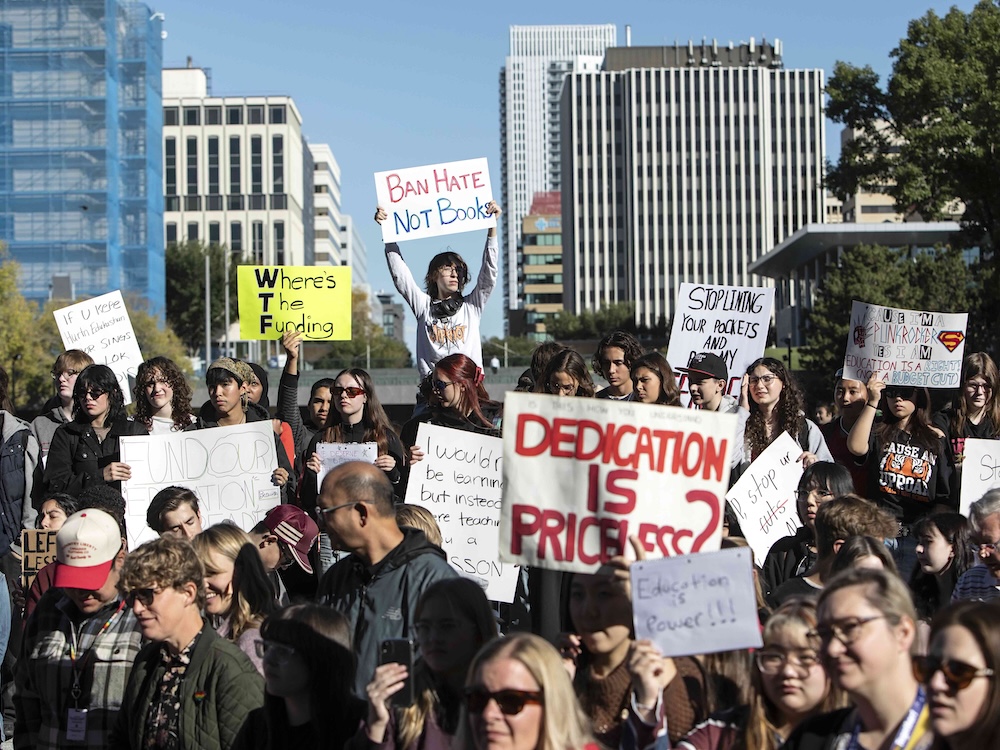
The Alberta teacher strike that has shut down schools and affected more than 700,000 students isn’t just another labour dispute.
It’s the latest front in a long campaign — with its roots in the United States — to undermine public education, closely linked to the right-wing Project 2025 initiative to transform America.
And Alberta is often portrayed, both in Canada and abroad as one of the movement’s big successes.
The campaigners claim their goal is better results and more parental control. They argue introducing competition for public schools would help students and let parents decide what and how their children should be taught.
Alberta parents can already choose from a wide array of publicly funded education options — from private and charter schools funded by taxpayers but shielded from public oversight, to public and separate schools offering specialized programming.
But members of the United Conservative Party have continued to push for policies that further privatize education.
As the strike loomed, the push for privatization intensified.
Instead of negotiating with teachers in good faith to prevent a strike, Alberta’s government has opted to spend up to $55 million per week to pay parents affected by the strike.
“That money will be used to support families as they determine how to navigate life with schools closed,” said Alberta Finance Minister Nate Horner last week.
This move not only belittles teachers, but also encourages parents to look for options outside the public system, including home-schooling.
Why is public education under attack?
One reason is obvious. Privatization creates profit opportunities for a range of stakeholders — private schools, educational tech companies, investors, contractors.
But abandoning public education also lets governments relinquish their responsibility to support an equitable, democratic society. It increases the disparities between the privileged and everyone else.
“Public education is a commitment to realize a society that’s just, that values diversity, equity, equality and participation in decision-making,” Sue Winton, a professor of education at York University, told The Tyee.
“Through public schools we can come together with people different from ourselves, learn to participate in democratic citizenship — privatization won’t move us any closer to our democratic ideal.”
The UCP record
Since the United Conservative Party came into power six years ago, Alberta’s government has tabled a series of changes to the Education Act that reflect the priorities not of Alberta parents, but of U.S. neoconservatives seeking to dismantle the public education system south of the border.
In 2019, 90 per cent of Alberta K-12 parents and students were satisfied with the quality of education, the provincial government’s education stakeholder survey shows. A different poll, carried out later that year, found that roughly 17 per cent of parents felt dissatisfied with the amount of school choice available in Alberta.
Despite this, in 2020 Adriana LaGrange, then education minister, introduced a bill that enshrined school choice as a parental right in the Education Act by enabling the expansion of charter schools, a form of publicly funded, privately delivered education that’s prevalent in the United States.
“This proposed legislation will affirm that parents, not politicians, have the right to choose the kind of education they feel will be best for their children,” LaGrange said in the legislature in May 2020.
The UCP government had already overhauled the Education Act, rolling back protections for LGBTQ2S+ students that prevented schools from outing students.
More controversial changes to the Education Act have followed since Danielle Smith replaced Jason Kenney at Alberta’s helm — a predictable move for a premier who has characterized the public education system as a monopoly that should be dismantled.
Legislation that came into effect Sept. 1 gave parents the power to decide whether their children can access educational content related to gender and sexuality at school and required that educators request parental consent before adopting a student’s preferred name or pronouns.
Education Minister Demetrios Nicolaides said parents “should be fully informed about every aspect concerning their child’s education: presentations, third-party presentations, or anything else occurring at a school.”
A move to private schools
The number of students receiving education outside of the public system increased from under 54,000 in 2020 to more than 71,000 in 2024.
Privatization advocates have argued that this shows a growing discontent with the public school system.
In a recent National Post op-ed, Peter MacKinnon, a senior fellow of the Aristotle Foundation for Public Policy — a conservative think tank with a stated mission to educate the public on the issues jeopardizing freedom in Canada, founded by former UCP staffer Mark Milke — suggests that ideological indoctrination in the public school system is driving Alberta parents to enrol their children in a charter school.
“Many parents of the young people I saw at the Classical Academy turned away from what they saw as dysfunctional public schools,” MacKinnon wrote in mid-September, referencing a charter school established by controversial UCP candidate Caylan Ford in 2022.
Echoing MacKinnon’s stance, John Hilton-O’Brien, executive director of Parents for Choice in Education, an Alberta group advocating for choice-driven education since 2012, takes aim at unionized teachers for curtailing parental rights by advancing topics like critical race theory, gender and sexuality in classrooms.
“The problem is that the administrators of the teachers’ association are trying to remove choice,” Hilton-O’Brien told The Tyee. “The Alberta Teachers’ Association is driving parents out of the public system.”
But there is little evidence that “ideological indoctrination” has played a meaningful role in the shift to private schools or that unionized teachers have caused parents to leave the public system.
A 2020 study by Cardus, a Christian think tank based in Ottawa, found family and religious values are the two most common reasons Alberta parents choose to enrol their children in an independent school, followed by safety and a sense of community. Only 10 per cent of K-12 students in Alberta are enrolled in a private or a charter school.
But UCP members still voted last year to “eliminate all political indoctrination from the curriculum,” and the Alberta government has changed the Education Act to curtail the exposure of students to subjects related to race, gender and sexuality.
This is not unlike what’s taking place in the United States, where amidst the culture wars against critical race theory and gender identity, free-market advocates have found a trusty ally in the parental rights movement.
The Project 2025 connection
In recent years, parental rights activists across North America have attacked public education, using wedge issues on race and gender to advance privatization.
Shannon Moore, an associate professor of education at the University of Manitoba, co-authored an essay that argued neoliberal groups are using the rhetoric of parental rights and conservative parents’ rising fear of “ideologically motivated teaching” to push free-market solutions.
“Privatization has been presented as a way to preserve parental cultural authority,” the essay says. “Manufactured crises have been used to shake confidence in the current system, veil underlying issues, distract the populace, and encourage buy-in for reforms that advance marketization and privatization.”
The Heritage Foundation, an American right-wing think tank, has been instrumental in advancing a narrative that blends Christian and neoliberal rhetoric to encourage religious parents to demand school choice. It has antagonized teachers and promoted conspiracies about race and gender.
In 2022 the foundation’s centre for education policy released a backgrounder urging the school choice movement to embrace the culture wars as a way to win more supporters.
With funding from billionaires, the Heritage Foundation takes its message to policymakers and the public. Its representatives appear on media outlets like Fox News and the Daily Wire, adding legitimacy to its claims.
The Heritage Foundation has also mastered social media. It has some 1.9 million followers on Facebook, where it promotes biased messaging on subjects ranging from parental rights and critical race theory to socialism and gender identity.
The influential organization’s brainchild, Project 2025, sets out a plan for President Donald Trump to transform the United States in his second term.
And it includes a focus on education. The organization plays on the fears of religious parents and soothes their anxieties with the promise of a free market. To preserve so-called family values, the project’s playbook calls for the dismantling of public education and characterizes “woke” bureaucrats, school administrators, teachers and their unions as a barrier to the right of parents to determine what their children are allowed to learn at school.
“Schools serve parents, not the other way around,” Project 2025’s “Mandate for Leadership” reads.
These ideas appear to be having an impact north of the border.
The UCP’s plan for education
In the fall of 2023, Alberta’s UCP members released an updated policy declaration that, much like Project 2025, lashes against the public education system by way of defending “the right of parents to direct the education and upbringing of their children,” and calls to scale back the Alberta Teachers’ Association by splitting the organization into two separate bodies.
“We have too many establishment members setting educational policies and not enough parents involved,” Hilton-O’Brien wrote last year in a jeremiad published by the right-wing Western Standard, challenging the authority of teachers to act in loco parentis, or on behalf of parents.
“The educational establishment is trying to take power away from elected governments and the parents that they are supposed to serve.”
Meanwhile, researchers associated with conservative think tanks regularly leverage far-right media outlets to communicate with parents on the issues driving the culture wars, and present privatization as a solution to their worries.
For instance, True North and the Epoch Times, the latter characterized by the New York Times as a pro-Trump “influence machine,” consistently publish editorials written by Michael Zwaagstra, a senior fellow of both the Fraser Institute and the Frontier Centre for Public Policy, who advocates for school choice while opposing so-called indoctrination on race and gender issues.
“Public schools exist to serve the community, not the other way around,” Zwaagstra wrote in 2023. “The moment parents discover that teachers are pushing their personal beliefs on students — or hiding important information from parents — is the moment when public schools will lose the trust of the communities they serve.”
Just like in the United States, the attack on public education has rich backers, including retired oil and gas executive Gwyn Morgan.
According to publicly available tax records, since 2020 the Gwyn Morgan and Patricia Trottier Foundation has donated close to $2.3 million to the True North Centre for Public Policy, the Justice Centre for Constitutional Freedoms, the Aristotle Foundation for Public Policy and the Frontier Centre for Public Policy, all of which have produced insights that promote parental rights and undermine public education.
The pressures on public education
Perhaps emboldened by the successful imposition of Project 2025’s agenda south of the border, Alberta’s UCP government appears more concerned about acting on the demands of a comparatively small base than about addressing the challenges facing some 738,660 K-12 students in Alberta’s public system.
As the amount of spending per student in Alberta’s public schools lags behind that of other provinces, the complexity and size of classes has increased significantly, making it difficult for teachers to deliver the quality education students deserve.
These challenges are driving some Alberta parents to search for alternatives beyond the public education system.
Christine Christoffersen, a Calgary mom, opted for unstructured home education, or unschooling, after her teenage daughter, Millie, fell through the cracks of an overwhelmed public school system.
“My daughter has a significant sheet of mental illnesses and learning disabilities,” Christoffersen said. “At home we understand her strengths and weaknesses, so we can help her feel successful.”
This wasn’t Christoffersen's first choice, however.
Initially, she’d sought to enrol Millie (not her real name) in a public school that offers Alberta students personalized, flexible programming, but Christoffersen didn’t feel supported when she raised concerns about having Millie attend a campus that would put her at risk.
Next year, Christoffersen hopes to enrol her daughter in a private non-profit school that offers similar benefits as the public alternative.
“My preference would have been to work with the public school to put her in a safe place where she has access to support,” Christoffersen said. “But that was not an option.”
Christoffersen’s experience evidences the shortcomings of an education system that’s stretched beyond its capacity.
“Neoliberal policies in education privilege economic purposes over social and political purposes,” said York University’s Winton. In a market-oriented approach, governments tend to favour consumer choices at the expense of policies that foster equality and fairness.
In her 2022 book Unequal Benefits: Privatization and Public Education in Canada, Winton suggests that policies that enable choice, whether it’s within or outside the public school system, inevitably lead to inequitable outcomes, though this is often unknown to parents.
“Many people don’t understand how their individual choices contribute to broader patterns of social inequality,” she wrote.
“As parents are expected to do whatever they can to help ensure their children’s success, their choices — encouraged by education privatization — may negatively impact other people’s kids.”
In Alberta and elsewhere, the culture wars are little more than a distraction from the interests already driving privatization in public education, eroding democracy and its promise of a more equitable future.
“Public education offers a potential for changing the world,” Winton told The Tyee.
To strengthen democracy, Canada’s public education system should ensure universal access to government-funded schools that give all students equal opportunity, and where decisions are made in the public interest.
Although Winton recognizes that few public schools currently live up to this ideal, she believes that privatization won’t help make education more equitable — and in fact may have the opposite effect.
“Our public schools can and must change to serve all children well. They remain our best hope for democracy.” ![[Tyee]](/design-article.thetyee.ca/ui/img/yellowblob.png)










Tyee Commenting Guidelines
Please note that email notifications for replies are not currently working due to a software issue which may be resolved in a future update.
Comments that violate guidelines risk being deleted, and violations may result in a temporary or permanent user ban. Maintain the spirit of good conversation to stay in the discussion and be patient with moderators. Comments are reviewed regularly but not in real time.
Do:
Do not: