


 SHARE:
[Editor’s note: This piece was first published on Geoff Meggs’ Substack Lotusland and is republished here with permission.]
No humiliation is more traumatic for B.C.’s corporate elite than being mocked in international business circles, yet it happened twice in December, both times because of the hot-burning crisis over Indigenous rights in this province and their impact on private property.
So far, however, business leaders have been mute in the face of attacks on recent court rulings and B.C.’s Declaration on the Rights of Indigenous Peoples Act, legislation they welcomed just six years ago as a major advance in the economic life of the province. Support for the long-debated bill was so broad in 2019 that it passed the legislature in a rare unanimous vote.
Now a BC Supreme Court decision confirming that the Cowichan Tribes hold aboriginal title to 750 acres underlying 150 properties on Lulu Island is making global news at great economic cost.
First it was the Wall Street Journal on Dec. 21 posing “Canada’s $1 Billion Question: Do Property Rights Still Exist in Canada?” As if that blow to investor confidence wasn’t bad enough, the Atlantic weighed in Dec. 28 with David Frum’s musings on “Good Intentions Gone Bad: How Canada’s ‘reconciliation’ with its Indigenous people went wrong.”
The crisis is so dire, Frum declares, that “the ownership of almost every piece of private land in British Columbia and possibly all of Canada” has been “called into question.” Even his 20-acre parcel in Ontario cottage country could be lost. “Some Americans may try to apply this precedent to the U.S., too.”
Just 15 years after the international marketing triumph of the 2010 Vancouver Winter Olympic Games (“It’s our time to shine!”), and six months before the province welcomes the world to seven FIFA World Cup matches, international investors are being told that B.C. is the place where fee simple private property comes to die.
It’s a claim both absurd and untrue.
Yet neither article contains a single calming or qualifying statement from B.C. business leaders as the province prepares for a legislative cage match over the future of DRIPA, and by extension, the province’s relationship to First Nations and their aboriginal rights.
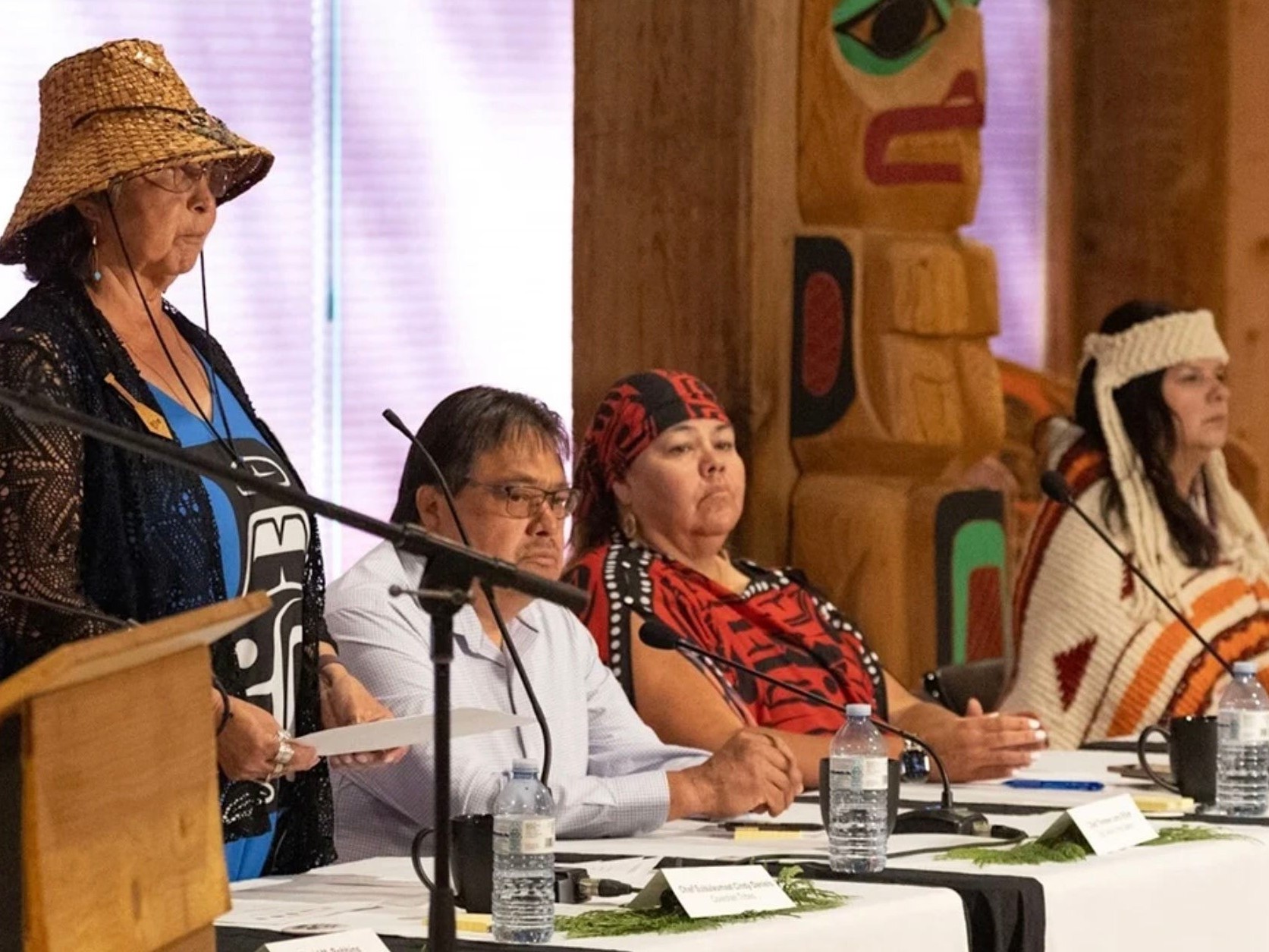
The trouble began in August with the BC Supreme Court’s Cowichan Tribes decision, which found that the Cowichan had established, in the longest trial in Canadian history, their aboriginal title to the historic village site of Tl’uqtinus on Lulu Island in the mouth of the Fraser River.
Evidence during the trial convinced Justice Barbara Young that the village site, which had been designated for reserve land in the 19th century, had later been improperly subdivided by colonial land commissioner R.C. Moody and sold for his own benefit.
The result is “defective and invalid” title for fee simple titles held by Richmond and Canada on the site, the judge ruled, a problem that Canada, B.C. and the Cowichan must clear up. The court did not rule on the validity of fee simple titles and interests held by private property owners.
Justice Young’s decision rested on Section 35 of the Canadian Constitution, not DRIPA. She expected negotiations among the parties “to reconcile the outstanding issues.” Her words were lost in the hurricane that followed. Private property is sacrosanct, critics said, even when effectively stolen. There’s nothing to reconcile.
The Tsawwassen and Musqueam First Nations, who say their territories also cover Lulu Island, immediately announced appeals. Premier David Eby promised B.C. would do the same, fuming at the judge’s findings and later vowing to “go to the wall” to protect private property. He rejected a quicker and simpler reference to the Court of Appeal, declaring that only a full appeal could put the matter to rest.
Although the Cowichan consistently disavowed any interest in disturbing the nearly 150 private property owners, and the judge suspended her ruling for 18 months to allow for negotiations, legal experts were soon loudly debating the implications of her decision. The issue exploded in October, when Richmond Mayor Malcolm Brodie sent letters to property owners, suggesting that their title was in doubt. Angry public meetings followed.
(See Terry Glavin’s valiant efforts to clear the air here, fill in some gaps here, and his longer, more lyrical response to the larger issues here. Two legal views that urge calm and deny a threat to private property are here and here.)
By the end of the year, a widely-quoted property tax expert was demanding a complete BC Assessment Authority re-evaluation of the Cowichan properties to determine how far their value had fallen, claiming the affected land was worth as much as $3 billion before the decision, perhaps nothing afterward.
The panic was compounded in December by a BC Court of Appeal ruling, Gitxaala v. BC Gold Commissioner, which declared the province’s mineral prospecting system not only inconsistent with DRIPA but with the original United Nations Declaration on the Rights of Indigenous Peoples itself. (This was an extra leap the John Horgan government and then attorney general David Eby had explicitly sought to rule out when DRIPA was passed in 2019.)
From now on, some said, even the simplest mining exploration claim would require free, prior and informed consent of affected First Nations.
The AME, the organization representing the province’s mining exploration sector, now led by former BC Liberal MLA and cabinet minister Todd Stone, was at first notably calm and cool in its reaction, arguing that changes had already been made to align with the lower court decision. Numerous lawyers argued otherwise.
In its only statement throughout these controversies, the BC Business Council welcomed the Cowichan appeal. Since then, whatever they may have said privately, the Council and groups like the Vancouver Board of Trade and the B.C. Chamber of Commerce, have been quiet.
Is it possible, during the hottest debate over Indigenous rights in a generation, that top business leaders have nothing to say? The stakes could hardly be higher. Private property is allegedly in doubt, mining exploration hobbled and the underpinnings of the province’s road to reconciliation at risk just as B.C. seeks to accelerate economic investment in mines, hydroelectric power and natural gas.
To be fair, the Eby government, which has struggled with DRIPA requirements on a series of critical files, did not get into this fix with one or two court judgements.
Changes to the Land Act were shelved in 2024 when a wide range of stakeholders reacted angrily to proposals that would have allowed shared decision-making with First Nations in specific circumstances, changes they charged were developed in secret. Then Indigenous leaders were outraged in 2025 when two bills to accelerate economic development were introduced without any DRIPA consultation at all.
Now Premier David Eby faces a perilous, possibly “lose-lose” decision as he prepares for the next legislative session. He can seek to calm the Gitxaala controversy by amending DRIPA to overcome the Court of Appeal decision, a route he has said he is considering, despite the clear opposition of B.C.’s First Nations leaders. (In fact, Eby vowed Jan. 6 to bring in amendments both to DRIPA and the Interpretation Act, notwithstanding First Nations opposition.)
Could he credibly override the objections of leading First Nations and their organizations in the name of protecting the government’s key legislation on reconciliation? Will First Nations leaders stand firm in their opposition or give tacit approval to amendments that reaffirm the government’s original intent to ensure that DRIPA’s commitments were “nonjusticiable,” in other words to be politically, not judicially enforced?
Then the government faces the perils of the legislature.
The Conservatives (and their former caucus members now sitting as Independents or OneBC) will fight for full repeal of DRIPA. The Greens have declared they will oppose any amendments. That leaves Eby counting on his one-vote majority, available only through a tiebreaker vote by Speaker Raj Chouhan, to carry the government’s legislation unless the Conservatives decide to support his amendments.
Complicating that scenario is the fact that three NDP MLAs — Amshen-Joan Phillip, Vancouver - Strathcona; Qwulti’stunaat - Debra Toporowski, Cowichan; and Lanaas - Tamara Davidson, North Coast - Haida Gwaii — are members of First Nations organizations that have signed the joint statement calling on the NDP not to make any changes.
Also on the list rejecting a DRIPA amendment: the Tahltan Central Government, which has just ratified a Section 7 agreement under DRIPA that would move forward a new gold mine with $1.7 billion in benefits to Tahltan members. The mine is one of three on Tahltan territory located in the so-called Golden Triangle where Canada and B.C. hope to fast-track critical mineral production.
None of Eby’s options for legislation meet the concerns of British Columbians anxious about the security of their private property.
In the Cowichan case, there’s no DRIPA issue at play, no legislative fix available. Eby has so far rejected a much speedier Court of Appeal reference and now must wait years for an appeal to play out.
Even a clear victory in a legislative debate over DRIPA amendments, triggered by Gitxaala, will do nothing to resolve the private property issue. (It would also be possible for Canada to make a reference, given its involvement in the Cowichan case, but there’s no sign it has any plans to do so.)
No matter what course Eby chooses, he faces a fired-up BC Conservative Party opposition, revitalized by its ouster of former leader John Rustad and united by its demand for full repeal of DRIPA. Is that what business leaders are hoping for? Go back to 2017? Or even further?
We’ve been down this road before.
In 2002, when newly elected BC Liberal Premier Gordon Campbell forced a referendum on the “principles” of treaty-making in the wake of the Nisga’a Treaty, only 36 per cent of voters cast a ballot. First Nations Summit leader Bill Wilson termed the initiative “a morally repugnant process… dredging up racism.” (Of those who voted, of course, 85 per cent agreed that private property should not be expropriated for treaty settlements, which has never been a First Nations demand.)
Campbell soon realized he needed to apologize for the referendum to make headway on a host of other issues. The 2003 throne speech declared that the “government deeply regrets the mistakes that were made by governments of every political stripe over the course of our province’s history.”
Throughout his remaining years in power, Campbell struggled to find some grand bargain with First Nations through a “New Relationship,” negotiated in secret, that could lead to legislation foreshadowing many provisions of DRIPA. Campbell failed to move the act forward, but First Nations made steady progress through the courts as the treaty process stagnated.
In 2014, the Supreme Court of Canada made a decisive judgement in Tsilhqot’in v. British Columbia, granting the Tsilhqot’in a territorial declaration of title to 1,750 square kilometres of land rather than a “postage stamp” village site. It proved a turning point in the province’s history.
Although then Premier Christy Clark acknowledged that Tsilhquot’in was “a fork in the road” and “our chance to be on the right side of history,” her government did nothing to resolve the growing tensions between Indigenous rights and title, confirmed in court rulings, and the need for fundamental economic and social change. Indeed, in a recent Hotel Pacifico podcast, she again dismissed the need for legislation, arguing “we were making good progress with First Nations without DRIPA.”
That was not the message B.C. businesses took from Tsilhquot’in. From that day on, any forward-thinking CEO, especially in the resource sector, was seeking direct partnerships with First Nations and an overarching legal framework that produced more economic certainty. The unanimous vote on DRIPA was the result.
Not surprisingly, British Columbians are concerned about the impact of Cowichan on property rights, but an important recent poll by ResearchCo, fielded after months of fearmongering about the death of private property, found that “more than seven-in-ten British Columbians (73 per cent) think the UNDRIP Act [DRIPA] is a positive development for Canada, while 14 per cent perceive it negatively and 13 per cent are undecided.”
In 2017, two years before DRIPA was enacted, former B.C. attorney general Geoff Plant, who sat next to Gordon Campbell from the days of the referendum through the long, futile battles over the New Relationship, hailed the incoming NDP government’s commitment to implement UNDRIP “in full participation with Indigenous communities.”
He then added: “They also need to make sure the rest of us are included in this vastly important and timely work.” It is here the Eby government has fallen short. That’s no reason to give up.
Despite the controversies of the last two years, B.C.’s First Nations have declared their determination to see DRIPA continue. Public opinion supports that direction. The question now is how the province’s business community weighs in.
Nearly 20 years passed between ratification of the Nisga’a Treaty in 2000 and the passage of DRIPA in 2019. How much further ahead would we be without the referendum? How far back will B.C. slide if DRIPA is rendered an empty shell or even repealed after a rancorous and divisive debate?
On Jan. 13, as the premier jetted off for a trade mission to India, the AME issued an open letter to Eby outlining four proposed amendments to DRIPA. Taken as a whole, they would fundamentally change the direction of the bill and expose the government to compensation claims. The AME declares that failure to pass them would render DRIPA “completely unworkable and detrimental to our sector and the overall economy of British Columbia.”
Is the business community committed to reconciliation, regardless of who is in power? Or is a setback to reconciliation — and some mockery in the business press — a small price to pay if it helps rid the province of an NDP administration that the business community deplores? We’re about to find out.
Some material in this column is drawn from ‘Unceded: Understanding British Columbia’s Colonial Past and Why It Matters Now,’ by George Abbott, former BC Liberal MLA and cabinet minister, published by UBC Press and Purich Books. It’s an excellent summary of the long and difficult road to reconciliation. ![[Tyee]](/design-article.thetyee.ca/ui/img/yellowblob.png)








Notice about commenting changes
The Tyee’s commenting system will be moving to a new platform on Nov. 12. If you’re already a Tyee commenter you must register with the new system on or after Nov. 12 with your preferred username.More information can be found here.