


 SHARE:
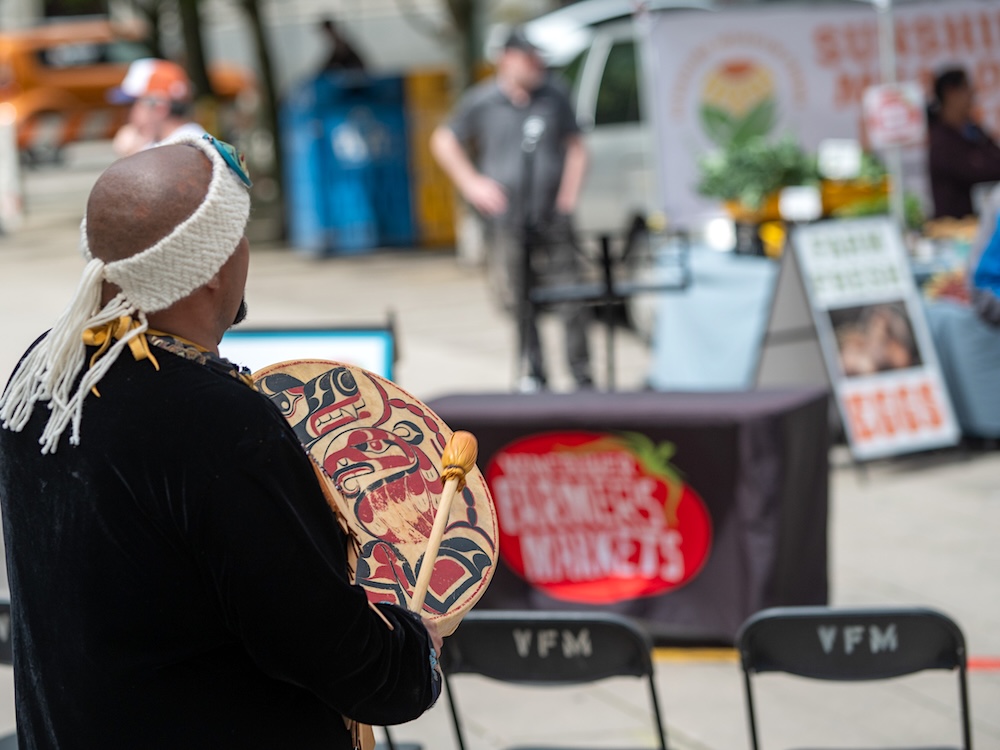
Picture this: a busy weekday in downtown Vancouver, diverse groups of people all around. And right in the centre of it all, at the symbolic šxʷƛ̓ənəq Xwtl'e7énḵ Square, the north plaza of the Vancouver Art Gallery, a different kind of local food infrastructure comes alive.
Around midday, farmers unload crates of fruits and vegetables harvested just hours earlier, bakers arrange loaves and treats, the egg and meat trucks start lining up, and so do many other vendors selling everything from cheese to flowers to local fish, dairy, honey, mushrooms and more. (Watch this short video to experience the Downtown Farmers Market virtually.)
Those of us who think of farming as a colonial activity might not think Indigenous reconciliation has anything to do with farmers markets. Yet Indigenous communities across the continent are challenging the dominant paradigms of land stewardship and agriculture, and for Vancouver Farmers Markets, or VFM, some of the most important learning has come from market gatherings of farmers, food producers and community members. Rather than beginning with answers, the journey has begun with questions:
- Who has access to fresh, culturally meaningful food?
- Who gets to participate in the social and economic infrastructure that we create?
- What does an authentic taste and experience of a place look like?
- And how can an organization with roots connected to immigrant and settler food systems begin to build relationships that acknowledge Indigenous presence, history and economic participation?
The answers remain incomplete. But over the past couple of years, VFM has begun taking small steps toward finding them.
A beginning, not an arrival
In 2025, VFM launched an Indigenous Vendor Pilot Program at its Downtown Farmers Market in partnership with Indigenous Tourism BC, or ITBC. The program was modest in scale. Four Indigenous-owned businesses were welcomed to the Downtown Farmers Market for the 2025 season, receiving support to access one of Vancouver's busiest public marketplaces.
Following a positive response in its first year, the program will return in 2026 for a second season. This year's Indigenous vendor cohort includes Creations by Antee, The Ivory Kraken, Sabian’s Arts and Crafts by Michael "Sabian" Rawcliffe, and Salmon n' Bannock. Together, these businesses bring Indigenous artistry, food traditions and entrepreneurship into one of Vancouver's busiest public gathering spaces.
“This program started because of two conversations — one expressing uncertainty about whether Indigenous vendors would be welcome in VFM market spaces and another expressing enthusiasm about the opportunity,” says Laura Smit, executive director of Vancouver Farmers Markets. “Taking the time to reflect on our experience and many conversations later, working in relationship with the vendors and in collaboration with our partners at ITBC has been a critical element in the program’s success.
“For VFM, continuity and adaptation has mattered as much as the launch itself. Announcing reconciliation and intentional welcome has been important. Even more important has been continuing to learn and adapt over time.”
Creating welcoming space for Indigenous vendors is an opportunity for market shoppers to try products from Indigenous businesses not as occasional features during commemorative events, but as ongoing participants in community life.
“The first season showed the value and success of creating space for Indigenous businesses at the market,” says Darnell Stager, Indigenous tourism specialist, engagement and development, at Indigenous Tourism BC. “Indigenous vendors connected with a new audience and shared their culture through their products. It's amazing to see these vendors become a part of the vibrant community of the farmers markets, and we're excited to bring more Indigenous businesses to the space.”
Jeremy Dyson, VFM board member, shares this reflection: “I love discovering collaborations at our markets — whether jam maker and farmer or baker and fruit grower. Organizational collaborations are equally exciting to me. This partnership emerged from a cup of coffee and an idea and it is now bearing beautiful fruit as we enter our second season. It's an honour to witness the market opening to traditional drum beats and I am excited to meet the new ITBC vendor cohort of 2026 at šxʷƛ̓ənəq Xwtl'e7énḵ Square.”
The economic side of reconciliation
Most reconciliation journeys begin with education, awareness and acknowledgment. These conversations are essential. But Indigenous leaders and organizations have increasingly emphasized another dimension: economic reconciliation.
Indigenous communities continue to face barriers to economic participation, rooted in generations of displacement, exclusion and systemic inequity. Creating opportunities for Indigenous businesses at farmers markets is not a solution to all of these challenges. Yet it can be one practical component of a broader effort to support Indigenous self-determination and economic participation.
Food access is part of the conversation too
This year, VFM’s Fresh to Families nutrition coupon program, which helps households facing food insecurity purchase fresh food directly from farmers market vendors, added a new community partner to the program: the Vancouver Aboriginal Friendship Centre Society. Through this partnership, 45 Indigenous families will receive support to purchase food at Vancouver Farmers Markets.
“Making space for 45 Indigenous families to access fresh, local food with dignity is a drop in the reconciliation bucket but one we hope will create ripples of change and connection in the community,” says VFM’s Smit. “Creating market spaces that foster relationships between neighbours and producers matters, and taking intentional steps to reduce barriers is part of the work. We know the nutrition coupon doubles impact by directing resources toward families and farmers.
“Who knows, maybe next year’s program will involve an Indigenous farmer!”
Making space and showing up
When a shopper stops to chat with an Indigenous vendor, and a family uses nutrition coupons to purchase fresh produce, the conversations that otherwise might never have happened grow into real human connections.
These interactions are often small and go unnoticed. Yet reconciliation itself is often built through accumulation: relationships formed, barriers reduced, opportunities created and trust slowly earned.
These initiatives do not represent a destination. They are simply early steps in a much longer journey. But they suggest that meaningful change often begins with something simple: making space, showing up, listening and being willing to learn. ![[Tyee]](/design-article.thetyee.ca/ui/img/yellowblob.png)
Read more: Indigenous, Food
This article is part of a Tyee Presents initiative. Tyee Presents is the special sponsored content section within The Tyee where we highlight contests, events and other initiatives that are put on either by us or by our select partners. The Tyee does not and cannot vouch for or endorse products advertised on The Tyee. We choose our partners carefully and consciously, to fit with The Tyee’s reputation as B.C.’s Home for News, Culture and Solutions. Learn more about Tyee Presents.




Tyee Commenting Guidelines
Please note that email notifications for replies are not currently working due to a software issue which may be resolved in a future update.
Comments that violate guidelines risk being deleted, and violations may result in a temporary or permanent user ban. Maintain the spirit of good conversation to stay in the discussion and be patient with moderators. Comments are reviewed regularly but not in real time.
Do:
Do not: