


 SHARE:
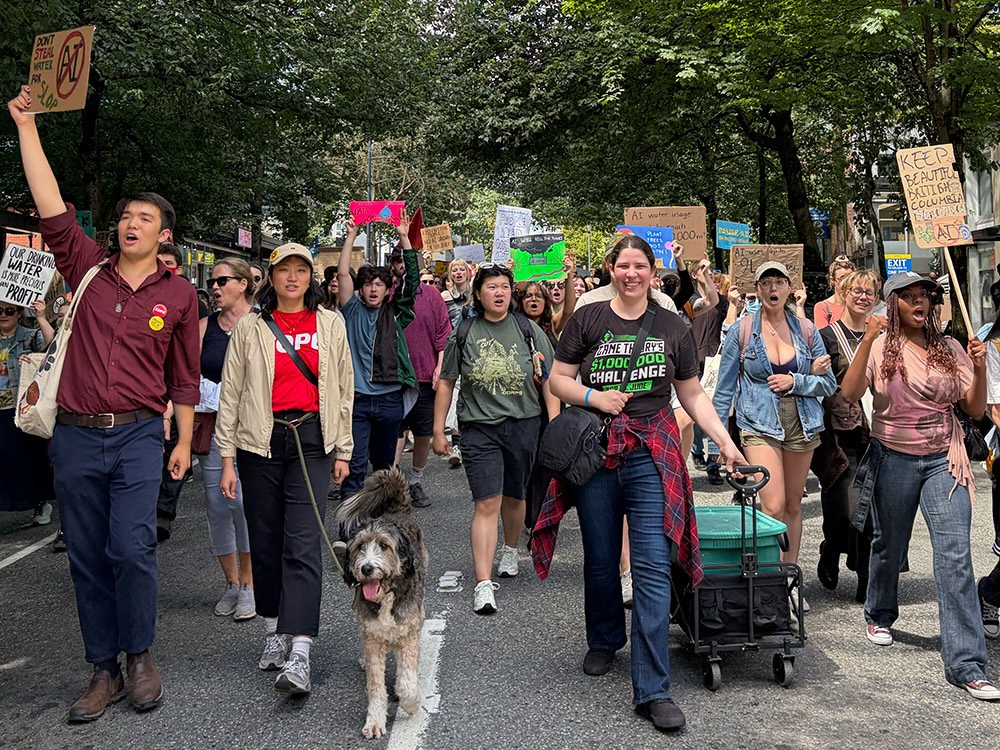
On stage at the Russian Hall in East Vancouver Wednesday evening, an organizer of a six-week-old protest group addressed a crowd.
“So many people are responding to this,” said Alex Carson, a member of No AI Vancouver. “They understand, across the political spectrum, that this is a threat to our very humanity.”
More than 100 people had shown up that evening to discuss the new data centres projects planned for Vancouver. Some lived near the proposed developments. Others were concerned about the technology’s impacts on their jobs and in their schools. Eddy Pedreira, president of the Canadian Animation Guild, was up next to speak.
“This stuff is not inevitable,” said Pedreira, who fought for protections against AI in his workplace. “It can be stopped, and with the united power of workers, it will be stopped.”
The crowd met Pedreira with cheers. Posted along the auditorium’s wood-panels and brick walls were red-and-white posters of Stephanie Allen, the Coalition of Progressive Electors’ mayoral candidate in the upcoming election.
The party, better known as COPE, has organized itself around a growing swell in public sentiment against artificial intelligence in Vancouver. Its candidates are calling for a moratorium on data centre construction in Vancouver, until further regulations are in place to protect residents and the environment.
“Overall, these data centers have so many negative impacts on so many things in Vancouver that I think it would be irresponsible to not take a stand,” said COPE city council candidate Solomon Yi-Kieran.
Last month, hundreds of people took to the streets in two separate protests against the new data centres announced in British Columbia. They’re not alone. Projects in Ontario and Saskatchewan have also sparked opposition. And protests against AI data centres have swept across the United States.
In this province, the backlash started with the announcement of new AI data centres proposed for B.C. On May 11, Telus CEO Darren Entwistle announced plans to build two new centres in Vancouver and expand an existing one in Kamloops. The developer of the Vancouver projects is Westbank Corp.
The largest is slated to be built at 150 W. Georgia St., near BC Place stadium in downtown Vancouver. Another is planned for 111 E. 5th Ave, in Vancouver’s Mount Pleasant Neighbourhood. In total, all three centres combined will initially draw 85 megawatts of power and scale to 150-megawatt capacity in six years.
Less than two weeks after Enwhistle’s announcement, approximately 500 people attended a protest against the proposed data centres in Vancouver. In the last weekend of June, nearly 1,000 people rallied a second time against data centre construction.
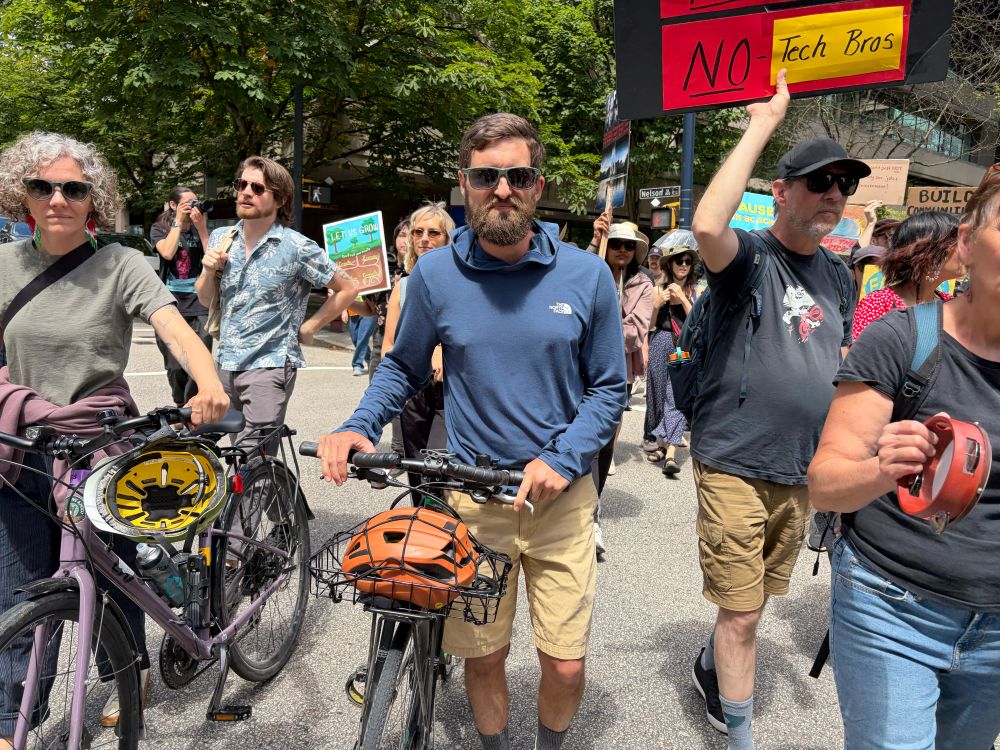
Chuck Wright and his partner live in Mount Pleasant, two blocks away from one of the proposed data centres. On June 27, they spent their Saturday among the crowd, marching from the Vancouver Art Gallery to city hall.
“We're concerned about the amount of water consumption the data centres are going to take, especially when we're facing level three water restrictions, and the amount of electricity it could take, exacerbating the climate crisis,” he said.
The company previously said the data centres will have a range of measures to reduce power consumption, heat, noise, water usage and other adverse environmental impacts.
But that doesn’t move the needle for Wright. He said he was concerned about artificial intelligence’s potential impact on jobs, and the fact that the province is considering further investments in LNG production and more hydro dams as power demand soars.
“I think these are kind of half-baked ideas that aren't going to hold up in the future,” Wright said.
As Wright spoke, the crowd chanted “no data centres” as they walked south on Cambie Street. Also among the protestors was Kiana, who asked The Tyee not to use her last name. She carried a sign that read “So much has been taken from this land. Do you really need the water next?”
“I hate AI,” she said. “It doesn't really get much more than that. There's nothing good about it.”
Despite the negative public sentiment, the federal government has plans to heavily invest in the new technology. Its new AI Strategy included a $500-million fund to invest in Canadian AI companies and a commitment to support construction of data centres that will bring at least a combined 850 megawatts of compute capacity (the processing power of a computer) by 2030.
Vancouver Granville MP Taleeb Noormohamed, who is parliamentary secretary to the minister of artificial intelligence and digital innovation, did not respond to a request for an interview for this story.
But last month, he addressed the pushback.
“Data centres are getting built,” he told The Tyee. “We need this compute power in this country, so that businesses can grow and thrive, so that Canadian researchers can ensure that their IP is protected.”
He added the Vancouver centres are being held to a high environmental standard.
Telus did not respond to requests for comment. But the company previously told The Tyee the Vancouver centres will use 90 per cent less water than traditional data centres, with plans to incorporate recycled water from BC Place. They plan to achieve these savings with a closed-loop cooling system, which cools servers without letting water evaporate.
Telus estimates the water savings to be about 300 million litres each year if the data centres are running at full scale. But that still puts the centres’ annual water consumption at more than 33 million litres.
B.C. Hydro previously told The Tyee the centres will not affect nearby residents’ electricity rates. The Vancouver centres will also be placed on separate district heating systems, meaning that excess heat can be used to heat nearby homes.
The larger Vancouver data centre will be placed on a system run by the Creative Energy, a private utility partly owned by Westbank.
Kieran McConnell, President and Chief Operating Officer of Creative Energy, said the data centre’s excess heat will reduce the heating system’s reliance on fossil fuel boilers during peak demand, like winters.
“Waste heat is being captured in a system to displace natural gas that's already being burned today,” he said. “It's a net positive effect on the environment.”
McConnell’s company is not building the new data centres. Still, he said it’s possible that in “extreme scenarios,” when there’s an excess of heat that cannot be captured in the district energy system, it might have to be released through a more conventional cooling system.
Still, McConnell said the projects promise to set a new standard for data centres’ sustainability and community benefits.
“There's just going to be an explosion of data centres across North America,” McConnell said. “It's important that we, as Canadians, ensure that we have control over that and ensure they're built to the highest standard possible.”
A moratorium on data centre construction
Yi-Kieran, who is running for city council with COPE during the upcoming municipal election, said they still aren’t convinced by Telus’ claims.
“Even if we take everything they're saying at face value, if we trust them completely, it's still 33 million liters of water,” Yi-Kieran said. “When there's water restrictions, and it's drought conditions, it's not really fair that something can go and suck up 33 million liters of water.”
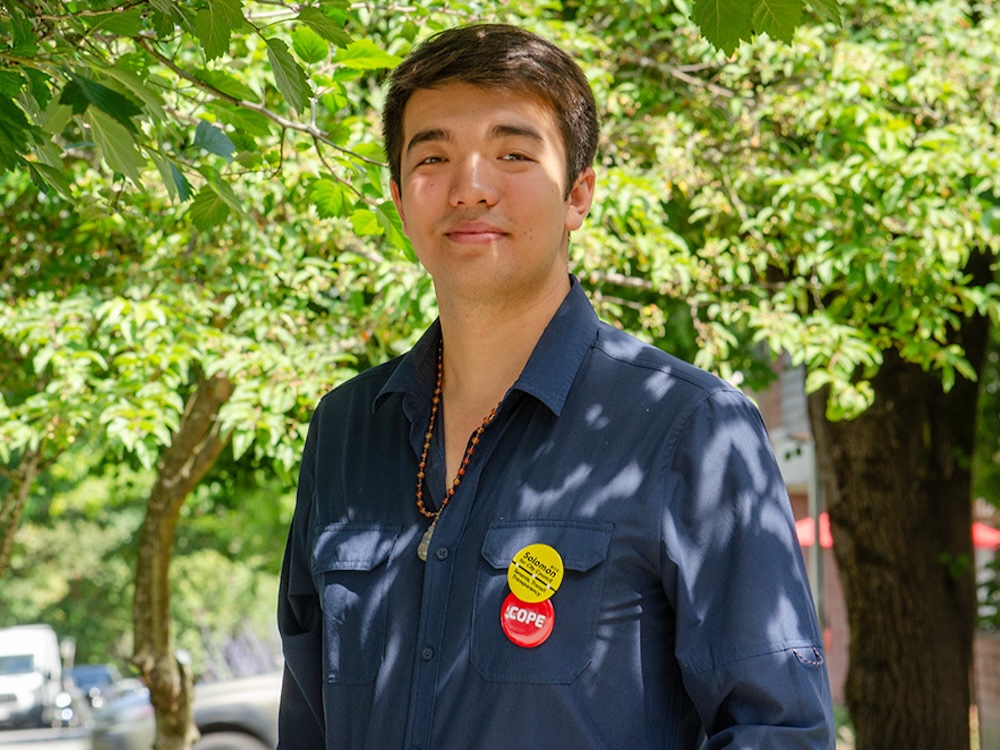
Yi-Kieran is calling for a pause on data centre development until all levels of government have regulations in place to protect the environment, Canadian’s data privacy, jobs and resident’s heating and water bills.
B.C. Green Party leader Emily Lowan is also calling for a moratorium on data centre construction.
A similar policy has already passed in Canada. The city of Hamilton, Ont. moved to pause data centre development last month. Earlier that month, hundreds gathered outside that city’s hall to oppose a proposed data centre.
Yi-Kieran said the policy is gaining support here in Vancouver. COPE has launched a petition calling for the moratorium and clearer estimates of the proposed Telus data centres’ environmental impact. At the time of publication, the petition has more than 8,000 signatures.
“Whether we look at protest turnout or we look at petition signatures, we are seeing a lot of people who do not want these data centers and who really want a moratorium,” they said.
On July 8, Vancouver city councillor Lucy Maloney, a member of the OneCity party, announced she plans to introduce a motion to “seek to temporarily pause consideration of large new AI data centres within the city, pending development of a framework to assess their community risks and impacts.” The motion will be heard at an upcoming July 15 council meeting. ![[Tyee]](/design-article.thetyee.ca/ui/img/yellowblob.png)
Read more: Energy, Labour + Industry, Municipal Politics, Science + Tech


Tyee Commenting Guidelines
Please note that email notifications for replies are not currently working due to a software issue which may be resolved in a future update.
Comments that violate guidelines risk being deleted, and violations may result in a temporary or permanent user ban. Maintain the spirit of good conversation to stay in the discussion and be patient with moderators. Comments are reviewed regularly but not in real time.
Do:
Do not: