


 SHARE:
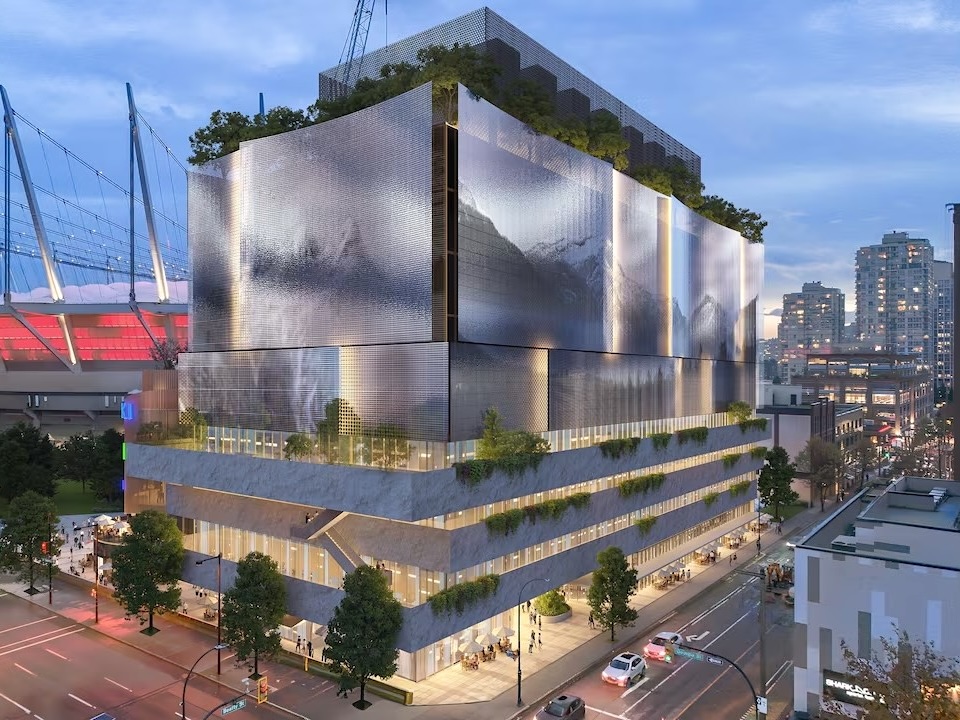
Torin LaRocque wants to stop a proposal to build two new AI data centres in Vancouver.
“When I found out they were bringing in data centres, which are going to harm the environment and the people who live here, I was quite distraught,” the North Vancouver resident said. “This is something that will affect all of us.”
On May 11, federal Artificial Intelligence and Digital Innovation Minister Evan Solomon joined Telus CEO Darren Entwistle to announce the expansion of AI data centres in downtown Vancouver and Kamloops.
The company plans to expand its existing data centre in Kamloops and open two new AI data centres in Vancouver: one at 150 W. Georgia St., near BC Place stadium in downtown Vancouver, and another at 111 E. 5th Ave. in the city’s Mount Pleasant neighbourhood — formerly the headquarters of technology company Hootsuite. The telecom company is calling the cluster an “AI factory.”
The announcements mark a boom in data centre construction as governments and tech companies rush to build the physical infrastructure needed to train and operate artificial intelligence programs.
The boom also comes while BC Hydro expects the province will need up to an additional 9,700 gigawatt hours of additional electricity each year by 2035 — nearly double the current output of the Site C dam.
The push to build the facilities worries LaRocque, and he’s not alone. Hundreds marched in Vancouver on Saturday to make clear their opposition.
AI data centres require vast amounts of energy for power and cooling. They consume a lot of water, leading to concerns about pollution, noise and the potential to increase energy bills.
Each centre’s size, capacity, construction and proximity to utilities mean that it may have unique impacts on the surrounding area.
The Tyee reached out to Telus, the City of Vancouver, BC Hydro, the federal government and project proponents for more information about how the three new government-backed data centres will affect residents in Vancouver and Kamloops.
The developer of the new projects, Westbank, did not respond to The Tyee’s requests for comment.
Why is the government helping to build AI data centres?
The Telus data centres are the first announced for consideration through the federal government’s new program to invest in AI infrastructure.
Artificial Intelligence Minister Solomon’s office said in an email that the federal government is entering discussions with Telus because the company’s projects may help advance Canada’s need for AI infrastructure to be built in Canada.
“Canada needs this capacity because AI compute is becoming core national infrastructure,” Solomon’s office said. “Canadian researchers, companies, public institutions and innovators need access to secure, reliable and high-performance compute if they are going to develop and deploy AI in Canada rather than relying almost entirely on infrastructure outside the country.”
The program puts emphasis on building data sovereignty, the idea that data generated or stored within a country can be controlled by its government’s laws.
“Data sovereignty is about control,” Solomon’s office said. “Canadians should have meaningful control over where sensitive data is stored, where it is processed, who can access it, what laws apply and how it is governed.”
A Telus spokesperson said in an email to The Tyee that its centres will enable B.C. and Canadian organizations to train and deploy AI models from scratch.
“Our infrastructure is sovereign by design and every layer — the facilities, networks, hardware and data — is governed under Canadian law and jurisdiction,” the Telus spokesperson said.
What is the government spending on Telus’s AI data centres?
Despite announcing Telus’s data centre expansion, the federal government has not yet agreed on any terms or amounts to fund, finance or invest in the project. Instead, it is entering discussions with Telus and the proponents of about 160 other projects before considering support for any centres.
Solomon’s office added it’s assessing projects based on whether they can strengthen Canadian sovereignty, provide enough AI compute capability, support Canadian companies and researchers, create economic and ecosystem benefits, include Indigenous participation, demonstrate a credible energy plan, move forward on a realistic timeline and provide value for Canada.
“This is not just about who can build the biggest data centre,” Solomon’s office said. “Any potential federal support would need to be tied to clear public value.”
Ottawa is spending big on building out AI infrastructure. Innovation, Science and Economic Development Canada previously told The Tyee the department has committed $925.6 million to support large-scale, sovereign AI infrastructure, which includes data centres.
It also enabled the Canada Infrastructure Bank to invest in projects such as AI data centres and related energy systems.
How will the Telus AI factory be powered?
According to Telus, all three centres combined will initially draw 85 megawatts of power and scale to have a 150-megawatt capacity by 2032. That’s approximately enough electricity to heat 85,000 B.C. homes.
The Telus spokesperson offered a breakdown of power per centre. They said that once fully scaled, the existing Telus data centre in Kamloops will run up to 12,500 graphics processing units, or GPUs, drawing up to 25 megawatts at peak capacity.
The M3 data centre to be built in Mount Pleasant will run up to 13,000 GPUs and draw up to 26 megawatts. Meanwhile, the new development adjacent to BC Place will run up to 50,000 GPUs and require up to 100 megawatts.
BC Hydro has committed to providing service to the data centres. Susie Rieder, a spokesperson for the utility, said in an email she could not share how much energy each will project use, as that information is “commercially sensitive.”
However, she confirmed the company has already secured access to power for the project's initial power draw and will be charged BC Hydro's standard commercial or industrial rates.
She added that if the project wanted to expand its capacity and consume more power, it would have to compete in the B.C. government’s new application process for AI and data centres and may be subject to different rates.
Will the new AI data centres affect my power bills?
“The short answer is no,” said Rieder. “While growth from sectors like AI and data centres does put added pressure on the system, there are safeguards in place to keep electricity reliable and affordable.”
She said BC Hydro and the province will limit how much power goes to “high-demand” users like data centres, will prioritize projects that deliver the most benefit to B.C., and will require new data centres to pay a premium on power.
She added BC Hydro expects to boost its supply by nearly 30 per cent through investments like Site C, procurement of new energy sources and energy efficiency programs like the utility’s Power Smart 2.0 plan — which offers rebates, rewards and offers to incentivize homes and businesses to reduce energy consumption.
How is the government managing AI data centres’ electricity use?
The B.C. government is regulating AI and data centres’ energy consumption. Last year, the NDP provincial government passed amendments to the Hydro and Power Authority Act that give the province power to limit the amount of energy used by industrial projects. That includes AI and data centres.
The new legislation means the provincial government can stop public utilities from providing data centres electricity, set the rates charged for electricity use and set further terms on their electricity services.
This year, the province announced BC Hydro will make up to 400 megawatts of power available to AI and data centres over the next two years.
In January, BC Hydro and the province launched a new process and new pay structure to determine who gets that power. BC Hydro’s Rieder said new AI and data centres must participate in a competitive selection process to be considered for electricity.
The proponents of new centres will bid on how much of a premium they are willing to pay above the standard industrial transmission rate and distribution rate — with the floor set at 10 per cent higher than the standard industrial transmission rate.
Rieder said existing projects that already have an agreement for energy transmission, such as the three Telus data centres, will not have to compete in that process — unless the company wants more power.
“Any additional electricity beyond what has already been secured is not guaranteed,” she said. “Some portions of the [Telus] projects are expected to proceed under existing arrangements, while future expansions will likely need to compete alongside other proposals for available power.”
How much water will these data centres consume?
Data centres also use large quantities of water to generate power and cool down the systems. One 2023 study estimated that using ChatGPT for 10 to 50 medium-sized queries could consume up to 500 millilitres of water.
However, Telus claims the Vancouver centres will use 90 per cent less water than traditional data centres, with plans to incorporate recycled water from BC Place.
Telus’s spokesperson said the facilities will be built with a closed-loop cooling system, which circulates liquid coolant around chips and processors and absorbs heat without letting water evaporate. The spokesperson said it’s a “fundamentally different” cooling system than those of traditional data centres, which cool servers by letting large volumes of water evaporate.
“Because the coolant is recirculated rather than consumed, water usage drops dramatically,” they said.
Telus estimates the water savings to be about 300 million litres each year if the data centres are running at full scale — which would put the centres’ annual water consumption at more than 33 million litres.
What will happen to the heat generated by these centres?
AI data centres generate massive amounts of heat as they work on queries from users of platforms like ChatGPT. But according to Telus and the City of Vancouver, two of the new data centre projects are expected to recycle that heat.
The East 5th data centre will be integrated into the False Creek Neighbourhood Energy Utility — a system that heats 47 buildings, including homes for more than 10,000 residents in southeast False Creek, parts of Mount Pleasant and False Creek Flats.
The city-owned heating utility is a district energy system, meaning one centralized plant heats several buildings in one area. It’s an alternative to individual systems that require buildings to generate heat on their own — often with fossil-fuel-powered boilers.
According to the City of Vancouver, the utility generates 70 per cent of its energy from renewable sources, mostly from the 9.8-megawatt sewage heat recovery plant under the Cambie Bridge. The plant uses excess heat trapped in sewage to then generate heat for nearby buildings.
Last year, the utility generated 63,000 megawatt hours of thermal energy, of which 41,000 were from sewage heat recovery. Nearby businesses can also sell excess heat to the plant, which is used to heat other buildings in the area.
“The main goal of the system is to reduce greenhouse gas emissions by reusing waste heat that would otherwise go down the drain,” a spokesperson for the city said in an email.
The system is supplemented by natural gas boilers capable of producing 28 megawatts of thermal energy, which kick in during peak demand for heat during the winter.
The city expects that incorporating the data centre into the heating system could help the utility expand while limiting its reliance on natural gas, the spokesperson said.
“Data centres generate significant amounts of heat as part of their normal operations,” they said. “When located near a district heating utility, that heat can be captured and reused to provide space heating and hot water to nearby homes, offices and public buildings instead of being wasted.”
Meanwhile, the 150 W. Georgia St. facility will be placed on top of the district energy project run by Creative Energy, a private utility that provides heat and hot water to several buildings in downtown Vancouver, including BC Place, St. Paul’s Hospital and the Vancouver Central Library.
Creative Energy did not respond to requests for comment. Telus’s Entwistle claims that by recycling waste heat, the Vancouver facilities will help heat more than 150,000 homes in Metro Vancouver.
“We are sending a clear message to the world: Canada will lead the AI revolution with uncompromising technological power and unparalleled climate leadership,” he said in a press statement.
According to Telus, its closed-loop liquid coolant system will reduce cooling energy consumption by 80 per cent compared with traditional data centres.
Telus did not provide information about the heat generated by the Kamloops data centre.
How much noise will the data centres make?
It’s unclear. But Telus’s spokesperson said the facilities are being designed with soundproofing and acoustic engineering aimed at preventing noise pollution “to the greatest extent possible.”
Is there a data centre in my neighbourhood?
There are dozens of data centres in British Columbia, according to the website Data Center Map. An advertising tool that helps data centres sell their services, the website lists the locations of existing or planned data centres across the world.
On its “About” page, Data Center Map says its list of data centres is incomplete, as it relies on data centre operators to submit information as advertisement. Still, the website offers a clearer picture of data centres in the province.
How are residents reacting?
LaRocque said he has been putting up posters around Vancouver and started an Instagram account calling for a halt on data centre construction. It was through his rallying efforts that he met other concerned Vancouver residents, who in turn helped him organize Saturday’s march against the planned data centres.
Now more than 1,200 have signed a petition against the centres’ construction.
LaRocque said he doesn’t want to see these data centres contribute to hotter temperatures here in Vancouver, especially after the city discontinued its “cool kits” program, which distributed spray bottles, cooling towels and hats during extreme heat.
“I would rather see Vancouver care more for its people,” he said. “Instead, they’re focusing on these buildings that will only increase heat.”
* Story updated on May 25 at 1:30 p.m. to correct information that mistakenly compared megawatts to megawatt hours. ![[Tyee]](/design-article.thetyee.ca/ui/img/yellowblob.png)
Read more: Energy, Science + Tech, Environment










Tyee Commenting Guidelines
Please note that email notifications for replies are not currently working due to a software issue which may be resolved in a future update.
Comments that violate guidelines risk being deleted, and violations may result in a temporary or permanent user ban. Maintain the spirit of good conversation to stay in the discussion and be patient with moderators. Comments are reviewed regularly but not in real time.
Do:
Do not: