


 SHARE:
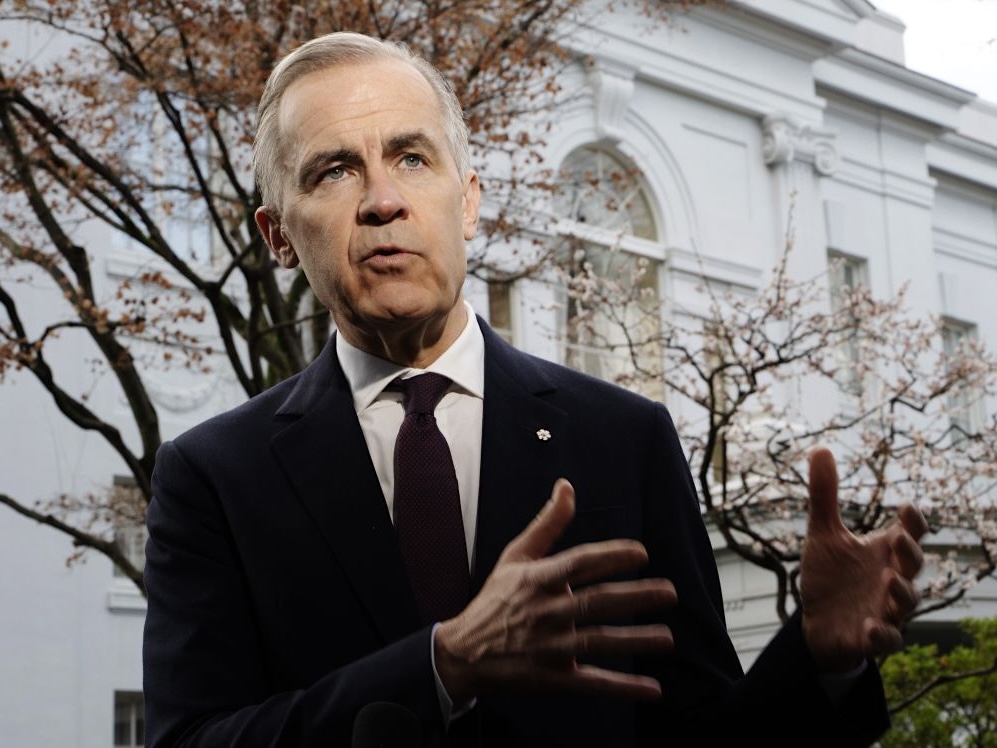
Prime Minister Mark Carney's much criticized ambiguity about the role of international law regarding U.S. and Israeli attacks on Iran is more than an excusable stumble by an inexperienced politician operating in a challenging environment.
Carney is building a foreign policy “doctrine” that increasingly warrants a closer look.
Last October, Carney lavished praise on U.S. President Donald Trump for supposedly “disabling Iran as a force of terror” with U.S. strikes months earlier. While the prime minister has softened — but not withdrawn — his support for the current military campaign that began in spite of progress on peace talks, he has not explained why he has long disagreed with intelligence assessments that Iran was not pursuing a nuclear weapon.
Nor has Carney or his ministers refused to rule out some form of participation in the conflict that is rapidly extending to other Persian Gulf states.
An opportunity to provide clarity on such issues was rebuffed when Carney skipped an emergency debate in Parliament on the growing crisis. Meanwhile, the war continues to unleash enormous human suffering and chaos.
The problem with ‘taking the world as it is’
The Liberal government has sought to frame its approach to Iran as a new policy “realism.” The prime minister himself repeatedly invokes the mantra that Canada, under his leadership, is “taking the world as it is, not as we wish it to be.”
In fact, the phrase was uttered more than a year earlier in a speech by David Lammy, the then-foreign affairs minister in the Labour government of Keir Starmer. Like Canada under the Carney Liberals, the United Kingdom is slashing international aid spending, reducing its foreign affairs budget and eliminating public service jobs, including diplomatic staff.
In an article published in the journal International Affairs, British academics Jason Ralph and Jamie Gaskarth warn against conflating pragmatism with more-cynical foreign policy realism, writing that “pragmatists would resist the politician's misjudged (or instrumental) invocation of realism as a reason why they cannot support democratic values at the local, national, international and global levels.”
When the prime minister says things like Canada supports U.S. strikes on Iran albeit with “regret,” it sounds cynical. When he does so even after the bombing of an Iranian girls' school that killed more than 100 children, it sounds callous.
Yet Carney seeks to absolve himself by invoking the main idea from his World Economic Forum speech, saying “the current conflict is another example of the failure of the international order.”
That speech, given in Davos earlier this year, has received near-fawning levels of praise for the perception the prime minister was defending middle powers like Canada against authoritarians like Trump. Unfortunately, Carney's actual assertions go much deeper and are more distressing.
Revisiting Carney’s Davos statements
In his remarks, Carney argued that countries like Canada should “stop invoking” the rules-based international order — the structure of global laws, norms and institutions that was built after the end of the Second World War — because it was always a “fiction.”
Carney went so far as to draw a parallel between middle-power countries operating within the rules-based order and Václav Havel's “greengrocer” passively existing under totalitarianism, as described in the writer's famous essay “The Power of the Powerless.” Referencing the imperative to no longer “live within the lie,” he proceeded to pronounce the rules-based order “dead” and advised that “we shouldn’t mourn it.”
In contrast to the almost universally positive media coverage the prime minister's speech has received, some striking direct and indirect criticisms have arisen.
Former chief prosecutor of the International Criminal Court Fatou Bensouda and Sam Sasan Shoamanesh, former chef de cabinet of the ICC prosecutor, for example, recently wrote in an opinion article: “International orders do not suddenly unravel because of political declarations broadcast at podiums, nor because of the conduct of aberrant outliers. They collapse when those collectively entrusted with their stewardship neglect to properly defend them.”
Longtime Canadian human rights advocate Alex Neve echoed that view in stating: “International law is not broken; our commitment to and defence of it is.”
Former senior Australian diplomat Sandy Hollway, who spent several years in Canada, took exception to Carney's pronouncement that the rules-based order was “fiction,” arguing that, “far from being a fiction, the rules-based order is actually an impressive edifice. It extends from the management of the world’s oceans and its airspace to arms control and disarmament.”
Indeed, it is important to recall these laws, treaties and organizations were created as a response to two world wars, a genocide, the creation of weapons of mass destruction, unregulated markets and a Great Depression.
A win list for rules-based global order
None of the measures taken in the past 80 years have ensured total peace or complete protection from harm or the end of poverty.
Yet this imperfect system has facilitated the eradication of smallpox disease and halted the spread of epidemics, helped end apartheid in South Africa and contributed to free and fair elections in more than 100 countries, reduced the quantity of nuclear weapons and landmines, protected the Earth's ozone layer, improved literacy for hundreds of millions of children, brought perpetrators of war crimes to justice, lowered the number of people living in extreme poverty and, just this month, created a consensus plan for strengthening access to justice for women and girls.
Certainly, there is value in an honest assessment of the contradictions, limitations and unmet promises of the international rules-based order. Absent a declaration of commitment to its spirit and clear proposals to address its shortcomings, pronouncing the death of the order looks less diplomatically courageous than politically opportunistic.
Where cynicism can lead
Voters encouraged to believe there is no effective rules-based order might be persuaded to consider there is no purpose to one either. In such an environment, policies once thought inconsistent with Canadian norms on responsible international citizenship may become more palatable. These could include policies the Carney government is presently enacting, such as:
- building a new “defence industrial strategy” and increasing military spending to $150 billion per year by 2035, double what the federal government currently spends on health and social transfers to the provinces and territories;
- fast-tracking major projects legislation that opponents argue is unconstitutional and a border bill that critics say violates international treaty obligations concerning refugees;
- abandoning climate change policies even though the International Court of Justice recently ruled that a clean, healthy and sustainable environment is a human right; and
- significantly cutting Canada's contribution to the Global Fund to fight infectious diseases, despite pleas from the executive director of the United Nations’ program on HIV/AIDS to reverse course.
If these norms can be shoved aside, the government may escape pushback on other files, too, including its conditions-free trade deals with countries that abuse human rights and allegedly assassinate Canadians, confounding failure to join international allies in regulating multinational technology corporations, and conspicuous silence over U.S. sanctioning of International Criminal Court judges, including Canadian Kimberly Prost.
Canadians can say they expect better
Signalling Canada's indifference to the international order also risks a broader movement away from global norms and rules, with potentially dire consequences for our own country. We are already seeing this play out.
Days ago, the Globe and Mail editorial board declared international law “broken” because the UN Charter applies to rogue countries like Iran. The Iranian regime is indisputably egregious, but by the Globe's logic Canada's Charter of Rights and Freedoms should not apply to disreputable citizens.
International law professor Mark Kersten calls the Globe's view "misguided and dangerous thinking for all states — all of them — facing aggression."
Considering the U.S. administration's repeated threats to our sovereignty, this applies to Canada too.
Lloyd Axworthy, the Canadian former foreign affairs minister who was instrumental in the development of the International Criminal Court and global landmine treaty, makes a similar point in accusing Carney of abandoning international law with his support for Trump's bombing of Iran.
"For a country that depends on law more than force for its own security, that is not realism; it is recklessness," Axworthy notes.
Similarly, University of Cambridge professor and former UN mediation expert Marc Weller warns: “The U.S., and the states that have failed to identify its conduct as a violation of international law, may come to regret the loss of legal and moral authority this will bring.”
Exhortations from political leaders like Carney to simply “take the world as it is” condition citizens to believe in inevitability, to conclude that we are without choices and, comfortingly, that we are without responsibilities.
As Maya Wang of Human Rights Watch assesses, referring in general to the Liberal government's "pragmatic" foreign policy approach, "Carney is somewhat coming from a defeatist point of view."
Canadians do not have to take the world as it is. We do not have to stay silent on violations of international law. We do not have to look away when schoolchildren are bombed. We do not have to rationalize injustice to appease a bully. We do not have to ignore our responsibilities or forget our values.
This moment of “rupture” in international politics is not a reason to discard our values; it is the reason to recommit ourselves to them. The survival of liberal democracy and Canadian sovereignty depends on it.
Canada and the world have faced this moment before. There was an international order prior to the Second World War: the League of Nations, considered to be the precursor to the United Nations. As history teaches us, that order failed to prevent the war.
However, as former French prime minister Joseph Paul-Boncour later remarked: "It was not the League which failed. It was not its principles which were found wanting. It was the nations which neglected it. It was the Governments which abandoned it."
Wartime British prime minister Winston Churchill agreed, declaring: “The League did not fail because of its principles or conceptions. It failed because those principles were deserted by those states which brought it into being, because the governments of those states feared to face the facts and act while time remained.”
It may not have been possible to stop the attack on Iran. It may not be possible to prevent the next violation of international law. It may not even be possible to save the international rules-based order from the authoritarian powers that wish to destroy it.
I expect, however, many Canadians want our country to try. ![[Tyee]](/design-article.thetyee.ca/ui/img/yellowblob.png)
Read more: Politics











Tyee Commenting Guidelines
Please note that email notifications for replies are not currently working due to a software issue which may be resolved in a future update.
Comments that violate guidelines risk being deleted, and violations may result in a temporary or permanent user ban. Maintain the spirit of good conversation to stay in the discussion and be patient with moderators. Comments are reviewed regularly but not in real time.
Do:
Do not: