

 SHARE:
[Editor’s note: This article includes reference to mass shootings, death, suicide and violent far-right racist ideology.]
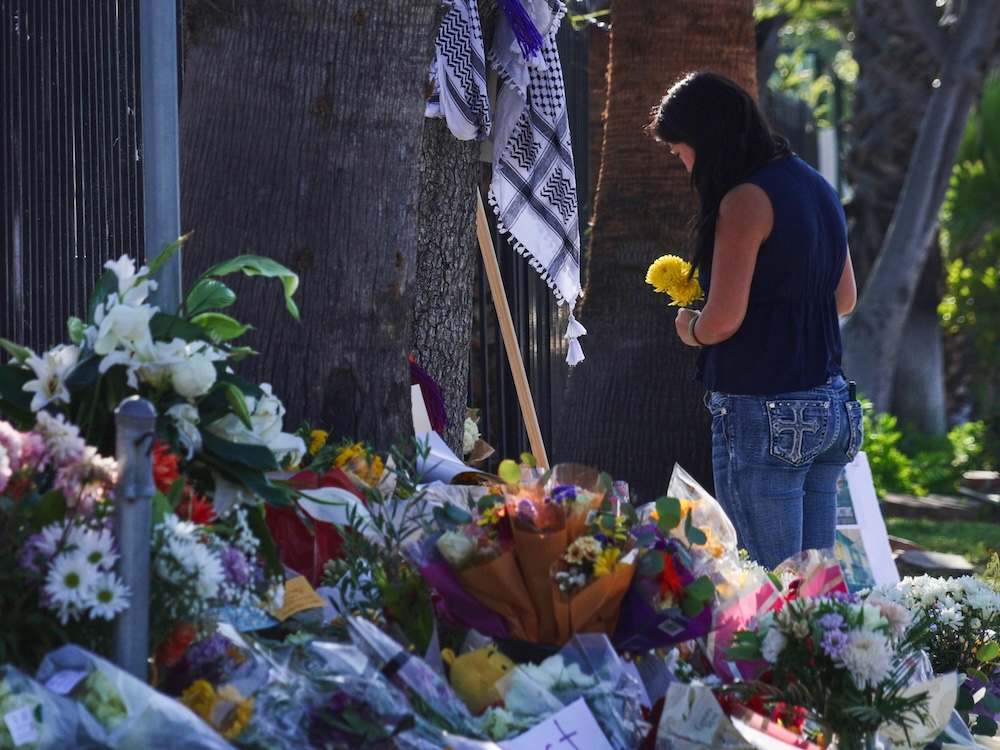
Two teenaged gunmen recently opened fire at the Islamic Center of San Diego, killing a security guard and two staff members before being found with fatal self-inflicted wounds in a nearby vehicle.
Like so many recent extremist mass shootings, they livestreamed the attack and, uniquely, even their suicides.
Police say one shooter’s mother had earlier reported him missing, suicidal and in possession of stolen firearms from her home. The attack is being investigated as a hate crime after authorities found a lengthy manifesto praising previous mass shooters.
No children were killed, and school staff and students at the centre’s academy were safely evacuated, thanks largely to the heroic actions of Amin Abdullah, the centre’s security guard. Abdullah was killed by the attackers.
As a radicalization and terrorism scholar, I have been researching extremist movements and mass violence for nearly two decades and have catalogued and read through close to three dozen manifestos.
What’s unique about the wave of attackers since the 2019 Christchurch attack is how much they’re inspired by each other, how they try to emulate the examples of previous assailants and encourage future violence.
The manifesto written by the San Diego attackers is no different and is the clearest recent example of how “saint culture” — a phenomenon that positions previous attackers not as cautionary examples, or even merely ideological predecessors, but as sacred models whose work must be continued — has galvanized the militant far-right.
The manifesto
There are a couple of things worth noting about their manifesto, entitled “The New Crusade: Sons of Tarrant.”
First, like with all manifestos, it’s an attempt to insert themselves into an existing lineage of far-right, racist and misogynist attackers.
From its opening pages, the document announces this ambition explicitly by invoking previous domestic terrorists as “heroes” — Patrick Crusius (the 2019 El Paso Walmart attacker), Anders Breivik (who killed 77 people in the 2011 Norway attacks), Dylann Roof (who murdered nine Black worshippers at Emanuel AME Church in Charleston in 2015) and John Earnest (the 2019 Poway synagogue attacker).
The most referenced figure in this lineage is Brenton Tarrant, who carried out the 2019 Christchurch mosque attacks in New Zealand, killing 51 Muslims. The “Sons of Tarrant” framing in the manifesto makes Christchurch the central symbolic origin point for the authors’ imagined movement.
This matters because Tarrant has become, in far-right accelerationist spaces, the paradigmatic “saint” — a figure depicted in their propaganda documents in quasi-Christian iconography and viewed as the attacker who kick-started a new wave of racial violence. After Christchurch, Tarrant was rapidly labelled “Saint Tarrant.”
In their manifesto, the San Diego attackers claim that before Tarrant there were only scattered examples of people who fought for the white race. After Tarrant, others followed in his footsteps. One of the goals therefore of the most recent attack was to inspire other would-be “saints” that the time to act is now.
The manifesto is not merely ideological; it is genealogical. It tries to place the San Diego shooters inside a chain of imitation that has become central to contemporary far-right “saint culture.”
This creates a kind of “wiki effect” where each attacker contributes something to the broader tapestry of racist militancy. Some attackers contribute ideology. Others contribute tactics and security measures they have taken to avoid detection and capture.
Curriculum of hate
Second, the San Diego attackers’ worldview was not organized around one grievance alone.
The mosque was the immediate target, but the manifesto makes clear that they were swimming in a much larger ecosystem of hate. They spread the blame widely. A lot of the manifesto’s arguments rely on pseudoscientific claims about race and gender; selective claims about crime rates, IQ, genetics, birth rates and social behaviour, presented as if they are neutral data.
In this sense, the attack was anti-Muslim in its target selection, but the grievance structure was much broader. In the manifesto, Muslims are cast as an enemy, but Jews are imagined as the hidden force behind social decline, women are blamed through incel language, LGBTQ+ people are framed as signs of degeneracy, and immigrants and racial minorities are treated as threats to white identity.
The shooters reject mainstream politics, including U.S. President Donald Trump and the MAGA movement, as part of the failed democratic system. They dismiss voting, protesting and mainstream conservative politics as useless.
In other words, the time for politics is over. The urgent threat to the white race must be met with force. The manifesto ends by praising attackers who came before them, and provides a “further reading” list, which includes Hitler’s Mein Kampf.
The result is a sort of curriculum of violence, which turns attacks into instructional material. Killers copy heavily from each other’s manifestos, they turn their weapons into propaganda material by inscribing on them earlier battles between Christian/European and Muslim/Ottoman forces, and previous far-right attackers.
The point is not only to kill, but to leave behind images and references that can be clipped and memed into saint culture.
Boys become believers
It’s important to note that the shooters were two teenagers, aged 17 and 18. How did they become immersed in bizarre pseudoscientific ideas about race, gender, sexual identity, Jews, Black people and Muslims? How did they come to see the white race as endangered?
Pseudoscience circulates constantly in online far-right and incel spaces as memes, charts, screenshots, YouTube clips, Telegram posts and “red pill” explainers. It gives personal grievance a bigger meaning.
If some young men feel humiliated or angry, these spaces make it clear that this is done intentionally. Society is lying to them, women are wired against them, multiculturalism is a sham and shadowy elites are dead-set on destroying their people.
So the challenge is not simply to understand what these young men believed, but to understand the ecosystem that taught them why they need to believe and how to perform this curriculum of hate. And only then can society begin to dismantle the ethos that sustains it.
![[Tyee]](/design-article.thetyee.ca/ui/img/yellowblob.png)







Tyee Commenting Guidelines
Please note that email notifications for replies are not currently working due to a software issue which may be resolved in a future update.
Comments that violate guidelines risk being deleted, and violations may result in a temporary or permanent user ban. Maintain the spirit of good conversation to stay in the discussion and be patient with moderators. Comments are reviewed regularly but not in real time.
Do:
Do not: