

 SHARE:
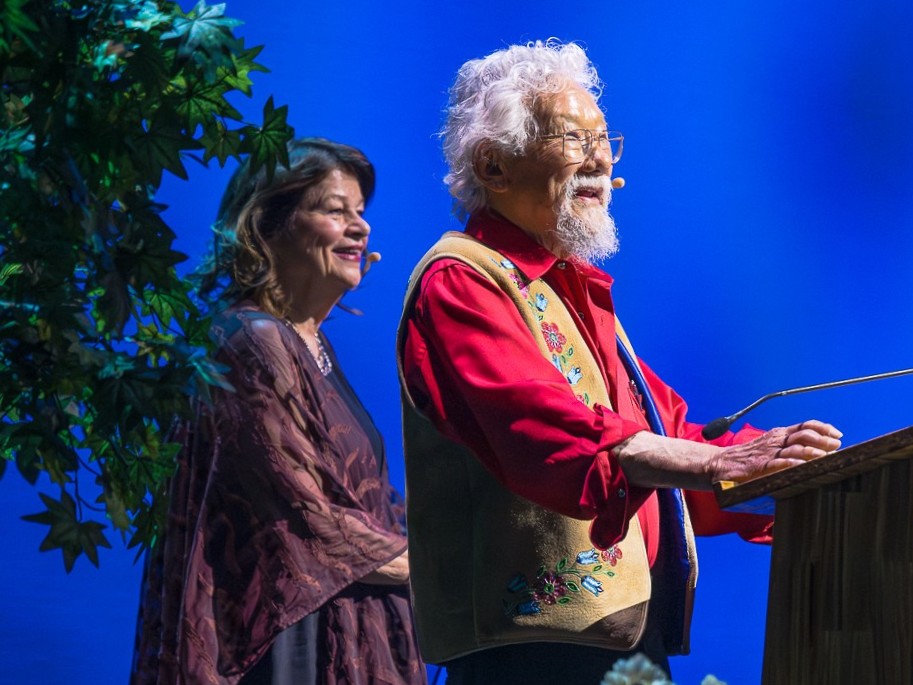
David Suzuki’s 90th-birthday celebration Friday at Vancouver’s Queen Elizabeth Theatre was named “Legacy” but it pointed forward — to future generations and our shared responsibility to leave them more than smouldering ruins. At a moment when climate change is slipping down the list of national policy priorities, the message was that giving up is simply not an option. And that fighting for the planet is not for the faint of heart.
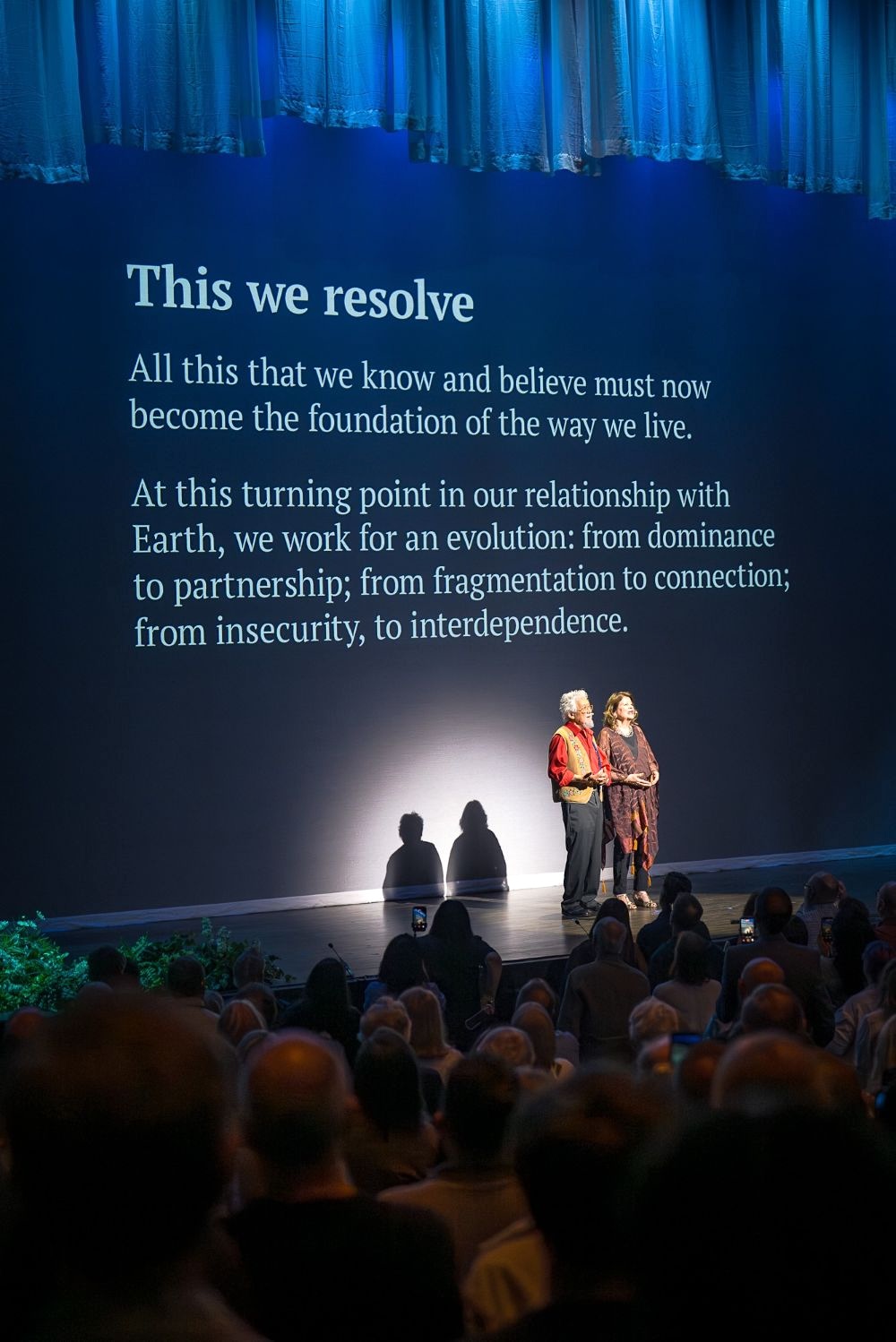
Sometimes the heart needs recharging. Among those who took the stage Friday night to do the job were famous friends of Suzuki like former U.S. vice-president turned climate crusader Al Gore and actress and political activist Jane Fonda (who trails Suzuki by two years and tossed an F-bomb while assuring that “as you get older, you get braver”). They read from the Declaration of Interdependence co-penned by Suzuki along with Tara Cullis, Wade Davis, Raffi and Guujaaw in 1992.
Throughout the fundraiser evening many noted First Nations leaders spoke of strides they’ve made in protecting their territories, some claiming as family Suzuki and his partner Tara Cullis, all crediting them for their respectful collaboration.
One tremendous musical performance after another by artists ranging from the Haisla hip-hop duo Snotty Nose Rez Kids to Bruce Cockburn, Sarah McLachlan and special guest Neil Young provided a soundtrack fierce and soaringly soulful. (See sidebar for all who paid tribute.)
As the evening neared its close, Tara Cullis spoke. (Her complete remarks, found here, traced a life's improbable arc.)
“Most of you know David as a TV personality,” she said, “but when I met David 55 years ago, he had just been named top scientist in Canada under the age of 35. He had the biggest genetics lab in Canada....
“So David is a scientist at heart” who “believed the public must have the chance to get excited, to understand the issues, to support basic science and be equipped to push politicians to good decisions.”
“The important thing to know is, he did not do this by himself!” she proclaimed with a smile. “He’s become a sort of figurehead that Canadians have nailed to the prow, but we, all of us, built that boat, and we’re rowing it.”
The last word went to Suzuki himself, who issued a thundering call to action. With his permission, we share it here. — David Beers
DAVID SUZUKI’S CALL TO ACTION AT 90
I thank the First Peoples of this land for the generous welcome to your territory.
Thanks everyone for this wonderful evening, too many to mention by name. This incredible night took so much effort from all the performers who gave generously of their talents and time, from sponsors who contributed financial support, the people backstage who made it all work, the incredible David Suzuki Foundation staff and volunteers, and thank all of you for coming.
We are here to celebrate our fight to protect a future for our children and grandchildren. It has been a privilege to have had 90 years to join the fight. I’m sure he doesn’t remember but in November 1992, I called Al Gore, the day after his election, to congratulate him and asked him, “What can people like me do to get people like you elected to office?” His answer gave me direction.
He said, “Don’t look to politicians like me. Go to the grassroots, convince them there is a problem, provide solutions and get them to demand change. Then, every politician will jump on board.” That’s what he has been doing as a champion fighting climate change.
Unfortunately, Donald Trump followed your advice with the MAGA crowd. But you are still right.
I asked Jane Fonda years ago how she was able to withstand the terrible attacks on her for opposing the Vietnam War and she answered simply, “I never felt alone.” That said it all; her celebrity enabled her to get media coverage but she always knew she was part of a movement. I was privileged to host The Nature of Things that reached millions of Canadians over the years but it was not just me carrying the burden of the entire fight and the attacks.
I said at Stephen Lewis’s memorial last month that the measure of a life is not in wins and losses, successes or failures or accumulated wealth, but in the values and actions by which one lived, and I hope that is how my 90 years will be viewed.
We are at a remarkable tipping point in the history of life on Earth.
We appeared on the savannahs of Africa 200,000 years ago, a two-legged, furless ape — not very impressive. So how did we make it? Of course, the answer is our brain. We were smart, curious, observant, inventive, and we remembered. And that brain invented an idea called a “future” that we could affect.
Walking along a path that branches, we remember Dad went right and almost got killed by a sabre-toothed tiger but Mom went left and found some fruit to eat, so we go left. Foresight was a huge survival trait.
Today, we have scientists and supercomputers. And for over 50 years, leading scientists of the world have looked ahead, warned of dangers and trumpeted the opportunities. But legal jurisdictions, economic priorities and political machination have blocked the actions needed.
The David Suzuki Foundation was established in 1990 to determine the underlying root causes of environmental problems because often after dams, clearcut logging and drilling for oil were successfully stopped, years later the very same issues popped up again.
And now, it is crystal clear why. For almost all of human existence, we understood that we are one small strand in a web of relationships with air, water, soil, sunlight and our relatives, all the other species that share the planet with us. In ceremony and rituals, we constantly acknowledged this relationship, thanking our Creator for Nature’s abundance and generosity and promising to “act in a good way” to ensure her continuing generosity.
This is still practised in many Indigenous cultures today but in the dominant culture, we lack this reciprocity, taking without responsibility because we believe we are supreme over the planet.
We forget we are animals — terrestrial, air-breathing mammals — because technology enables us to exceed all limits of our biology. Machines amplify our muscle power. We can fly faster than sound, dive the deepest oceans, escape gravity and live in outer space. Imagination seems our only limit and now machines can imagine for us at the speed of light. Already we dream of controlling weather, establishing colonies on the moon, harvesting minerals from asteroids and migrating to Mars.
All while ignoring the massive degradation of our home.
We must return to an ancient relationship with Earth. Laws, the economy, politics are all human constructs and can be changed. They were designed to shape, guide and constrain our behaviour and actions, but ignore the reality that our very existence and well-being rest on Nature.
If we don’t have air for three or four minutes, we die. If we don’t have water for four to six days, we die. If we don’t have food for four to eight weeks, we die.
These basic needs are not created by human technology or factories; they are gifts from Nature.
How can any creature who treats air, water, soil and the rest of life in thoughtless and destructive ways that threaten their own existence claim to be intelligent?
We have become too smart for our own survival because we have such faith in our intellect and the institutions we have created. To transform the legal, economic and political systems, we have to begin with the understanding that Nature is the foundation of our lives and well-being.
Then science must be elevated — out of the babble of social media — as the most credible source of information about the state of the planet and principles underlying ecological sustainability.
And the primary force motivating the demand for change must be not fear but love.
Love for our children and grandchildren. Love of community.
And love of the planet from which we are created. ![[Tyee]](/design-article.thetyee.ca/ui/img/yellowblob.png)
Read more: Environment









Tyee Commenting Guidelines
Please note that email notifications for replies are not currently working due to a software issue which may be resolved in a future update.
Comments that violate guidelines risk being deleted, and violations may result in a temporary or permanent user ban. Maintain the spirit of good conversation to stay in the discussion and be patient with moderators. Comments are reviewed regularly but not in real time.
Do:
Do not: