


 SHARE:
On Easter Monday, right-wing influencer Lauren Chen posted a selfie of herself and husband Liam Donovan standing on a lawn in the sun with the White House and a U.S. flag in the background.
The couple were attending a free annual children’s event open to the public via a ticket lottery.
It was a rare positive post about the U.S. government by Chen. Through the fall and winter she had been writing about how government agents had frozen her assets, “sieged” and raided her home and prevented her from renewing her work visa. She also posted several pleas for donations to fund her legal costs, posing with two of her young children.
But the April appearance at the White House signalled a comeback of sorts for Chen, a Canadian who lives in the United States and is a minor figure in the right-wing media ecosystem that has flourished under the two administrations of President Donald Trump.
Later that week she would announce her return to a regular production schedule, cranking out videos for YouTube and Rumble that complained about Black actors being cast in the movie The Odyssey or gloated that another prominent influencer “enrages Black activists with civil rights documentary.”
Alleged millions from Russians
Chen’s troubles had started in September 2024, during the waning months of Joe Biden’s presidency. According to a U.S. Department of Justice indictment, she and Donovan had accepted $10 million from two Russian nationals to set up a company called Tenet Media. Chen and Donovan didn’t face any criminal charges, but Kostiantyn Kalashnikov and Elena Afanasyeva — both employees of Russian state broadcaster RT — were charged with money laundering and conspiracy to violate the U.S. Foreign Agents Registration Act.
(The Department of Justice has never released any updates on the criminal prosecution, and Kalashnikov and Afanasyeva likely remain in Russia.)
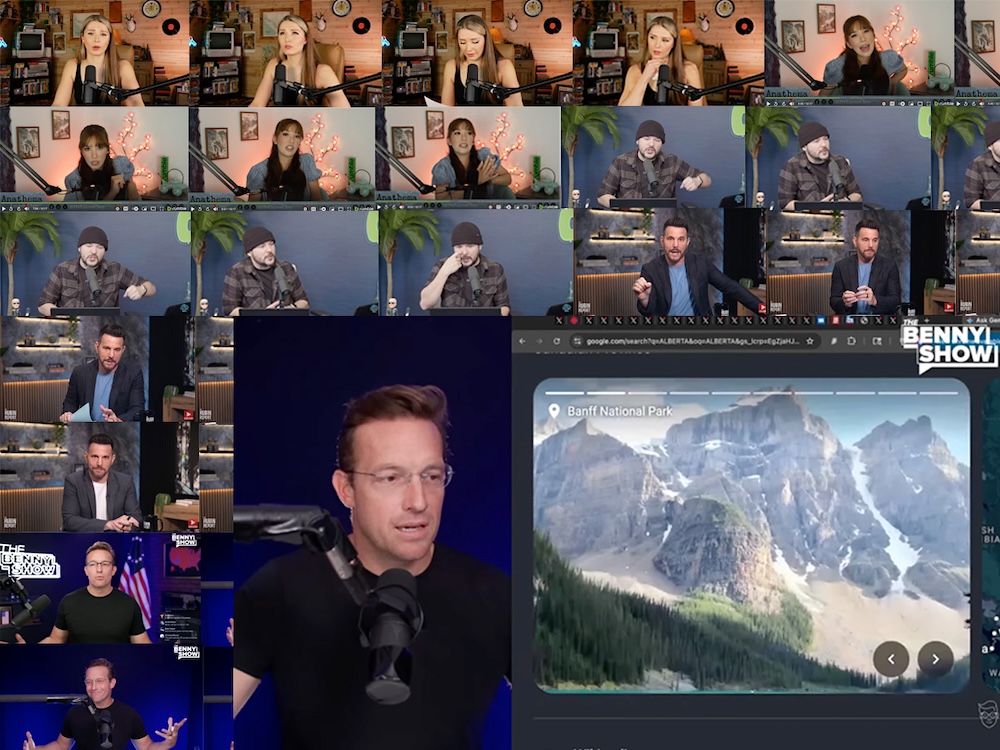
Chen and Donovan hired some of the highest-profile influencers in the right-wing media world to produce videos for their new channel, according to the indictment. Many had strong ties to the MAGA movement that backs President Trump: Benny Johnson, Tim Pool and Dave Rubin were included in the roster, as were Taylor Hansen, Matt Christiansen and Canadian YouTuber Lauren Southern. All have said they were unaware of the Russian money backing the company.
The Tenet Media indictment was part of a Department of Justice focus on the Russian government’s attempts to influence U.S. elections and politics. Around the same time as the Tenet indictment, the department disrupted several Russian influence operations, including seizing 32 internet domains for sites that mimicked mainstream news sites.
The U.S. Treasury Department also imposed sanctions on a Russian “hacktivist” group it claimed was run by Russian intelligence officers.
After the Tenet Media indictment was released on Sept. 4, 2024, Chen and the influencers she’d hired faced intense media scrutiny, including questions from other right-wing media figures. Chen and Southern pretty much disappeared from social media, while the higher-profile male influencers blustered it out, claiming ignorance and, later, unfair treatment from the Department of Justice.
Chen did not respond to The Tyee’s request for an interview for this story.
Pulling back the curtain, briefly
Experts who study disinformation said the case provided a rare look inside the Russian government’s attempt to influence public opinion in the United States and other countries, including Canada. And the indictment provided fuel for yet more speculation about the apparent connections between Trump and Russia.
But in November 2024, Trump was re-elected for a second presidential term. In the year and a half since then, the U.S. Justice Department has taken a sharply different path and has attempted to prosecute journalists and various high-level civil servants and politicians whom Trump perceives as enemies.
In April, the Department of Justice announced fraud and money laundering charges against the Southern Poverty Law Centre, a civil rights organization that has researched and raised awareness of far-right extremism for decades. The American Civil Liberties Union called out the charges as politically motivated, saying that "SPLC has been in the Trump administration’s crosshairs because of their central role in calling out right wing extremism."
Lucrative digital comebacks
Today, the Tenet Media creators are more powerful than ever. Pool, with 1.4 million YouTube subscribers, is a member of the White House press pool. Rubin, with 3.2 million YouTube subscribers, pumps out about four videos every day. Benny Johnson, with six million subscribers, is currently promoting a sit-down interview with Vice-President JD Vance and frequently promotes Alberta separatism and Canada becoming the 51st U.S. state.
“Their brands are growing,” said Jared Holt, co-host of a podcast called Posting Through It that examines right-wing media figures in the United States.
“Tim Pool once told me he makes millions and millions of dollars a year, just because of how wide the circulation on this podcast is. This [indictment]... didn’t seem to set anybody back really, except maybe Lauren Chen, who was nervous about legal implications for a minute.”
Aengus Bridgman, the director of the Media Ecosystem Observatory, said tracking the Tenet Media case and its fallout has led to a greater understanding of how major influencers have become media companies, a fact their audiences might not fully grasp. And why they are given relatively free rein to spread disinformation.
“A person has a set of legal obligations and a set of expectations about their behaviour and their ability to speak, and media institutions have a different one,” Bridgman said.
Organizations that pull in big dollars through their media operations should be held to a higher standard for consistency and truthfulness than, say, a lone actor offering scattershot opinions on social media. But largely that’s not yet the case. “Creators, particularly in the United States, have become institutions. And they know it — but the world and the public still treat them like people,” said Bridgman.
Leaving the US and visits from CSIS
It’s the Canadian Tenet influencers who appear to have faced actual disruptions to their professional lives.
Chen describes facing consequences such as having her bank accounts frozen, her YouTube channel suspended and having to leave the United States after her work permit lapsed. But she also claims Joe Rittenhouse, a senior adviser at the U.S. State Department, “moved mountains” to help her family return to the United States in December.
Southern is a YouTube video creator who lives in British Columbia and has a history of producing anti-immigration, anti-Islam commentary. In a 2017 book, she wrote that “Islam the religion is by its nature dangerous to the West” and warned of a clash of civilizations and called immigration a threat to “borders, family, identity.”
She says that after the indictment was released, she was contacted repeatedly by agents from the Canadian Security Intelligence Service, or CSIS. She says those agents implied an investigation was underway.
In recordings Southern released on YouTube on Nov. 10, a man can be heard trying to persuade Southern to give information about the Tenet Media influencers. He appeals to her role as a mother, then tries to flirt with her, then implies there could be serious legal consequences if she doesn’t co-operate. “There’s certain things in motion right now,” the agent says, claiming the other influencers have been speaking with the Federal Bureau of Investigation. “This is not going away any time soon.”
In the months following the Tenet Media indictment, Southern published a memoir that got international attention for its allegation that Andrew Tate, a “manosphere” influencer charged with rape and human trafficking, had sexually assaulted her in 2018.
She’s recently returned to making long-form YouTube videos, and this February she gave a speech in Victoria, B.C., to We Unify, a right-leaning Canadian political group. In May, she appeared at a Vancouver tech conference that attracts politicians and tech executives, speaking as an expert in online media.
‘Successful propaganda’
In her book, recent YouTube videos and the We Unify speech, Southern has claimed that political influencers regularly accept money to make videos and social media posts, but she has not described any specifics. In testimony to a Canadian parliamentary committee, she downplayed the reach of the Tenet Media videos and scoffed at concerns about Russian involvement.
She’s continued to paint immigrant communities as a threat to Canadian culture and has written about feeling uncomfortable around South Asian people when she was growing up in Surrey. She told The Tyee that being concerned about immigration is now a mainstream political position in Canada, and she does not consider her views to be far-right.
Southern’s work also appears to have influenced the Trump administration. Her 2018 documentary Farmlands focused on murders of white farmers in South Africa, exploring a narrative popular with white nationalists that the crimes are racially motivated.
Holt said a direct line can be drawn from Southern’s documentary to the United States’ current refugee program for Afrikaner South Africans, put in place supposedly to protect the minority white ethnic group that ruled South Africa during apartheid. The program is operating at a time when the U.S. government has suspended all other refugee programs.
“Farmlands was the most successful propaganda on that issue that has maybe ever been produced,” Holt said. “Breitbart was helping her promote it; she was doing sort of a media tour around it. And after a Tucker Carlson segment on it, Trump started to take interest in the issue.”
Southern told The Tyee she thinks Farmlands “contributed to a broader discussion around violence and instability affecting some South African farming communities, particularly among conservative audiences in the United States,” but she does not think her work had a “sole or direct influence” over the U.S. refugee program for Afrikaner South Africans.
She also told The Tyee she’s currently working on several projects with mainstream media that will focus on manipulative online information campaigns.
Bridgman said he’s been struck by Southern’s and Chen’s stance of never apologizing for accepting money from Russian state media.
“There was no accountability, there was no apology, there was no reflection,” Bridgman said.
Did Canadian influencers violate sanctions laws?
The Tyee contacted the U.S. Department of Justice, the RCMP and CSIS to ask about the status or existence of any investigations related to the Tenet Media indictment.
A Department of Justice spokesperson said they could not discuss any investigations, and the RCMP did not reply to The Tyee.
CSIS spokesperson Magali Hébert told the Tyee: “We take our obligations to the Canadian public and to national security very seriously, including as they concern potential state-sponsored disinformation campaigns that are conducted covertly or clandestinely by known threat actors.”
Asked about the conversations with CSIS agents Southern has described and released a recording of, Hébert said CSIS wouldn’t comment. “To protect our operations, we cannot confirm or deny the veracity of the purported conversations being referenced in your request.”
Marcus Kolga is the director of DisinfoWatch, a Canadian organization that monitors and debunks disinformation. He said he continues to have questions about whether Chen and Southern violated Canadian sanctions laws when they accepted money from RT.
“If we don't investigate, if we don't hold those to account who are involved, then it renders our sanctions regime — which is supposed to be acting as a deterrent — it renders it sort of useless and toothless,” Kolga said.
After Russia’s invasion of Ukraine in 2022, Canada imposed “special economic measures” against RT. In 2023, Canada added sanctions against RT’s parent company, MIA Rossiya Segodnya, which Global Affairs described as “a Russian state-owned media company.”
Tenet Media launched in November 2023. According to the Department of Justice indictment, Chen and Donovan accepted wire transfers from the two RT employees from October 2023 to September 2024. Some of that money was deposited in the Canadian bank account of the Canadian subsidiary of Tenet Media, according to the indictment.
Neither Global Affairs nor the RCMP responded to The Tyee’s request for information on whether there are any current sanctions investigations open for Chen, Donovan or Southern.
In her 2025 memoir, Southern writes about being concerned about possible Canadian sanctions violations for previous work she’d done for RT in 2022, but she was then reassured that those payments weren’t affected by the time period covered by the new Canadian sanctions. She also writes that all her remaining worries about possible legal consequences for her Tenet Media work disappeared when Trump was re-elected in November 2024.
A convergence of US and Russian disinformation
Kolga has continued to monitor the Tenet Media influencers. He’s noticed that the American YouTubers who produced videos for the Russia-funded company have been talking a lot about Alberta separatism lately.
In a recent report to which Kolga’s DisinfoWatch organization contributed, disinformation researchers warned that Alberta separatism has become a focus for both Russian disinformation narratives and U.S.-based influencers. Officials in the U.S. government have also openly supported Alberta separatism, as Trump continues to call for Canada to become part of the United States.
The researchers wrote that the Tenet Media scheme represented a “convergence” of U.S. and Russian disinformation.
“No one’s suggesting that these people, these influencers, are continuing to get some form of benefit from Russian government or organizations,” Kolga said of the content creators who signed on to produce videos for Tenet Media.
“But the fact that there were some who are alleged to have received upwards of US$100,000 per podcast or episode, the fact that these same voices are now [talking about] Alberta, I don’t think is a coincidence.”
This article is part of The Tyee’s reader-funded Reality Check project exposing and explaining disinformation. ![[Tyee]](/design-article.thetyee.ca/ui/img/yellowblob.png)







Tyee Commenting Guidelines
Please note that email notifications for replies are not currently working due to a software issue which may be resolved in a future update.
Comments that violate guidelines risk being deleted, and violations may result in a temporary or permanent user ban. Maintain the spirit of good conversation to stay in the discussion and be patient with moderators. Comments are reviewed regularly but not in real time.
Do:
Do not: