

 SHARE:
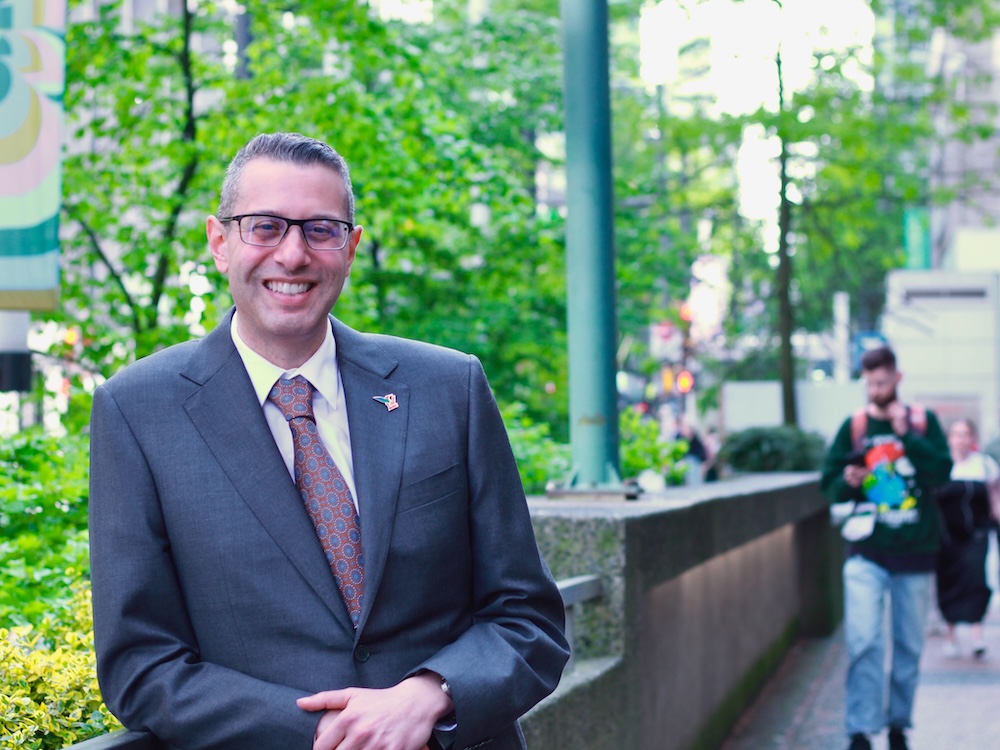
Kareem Allam knows a thing or two about running election campaigns.
The self-described policy nerd successfully steered Ken Sim to become Vancouver’s mayor, and Sim’s party, ABC Vancouver, to a resounding victory on council, park board and school board in the 2022 municipal elections. Allam was responsible for creating simple and easy-to-understand campaign promises, such as a pledge to hire 100 police officers and 100 nurses.
Before that, Allam was helping Dianne Watts win her 2005 Surrey mayoral race and working on former Conservative leader Erin O’Toole’s leadership campaign and Kevin Falcon’s run for leader of the BC Liberal Party. And he cut his political teeth working for the now defunct federal Canadian Alliance party.
While Allam initially served as chief of staff for Sim, he was fired when public allegations of a coverup involving his boss were sourced back to him. He’s since become an outspoken critic of Sim.
Allam’s got plenty of policy ideas for the city. But it takes a team to run a political party, in this case the Vancouver Liberals party Allam founded last year when he became the first to announce his mayoral candidacy.
And when Allam met with The Tyee in a downtown Vancouver office building for our interview, he let us know he’s not the sole creative force behind the party’s social media channels that have been pushing out campaign platform videos since last September.
Except for one recent video: a Star Wars “May the Fourth” post.
“Then I get full creative final control,” Allam said with a grin.
In case you’re wondering, he loves all the Star Wars movies, particularly the most recent films with their powerful female Jedis. But if he had to pick, Rogue One is his favourite.
“Because it was like less lightsabres and just more people who don't have control over the force,” he said.
Allam was born in Vancouver and raised in Richmond. His parents are a former Sudanese refugee and a former Egyptian colonel and Israeli prisoner of war.
Allam’s father, Mahmoud Allam, would later return to Egypt and a successful career as executive manager of the Al Ahly football club.
But while Allam would leave the West Coast for high school and grad school, and a brief stint in Ottawa to work on Parliament Hill, he keeps coming back to Vancouver. When not running political campaigns, Allam worked for the Vancouver Board of Trade, the Fraser Health Authority, TransCanada, FortisBC and Britco.
He’s also sat on numerous boards, from the Fraser Health board to the TransLink screening panel, the Overdose Prevention Society, or OPS, and the College of Massage Therapists of BC.
The 2022 ABC Vancouver campaign was supposed to be Allam’s last. People encouraged him to run against Sim in 2026, but Allam had already promised his wife that his campaign days were over.
But then last year Mayor Ken Sim announced he was suing his former campaign manager and chief of staff for defamation.
“He didn't upset me. He upset my wife,” Allam said with a laugh. “She's like, ‘Well, I hope you run. And I hope you beat him.’”
The lawsuit is ongoing and unlikely to wrap up before the election, unless the parties agree to a settlement. Allam has also filed a third-party claim against the city to pay for his legal fees based on the indemnification clause in his chief of staff employment contract.
Sim and Allam do have some things in common, though. During our interview Allam made a pledge to scrap the Vancouver building code in favour of the provincial code, almost two weeks before Sim announced his own motion to do the same.
Both proposals are aimed at speeding up housing construction in the city. However, Allam seems to accept Vancouver’s natural gas heating ban, while Sim wants to return the choice for gas or electric to developers.
This interview has been edited for length and clarity.
The Tyee: People have different versions of what kind of city they think Vancouver is. What kind of city is Vancouver to you?
Kareem Allam: My family history defines a lot of how I perceive this place. My family was expropriated in a revolution in Sudan. My mom lived in a refugee camp in Lebanon for two years before coming to Canada.
[Vancouver] was a welcoming place, a place of refuge and a place where they were able to thrive, raise their children. It wasn't always prosperous. But over the arc of time, the family has done well.
After my mom graduated from Simon Fraser University, she went back to Egypt for work. She met my dad. My dad fought against Israel in the ’67 war; in the ’73 war as a colonel. He spent 11 months as a prisoner of war. The experience he had here in Canada helped enhance his perspective and his ability to be successful in his career. He recently passed away.
I don't want to be too nostalgic about the good old days, because they were good for some people, bad for others. But some of the things that built that social cohesion that existed when I was younger are tearing away.
I had Jewish, Indian, Chinese, Indigenous friends, because I met them at our community centres, pools, libraries. I connected with them at our schools. The biggest challenge for the city right now is how divided we've become. And I attribute that to decline in those frontline services that build social cohesion.
What is your history with politics?
It's been 25 years of time in politics. I've run 40 political campaigns, mostly successful. I've also been a policy analyst.
For the last 15 to 20 years [I’ve] primarily been involved in working with First Nations on economic development projects. And more recently the Richardson Strategy on title and rights negotiations. So a good and growing understanding of the complexities of DRIPA [the Declaration on the Rights of Indigenous Peoples Act], Section 35, of Supreme Court decisions ranging from Calder in 1969 through Delgamuukw, to most recently the Williams decision.
You spent a brief time as chief of staff for the mayor. What did it teach you about city hall?
We have an incredible civil service at the City of Vancouver that has struggled with a very chaotic council table for the last 20 years. When you get erratic, unpredictable legislative bodies in power, the bureaucracy acts erratically or shuts down. You need clear direction, clear vision to drive outcomes at the policy level.
One good example is: ABC ran the last election on supporting a democratically elected park board. And then erratically, suddenly, there was a dramatic policy shift. The outcome of that instability is the bureaucracy starts to shut down, not knowing what is going to happen. Is the province going to pass this?
The instability impacts long-term planning. Which means, how are we investing in parks? Which community centres are we going to prioritize for construction next? But it really impressed upon me that the biggest challenge is the lack of clear, concise directioning from council. And to get stability is what's critical to driving outcomes.
Why do you want to be mayor?
I want to be mayor because the city of Vancouver deserves someone who wakes up every morning and asks themselves one question: “How am I going to make life better for the people of the city?” I don't think we've had that with this mayor.
To run this city, to drive a good, thoughtful agenda, you need a coalition builder. You need someone who's not afraid of putting people with diverse opinions around the table to wrestle with the more difficult and challenging questions facing our city.
I looked at the parties that exist and felt that they were too ideologically rigid. And we need a government at city hall that is going to make decisions based on facts, science, evidence, data and lived experience. Not on the hottest take of Ayn Rand, Foucault or Marx.
You were the architect of much of ABC's campaign last time. Why should people unhappy with Ken Sim trust you?
I was hoodwinked by Ken Sim. I thought he was interested in having a broad base coalition; making decisions based on fact and evidence; bringing people around the decision-making table that disagreed with him. After he got elected, it very quickly became apparent that he didn't share that vision.
I became, certainly outside of council, his most vocal critic. I was really critical of his decampment of [East] Hastings, which he also promised to not do. The commitment that I was sent to make by him and council to the [Coordinated Community Response Network] was that everyone decamped would be offered housing. Not shelter, but housing.
And then he decamped before that housing was ready.
No one gets involved in politics to become wealthy. There's a sense of public service and duty, and you really have limited currency. Where you don't get to go into disenfranchised communities, make promises and roll back on them. To me, that was a betrayal of the highest order.
Rebecca Bligh describes her Vote Vancouver party similarly to how you describe the Vancouver Liberals, as a big tent for people across the political spectrum. How do the Vancouver Liberals differ from other parties?
One is the calibre of the people we've been able to attract. Just the diversity of experience we have on the team. We have a self-described feminist, socialist, environmentalist as one of our council candidates. We have a former B.C. Conservative candidate running as one of our candidates. We have a former cabinet minister who served provincially for eight years.
We've been able to attract a team of advisers that have decades of experience, the federal, provincial and municipal level, advising our policy or platform.
But beyond that, Rebecca has been a councillor now for almost eight years. She's had her chance, and nothing in the City of Vancouver has gotten measurably better. And I would hold her to the same standard as I would the other incumbents that are running for office. I find a lack of ambition with all the other parties’ position.
I'm the only candidate to say that my No. 1 priority is the University of British Columbia SkyTrain line. I'm also talking about amalgamating with UBC, creating one municipality to ensure that my council has the authority to zone that innovation corridor that is going to fuel the next generation of jobs. That's going to bring young people back to Vancouver.
Where do we get the money for the SkyTrain to UBC?
Density bonus captures.
So densifying more Broadway or?
Yes.
Anywhere else?
Down that SkyTrain line. So from Arbutus to UBC.
What do you mean by innovation corridor?
I see the incredible amount of innovation coming out of UBC. You've got TRIUMF, one of the only two cyclotrons in the world. You've got nuclear physicists. You've got some of the top biotech research happening there.
I see an innovation corridor as a job centre where we're incubating, encouraging some of the larger innovative companies globally to come to Vancouver. But also to get Vancouver companies the resources and connectivity with those researchers.
We're producing some most incredible talent, also in the arts. Vancouver has the highest number of artists per capita of any city in North America. So again, connecting those artists with the art community here.
And then part of it is also health. [We’ve] got this great hospital, UBC Hospital, that under-services the community. Do you know why 75 per cent of supportive housing is in Vancouver? Because we have seven hospitals and Surrey has one. You need an acute care system to support those supportive-housing units. So to me, connecting up with UBC also enables the opportunity to expand supportive housing.
There are seven people currently running for mayor. How do you respond to criticism that so many people running for mayor will split the vote and allow Ken Sim to win again?
That was the exact same criticism that everyone made last time to say that Kennedy Stewart would win the election.
Are you a homeowner or renter?
I'm an owner.
How do you feel about property taxes?
Ken Sim has raised property taxes by more than any other mayor in the history of the city. It's 26 per cent. The budget that he inherited from Kennedy Stewart was $1.7 billion and today his budget is $2.4 billion. Where's all the money going?
I'll tell you where the money's going. The internal inflation rate in the city of Vancouver ranges between eight and 11 per cent. Ken was supposed to be the financial ninja to get at the root cause of these problems to ensure that our property taxes, when they go up, go to pay for frontline services. And he's miserably failed at that.
What do you mean by internal inflation?
In government, the bureaucracy is very concerned with their internal inflation rates. Because you might get, as we're seeing at the school board, a two or three per cent increase from the Ministry of Education for their budget. But their cost pressures internally might be going up by six or seven per cent. So it leads to a cut in services.
One of the things that impacts internal inflation rates are labour and wages. But here's the funny thing that most people in public don't know: labour wages tend to be deflationary, not inflationary.
Why is the inflationary rate in the city going up?
When you have concrete falling from the ceiling, like the aquatic centre, the maintenance costs on those go up dramatically. It's materials, it's overtime labour. When you don't invest in the capital, it triggers increases in the operating cost.
The Vancouver Liberals have committed to $1.4 billion worth of new capital spending to get our community centres, pools, parks upgraded. This will decrease our operating costs. This will decrease our internal inflation rate. And will drive great new programs and great new assets to build connectivity in the city. Six birds, one stone.
So where do property taxes factor in?
The property taxes keep going up, but we’re not getting more increases in frontline services. It’s well documented that Vancouver, against a list of other cities in North America, we don't charge property taxes as much.
For those that are concerned about property taxes being too high, it’s the internal inflation rate that's driving the property taxes going up. For those that are concerned about frontline services, if we don’t solve this internal inflation rate, you can increase property taxes all you want. But it's still not going to lead to more frontline services.
I don't believe in a “zero means zero” budget. I worked for Mayor Watts in her 2005 election. Before her, Doug McCallum, he did a property tax freeze for two or three years. And the negative impact that she had to deal with in her term in office as a result of that “zero means zero” budget led to a massive degradation in community centre, library centre hours, every frontline service imaginable.
How would you handle the city's housing crisis if you were mayor?
So on Day 1 of a Vancouver Liberal government, we are getting rid of the Vancouver building code. And we're replacing it with the B.C. building code, just like every other municipality in the province. We are the only jurisdiction in Western Canada that has its own building code. It just adds more regulation and more red tape.
There was a time, not too long ago, where all the approvals for low-, mid- and high-density projects were approved in one single department. Today there are 12 departments that all have a veto on your project. We're going to bring it back down into one department. That work starts on Day 1.
The last thing is a bylaw review. Every time we draft a new bylaw, we don't go back to check and see if it conflicts with an old bylaw. We are adding so much complexity and the requirement for so many consultants to navigate through this maze of bureaucracy and bylaws that don't actually build housing. And don’t actually make housing safer, better for the environment or any of the other objectives that we would have around housing.
How should the city respond to the toxic drug crisis and the mental health crisis?
I didn’t learn till much later in my journey with [Overdose Prevention Society] that even within health care there’s a lot of systemic bias in how they approach a community and neighbourhood. Let's break this down into a few categories.
There are three parts to a drug user’s life: there's the before, there’s the during and then, if we do things right, there’s an after. The during part will never be zero. Throughout the entire history of humanity, there have been drug users. But if the goal is to reduce the number of people using drugs, then we need to slow the number of people coming in from that first category and speed the number of people coming out.
The before part is largely people who have experienced significant levels of trauma in their lives. A significant part of the population is Indigenous: legacy of the residential school system, of the Indian Act, of a whole range of issues. Former Afghan war vets, police officers, firefighters and paramedics.
Construction workers physically injured on the job. Another group: children who bounced around from foster care. We don’t really have a great system in the province of British Columbia for transitioning young people out.
One of the fastest-growing groups is women escaping gender-based violence, again significant trauma. And then the fastest-growing group are seniors. Often being renovicted, demovicted, not able to afford to age in place.
The first issue is, as Canada, we’ve built all our social supports an inch from the ground.
What do you mean by that?
If you're a senior and you’re $75 or $100 short for making rent, government should help make that rent for you. It’s cheaper. You get better outcomes. You’re keeping people in community. It’s a good policy.
If we don’t give them that $75, they have to fall all the way down through the system till they’re about homeless. And then the system picks them up there, and that costs us $70,000 [to] $100,000 a year. It’s more expensive, and you get worse outcomes.
To me, this is a public policy failure of monumental proportions. The answer is so obvious on what needs to be done at least with that quadrant of the population.
The second thing is, because we have a socialized system of care, we build centres of excellence. That’s how you drive efficiency. There’s only one children’s hospital in the province. There’s only one women's hospital.
The same thing is true about the Downtown Eastside. Our best, our brightest caregivers are all there in the Downtown Eastside. I don’t think people understand how delicate the system is, and how much is being propped up by individual acts of valour, heroism and self-sacrifice.
When you talk to recovered drug users, what’s required to help most people is one-on-one, individualized supports and care. We have a really good health-care system if you have cancer or heart disease. But everyone’s trauma is different. Everyone’s dealing with comorbidity issues.
If we’re going to see progress, we need to stop looking at the Downtown Eastside as a population, and we need to start looking at and treating people as individuals.
What would that look like from a city perspective?
I will be a passionate advocate. But also try to educate the public on what’s required to vote for the governments that are going to align with me on these issues.
I did a round table with a group of unhoused individuals a few months ago and asked them, “If I became mayor of Vancouver, what are some simple, easy things I could do to make your life better?” And the first person says, “Can we get some benches?”
The second person said to me, “Why is it when I go to Gastown, Mount Pleasant, Yaletown, they’ve got trees, they’ve got banners, they’ve got garbage cans. And we don’t have any of those things here?”
The third thing was rats. “What are you going to do about the rats?”
The city has fallen down on its responsibility of delivering the same standard of frontline services in that neighbourhood as it has everywhere else. [The Downtown Eastside] has the worst tree canopy growth; it's horrible in the hot summers.
On Day 1, I'm repealing Ken Sim’s supportive-housing ban. In our Vancouver, we do not ban any kind of housing. We’re not banning overdose prevention sites. It is a critical service area that connects people up with services, but it also saves lives. Some of the struggles, the roadblocks that we’ve had on getting unhoused people housed, these start to go away.
We’re building to too high of an environmental standard for supportive housing. You got that project right now, across the street from OPS. It’s an 11-storey tower, it's being built at LEED Platinum standard. Can we build it to LEED Bronze and get 80 more people off the street?
You have criticized the removal of the renters’ office. Would you bring that back?
I would.
Violent crime has gone down, but there’s still a lot of emphasis on crime and safety in the city. How would you address people’s safety concerns?
First thing is, crime has not gone down. Task Force Barrage was an unmitigated policy failure of monumental proportions. All it did was take the problem of homelessness, drug use and crime and spread it out throughout the entire city.
But more importantly than the crime aspect of it is you’ve disconnected people from the services that are present in the Downtown Eastside. There are 45 different kinds of services delivered in the Downtown Eastside, from hepatitis to mental health services, that each unique individual will rely on differently. None of those exist outside of that neighbourhood.
So, pushing this out has led to worse health outcomes and has put way more pressure on the health-care system, a system that's already quite overtaxed.
The second thing I’ll say about public safety is the drug supply in the Downtown Eastside changes very rapidly. And health care can't adapt as quickly as the drug supply does. We do not have a strategy for methamphetamine. Very difficult to recover once you've been on meth.
We’ve seen a dramatic increase in meth use in the last three years. Meth combined with alcohol or a psychotic episode is what makes people have those violent screams that you hear on the street. It’s often what is behind these machete attacks.
[Manitoba] Premier Wab Kinew recently announced a meth strategy. If you’re having a psychotic episode while on meth, you will be incarcerated for 72 hours to come down from a meth high. I would do exactly what Wab Kinew did.
Would they be incarcerated in jail or in a hospital?
Treatment.
Does this treatment exist?
No. It takes the courage of conviction of a premier to do it. But David Eby’s phone will not stop ringing about this issue.
Every year the Vancouver Police Board asks the city for a budget increase. They are now a fifth of the city budget. How would you respond as mayor if the police asked for more money?
In 2010 the police budget was $193 million for 1,400 police officers. In 2025, today, the most recent police budget that passed was $497 million. I’m just gonna play a fun little game here. Guess how many police officers?
1,400.
Yep. Where did all the money go? Since we didn’t get more police officers, did we get more dogs for our K-9 unit? Did we get more horses for our mounted unit?
Because even as chair of the police board, I don’t get visibility into the police budget to audit it. The only person that does is the solicitor general of the province of British Columbia, and that will be another phone call I'll be making to Premier Eby.
And maybe the audit uncovers that the police are in fact underfunded. I don’t think that’s going to be the case. But before we have a really legitimate, honest conversation about the police budget, there will be some form of accountability.
But the accountability is not to me. The accountability is to the province, and there’s a discrepancy with the accountability being to the province, but me being the taxing authority. That is a systemic failure.
How would you run a city budget process?
Not the way it’s currently being run. On Day 1 of the Vancouver Liberal government, we’ll be requisitioning for 400 new frontline CUPE [Canadian Union of Public Employees] workers. That’s to increase library hours, community centre hours, maintenance of our parks, our fields, garbage pickup.
And I’m going to pay for that by reorganizing some of those white-collar exempt positions, by getting rid of managers at city hall who do nothing more than manage other managers. And ending the ruinous practice of hiring consultants. Our best guess as Vancouver Liberals is somewhere between $110 and $180 million a year is going to accountants, communications firms, the public affairs firms and the relentless stream of polling that the city does.
To bring young people back, I need to do three things. Create the jobs that pay the wages that allow them to afford to live here. I will do that with my innovation corridor down the SkyTrain line, in conjunction with the amalgamation with UBC.
Second thing is housing, which I’ve already talked about. No. 3, and this is critical, is enhancing frontline services with those 400 CUPE workers in conjunction with that rapid expansion of that $1.43 billion of community centre money and pool money that I’m going to invest in. We’ve got to make it affordable, enjoyable and easy for parents to raise kids here.
We used to brag about Vancouver being the greenest city. How would you balance your hopes and wishes for Vancouver with preparing for climate change or ongoing sustainability concerns?
Yeah, our CO2 emissions have gone up every year since 2010. We need to relook at how we measure CO2 emissions. For example, we’ve got a natural gas ban here in the city. So if a business [that uses gas] leaves Vancouver and goes to Burnaby, will it really reduce CO2 emissions?
For me the biggest opportunity to reduce CO2 emissions is transit. UBC SkyTrain line will have a dramatic impact on reducing CO2 emissions. We’ve got part of the way there on a rapid bus for 49th Avenue. And I don’t know if it’s been funded, but connecting Marine Gateway with 22nd Avenue SkyTrain station [with a rapid bus line] in New West. I'm a big fan of active transportation. I haven’t owned a car for three and a half years.
We can do a lot better job by planning out how we electrify those vehicles that have to be on the road. Maybe my encouragement to the provincial government is, as they’ve gotten rid of some of these rebate programs, they help with the financing.
The city has done a reasonably good job on reducing CO2 emissions in buildings. As old buildings come down with a natural gas ban in place, electric lines go up.
How would you approach a relationship with both the urban Indigenous community and the host nations, səlilwətaɬ (Tsleil-Waututh), xʷməθkʷəy̓əm (Musqueam) and Sḵwx̱wú7mesh (Squamish)?
I enjoyed a great relationship with the host nations and worked for each of them. In the case of səlilwətaɬ, my relationship goes back almost 15 years now. I have a fond appreciation for their governance, for their culture. But also enough of an instinct to know when I don’t have the answers. And enough familiarity to know when to pick up the phone and ask for guidance, advice on issues.
I’m much earlier in my journey in understanding the complexities of urban Indigenous people. I built some really great relationships. I understand the struggles and some of the frustrations in accessing services, in being seen and being recognized.
Getting rid of [the city’s diversity, equity and inclusion] department and not investing in a full-time position or a team to work with urban Indigenous, it’s priority for me to restore those positions. There’s an opportunity to consult in terms of what that looks like and actually build it right this time.
If you win and Vancouver Liberal councillors are also elected, would you require everyone to vote the same?
On platform items, yes. Because we came up with that platform together. Now I say that, knowing that things can rapidly change that require [you] to adjust the position, or new evidence or new data comes to light.
But it’s my commitment to the civil service, to the bureaucracy: no erratic policy. Clear vision, clear guidance. I want the public to know where we’re going at all times. And if we can develop that stability and that clarity around the council table, we'll start to see good outcomes at city hall.
What is your plan for sports teams in Vancouver?
It’s a matter of public record that I was doing public affairs for the investor group looking to bring a Major League Baseball team here. I’m excited about the prospect of a Major League Baseball team coming here to Vancouver.
I don’t think public money or public lands should be used to support for-profit endeavours. I could be convinced of a land swap, a lease or something. But the idea of the public subsidizing something does not work for me.
On the Whitecaps, I don’t think the PNE lands are an appropriate site. There's a trust that guarantees that those lands in perpetuity would be used for public benefit. My preferred plan is the original plan that [Vancouver Whitecaps FC owner Greg] Kerfoot proposed, which is to put the Whitecaps stadium at the waterfront.
Problem is, CPKC, the railroad company, owns the right of way on top. [But] Minnesota Twins in Minnesota built their ballpark over railroad tracks. And since then another dozen stadiums worldwide have been built over railroad tracks.
But the other great thing that I’ve seen about urban stadiums in downtown cores is they create a lot of low-barrier jobs. I would put pressure on the Whitecaps to work with United Gospel Mission, First United, OPS, all the organizations in the Downtown Eastside that are fantastic at connecting business with low-barrier employees.
That was one of the big things I’ve learned at OPS. On someone’s recovery journey, if you don’t get them housing, if you don’t get them jobs, you’ll tend to get a relapse. This could be a catalyst for a real neat partnership between the downtown business community and the neighbourhood, without gentrifying the neighbourhood. ![[Tyee]](/design-article.thetyee.ca/ui/img/yellowblob.png)
Read more: Municipal Politics




Tyee Commenting Guidelines
Please note that email notifications for replies are not currently working due to a software issue which may be resolved in a future update.
Comments that violate guidelines risk being deleted, and violations may result in a temporary or permanent user ban. Maintain the spirit of good conversation to stay in the discussion and be patient with moderators. Comments are reviewed regularly but not in real time.
Do:
Do not: