

 SHARE:
There’s supposed to be a hard line between politics and journalism.
In theory, once you cross over into politics from journalism, you can’t go back again. People won’t trust you — no matter how hard you try — to be non-partisan.
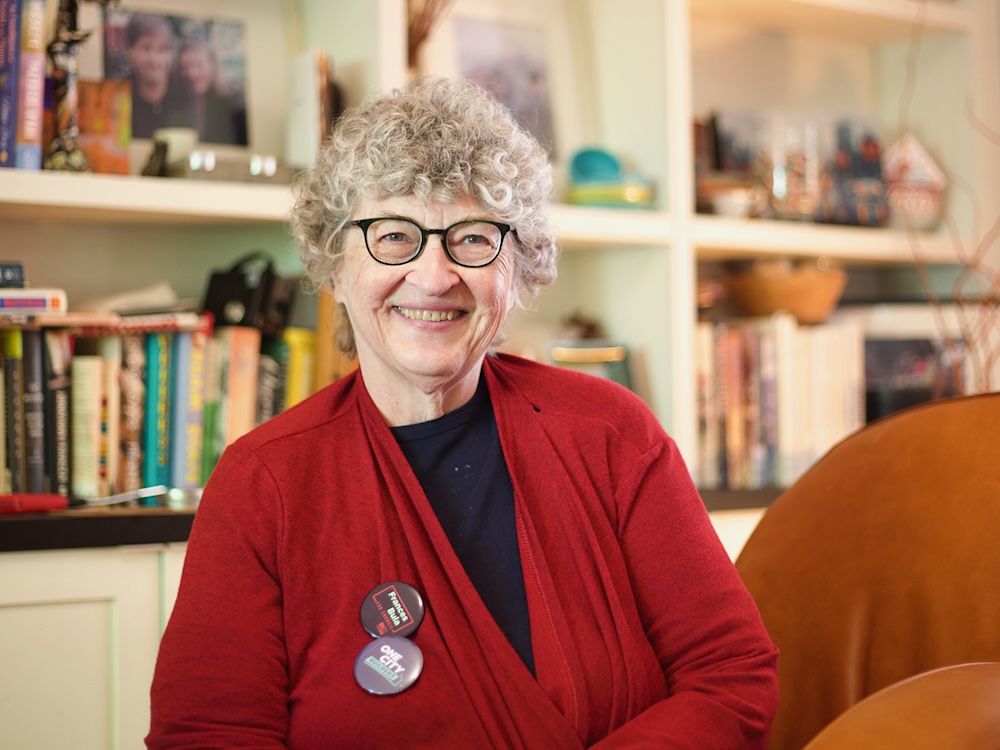
Nevertheless, veteran Vancouver city hall reporter Frances Bula has noticed some similarities between the two professions since launching her city councillor election campaign this spring.
“It does feel like my earlier decades in journalism. Because when I first started in 1983, my first official job, you were always out at events,” Bula told The Tyee in a recent interview at her Mount Pleasant home.
“I'd go to every fundraiser, every news conference, every council and committee meeting. And I was always out meeting people and hearing their opinions on things. Which would sometimes make me shake my head, and other times were like, ‘Oh, that's a really good point. I never thought of that.’”
Thanks to technology and a smaller pool of reporters covering the news, today’s journalists are more desk jockeys than people about town.
But not political candidates, says Bula, who just won her nomination race to represent OneCity in the coming Oct. 17 municipal election.
“I'm loving being out again in public, talking to people non-stop,” she said.
Bula, whose career started at the Creston Valley Advance on the first day of the province’s general strike in October 1983, went on to report in Comox and Kamloops before starting at the Vancouver Sun in 1987.
From 1994 until she left the Sun in 2008, Bula reported on city politics, including housing and homelessness. She later freelanced on the same topic for the Globe and Mail, as well as writing an award-winning column for Vancouver Magazine and her own blog on municipal affairs.
Now, at 71, with 43 years as a journalist under her belt, Bula is trying something new. Even if politics turns out to have a lot of parallels to her former career.
“Another part that feels really familiar, that I didn't really think about, is being part of a team,” Bula said, adding that friends and neighbours have surprised her with four-figure campaign donations and even joining her for door knocking.
“There's deadlines, and every day I have friggin’ homework to do. ‘Go knock on these doors. Fill out this form for the labour council. Go phone this person and see if you can get an endorsement from them.’”
Despite being a multi-award-winning journalist, known to B.C. politicians, bureaucrats and news readers, Bula still has a bit of an uphill battle to get her name out there. Especially for younger voters.
“I was at this one event, and this young guy said, ‘I work on NDP campaigns, and I really love politics.’ And I said, ‘Oh, I'm a former journalist who’s running,’” Bula said. “And he said, ‘Oh, have you ever written about local politics at all?’ And I was like, ‘Dear, I'm not gonna tell anyone you ever said that.’”
The Tyee sat down with Bula in her Mount Pleasant living room to talk about what drew her to OneCity, her love for community land trusts, and progressive pragmatism. And why we should look to the United States — not Europe — for housing solutions.
This interview has been edited for length and clarity.
The Tyee: You started covering city politics in 1994. Why did you stay on that reporting beat for so long?
Frances Bula: There was always something new. There was so much to do. And I am a city person. I love cities. I went to Hong Kong once, and all I did was take transit all over the place. I love bopping around cities by streetcar, ferry and everything.
And then I got very interested in homelessness and housing. I got the Atkinson Fellowship in 1998 and I got to spend a year studying that. Then I wrote a 15-part series for the Toronto Star.
When did you first ever have an inkling that you might want to run for city politics?
It's like being a theatre critic or a sports journalist. Every so often you look at it and go, “I could do that.” I'd always wanted to see what was really going on, on the other side.
In 2020 my husband and I went to New Hampshire and Iowa for the [U.S. Democratic party] primaries. I campaigned for Elizabeth Warren, Bernie Sanders and Amy Klobuchar. I also went to Atlanta in 2022 and campaigned for Raphael Warnock and Stacey Abrams.
I've had a lot of things happen in my life that prevented me from making any big decisions. I've had cancer twice; I'm still undergoing treatment. Two hip replacements, and a relative who had some pretty serious mental health issues. And my younger brother needed help. He just died, actually, a couple of weeks ago. So that's been hard, too.
Some people suggested I should run in the byelection last year. And I was like, “No, my life is such a mess right now.” And then when [OneCity mayoral candidate] William [Azaroff] got chosen, I thought, “Oh, I like what he's saying.” Pro-housing, but pro-worker.
I knew William because I'd interviewed him at Brightside in 2019 when they were just starting to redevelop five properties. I never heard a single complaint from a tenant, and they were really nice six-storey buildings. Every time I'd think about how to do housing well, I think of Brightside.
And also the fact that Ken Sim and ABC did so badly. When they first came in, like a lot of people, I thought, “They're going to do this centrist thing. Vision Vancouver, except a little bit more to the right. Centrists who have compassionate social policy, and take care of business and run the city fiscally well.” And none of that turns out to be true.
Have any other parties ever approached you to run over the years?
No. And OneCity didn't approach me. I approached them.
There's people over the years who have said, “You should run, I would support you 100 per cent,” from a wide variety of the spectrum. A political consultant tried to convince me, Moira Stilwell and a third woman to run as independents last fall. I was still having a rough time with my cancer treatment.
Ultimately, Moira went with Kareem [Allam, Vancouver Liberals], and the third woman said, “No, I'm happy doing what I'm doing.”
How do you see yourself politically?
My mom was from a farming family that went through the Depression in Saskatchewan. And Tommy Douglas would give speeches in the town nearest to them. I would say that I've always been a Saskatchewan progressive. My mom was a single mother who brought up four kids on her own, at a time when there weren't very many people like that. My family’s had any number of issues over the years.
I've always been a person who’s aware that social supports are crucial for a lot of families. I have a lot of empathy for people who are having a rough time. But also I've never been that involved in formal politics.
What else about OneCity drew you in?
I've been writing about the Broadway Plan and how I feel like it needs some tinkering with it. It was passed at a time when everyone at both the province and at civic levels was in a panic that 50,000 people a year are moving to the region, and we don't have enough housing. So rent and condo costs and housing costs are just skyrocketing.
We're not in that stage right now. Everybody I talk to doesn’t think anything’s coming back for at least another two years.
So I felt like [OneCity] people were having interesting, nuanced discussions about how to provide more housing in Vancouver, but do it in a way that works with the city, as is. Just felt really like it was going to be progressive, but it was also going to be pragmatic.
And living with the system that we have. For example, even though we live in a pretty capitalist system, albeit with many social supports, it's trying to find ways to remove a certain percentage of housing from the speculative market.
It’s why I’m so keen about community land trusts, which Vancouver is just getting started. I'm enthusiastic about mechanisms that help people deal with what can be an overly speculative real estate market that affects everybody’s quality of life in the city.
What strengths do you think reporting on the city council provides a city councillor?
The historical perspective. Knowing what’s been tried before, what’s worked, what hasn’t worked. What the typical dynamic is. Knowing a lot about other cities. So many North American cities are going through very similar problems. And I don’t claim to know everything. I still make mistakes all the time.
I went to Amsterdam and wrote quite a bit about the housing system there. A lot of people love to look at Europe: “We should be like Vienna. We should be like Finland. We should be like Hamburg.”
But the reality is, they have a very different political culture and completely different financing mechanisms. Vienna, they've had progressive housing policies that started 100 years ago. The city owns a phenomenal amount of the available land and can dispose of it as it wishes. And they get a billion dollars a year just for housing programs from the Austrian government.
I thought if I could show housing solutions in the States, which is even more market driven than we are, there could be things that could be imported. I wrote about how Miami had started a one per cent tax in restaurants to build homeless shelters. And San Diego started building new single-room occupancy hotels.
Part of the growth of homelessness is due to the fact that there used to be this layer of crap, cheap housing in every city. SROs, crummy wooden row houses, tenements. Slowly, those have been forced out of existence. Our current building code won't allow us to build the kind of really terrible but cheap housing that used to exist 100 years ago.
Are you suggesting we make the building code worse?
No! But it just means all these people who say, “Builders could build affordable housing if they really wanted to” — the reality is, and I think Alex Hemingway [formerly] at the Canadian Centre for Policy Alternatives did a study once showing that even if you had free land and no marketing costs, you probably couldn't get rents below $1,300 a month for a one-bedroom.
A lot of people don't get if you’re going to build to current codes and standards, there is no way on God’s green earth that you’re ever going to be able to rent that for $500 a month without heavy subsidies. And that’s a basic economic fact under the current system that we have to live with.
Is there anything about being a city hall reporter that might be a detriment to becoming a politician?
Yeah, I've never had to make the tough decisions. As a journalist, you get to sit back and write stories where “Oh, so-and-so says this was a really bad decision for them to make.” Or “They should have done this,” or “They should have done that.”
When you're an elected person, you’re in the hot seat and you’re going to be voting on things where you’re going to go, “Oh my God, this is terrible. But it's still better than the other option.” Making decisions and justifying them in public is going to be different.
You've seen the former ruling party Vision Vancouver in action. And I'm hearing a lot — usually from people who don't like OneCity — that OneCity is the new Vision Vancouver. What do you think?
Anyone who’s going to try to be the big party in the centre is going to get accused of being Vision Vancouver. There’s obviously some overlaps in the sense that they are trying to build a centrist, slightly left position.
But there's a personality difference. Vision was very strong about what it wanted to do: climate change, bike lanes, getting rid of street homelessness. They were a very hard-driving team. They hired Penny Ballem as the city manager, someone who would just upset the apple cart in unmistakable ways. They didn't want to do things incrementally.
OneCity is coming with more nuanced policy. Obviously election campaign financing has changed a lot since Vision. It was crazy. People were giving $50,000 at a time — not just the big developers. There's still a lot of money: ABC raised $2 million last time. Somebody who runs a development company gets every one of their friends and family to donate the max.
OneCity probably makes more of an effort to get non-builder money, to be able to run a functional party. And one of the reasons I should have mentioned why I decided to go with OneCity is I felt like they had the best chance of being the big opposition party. They have the energy and the momentum that I wasn't seeing elsewhere.
If you don’t win the election, would you consider going back to journalism?
I don't think I could. I would be seen as partisan. And it wouldn't matter how neutrally I wrote. So I could probably do opinion columns. And I could try doing different kinds of journalism. I'm super into personal financial planning.
But I couldn’t go back and, in a way, I don’t want to. If this doesn’t work out, I have a couple of books in mind that I'd like to work on. I might go work for a non-profit, or be on a board of some organization that is doing good work. ![[Tyee]](/design-article.thetyee.ca/ui/img/yellowblob.png)
Read more: Municipal Politics, Media




Tyee Commenting Guidelines
Please note that email notifications for replies are not currently working due to a software issue which may be resolved in a future update.
Comments that violate guidelines risk being deleted, and violations may result in a temporary or permanent user ban. Maintain the spirit of good conversation to stay in the discussion and be patient with moderators. Comments are reviewed regularly but not in real time.
Do:
Do not: