


 SHARE:
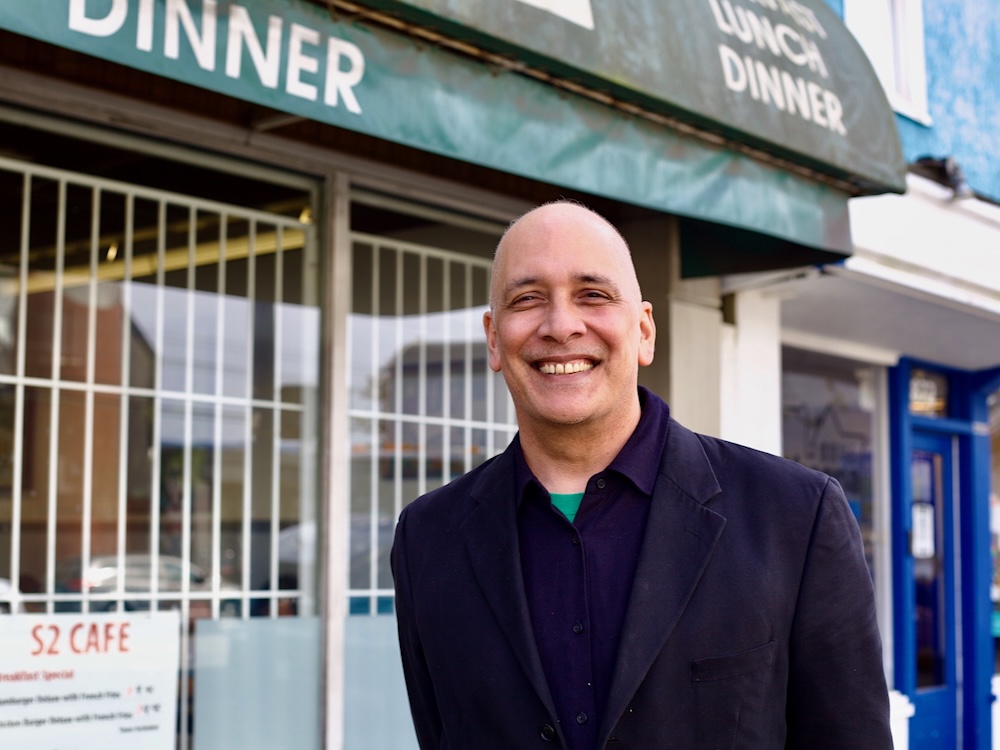
Vancouver Coun. Pete Fry can recall his life in Vancouver by naming the restaurants he met along the way.
“My first memory was this neon dragon. I told my dad that one day, and he’s like, ‘That was the Smorgasbord on Kingsway,’” said Fry, who immigrated to Vancouver from Dublin, Ireland, as a toddler with his doctor parents, Hedy and Peter Fry.
The Dragon Inn Smorgasbord was just a block away from the family’s first home on Kingsway. “There was a neon dragon that apparently emblazoned itself into my little pea brain,” Fry said.
Moving out on his own in the 1980s, Fry first lived in a “punk rock house” at Princess and Cordova in Vancouver’s Downtown Eastside, frequenting late-night cafés with his friends.
“There was the Dutch delicatessen on Hastings, just off Princess, with the sign like, ‘Dutch Delicatessen: We Sell Horse Meat,’” he told The Tyee.
Back then there weren’t as many people in the neighbourhood in obvious physical, mental or economic distress, Fry said. But he said the order on the streets came with a cost: Hells Angels were much more present and powerful in the Downtown Eastside at the time.
That all changed, Fry said, when then-mayor Philip Owen unintentionally brought the neighbourhood’s underbelly out into the open by closing many of the 24-hour restaurants, cafés and pawnshops.
"Where people would fence stolen goods... and buy drugs, sell drugs, do drugs, be high," Fry said of those 24-hour businesses. At the time, Fry was operating his Digiboy print shop on East Hastings, designing Terminal City magazine covers and posters for local rock shows.
"It created an environment where suddenly people had to step over bodies, see visible poverty and addiction and see all sorts of things that nobody really wanted to experience. I think it precipitated a lot of the rapid decline."
Most of the 24-hour neighbourhood restaurants Fry used to frequent are gone now, like the Red Way Café. Today it’s under new management as the S2 Café, which Fry continues to frequent for comfort food and all-day breakfasts.
It’s where the two-term city councillor met up with The Tyee in late March for an interview about his mayoral campaign.
Where some move away from a neighbourhood in decline, Fry has leaned in and still lives near the Downtown Eastside in Vancouver’s Strathcona neighbourhood. Perhaps inspired by his mother, Hedy — the longest-serving female MP in Canada, representing the Vancouver Centre riding since 1993 — Fry gradually became more and more involved in civic life.
He started small, sitting on the city’s Dog Strategy Task Force in the mid-2000s, before getting involved in the Downtown Eastside’s local area planning process in the early 2010s.
In 2014 and 2017, Fry unsuccessfully ran for a council seat with the Green Party of Vancouver under then-party leader Adriane Carr.
He was elected in 2018 alongside Green candidates Carr and Michael Wiebe, as well as Coalition of Progressive Electors, OneCity and Non-Partisan Association councillors — four of the five NPA councillors would leave the party before the term was up — and independent mayor Kennedy Stewart.
“To his credit, Kennedy was pretty good in distributing roles to all of us on council,” said Fry, including appointing Fry as the council’s Union of BC Municipalities representative.
But current Mayor Ken Sim has kept council appointments within his own ABC Vancouver party.
“That's how he plays power politics, which is shitty,” said Fry, who regularly collaborates on motions with fellow councillors Sean Orr of COPE, Lucy Maloney of OneCity and Rebecca Bligh of Vote Vancouver. (Bligh was initially elected as an NPA and then as an ABC councillor but was ejected from ABC in early 2025 over her refusal to support the party’s freeze on new supportive housing.)
Which is why Fry is pledging, if elected mayor, to work across partisan lines, not within them.
"Vancouver deserves a good mayor," he said. "Vancouver deserves to be a city where, if you're part of the city, if you work here, if you live here, that you feel like you belong here and you can have a good life here."
The following interview has been edited for clarity and length.
The Tyee: Everyone has a story of what kind of city Vancouver is. What is your Vancouver?
Pete Fry: I am old enough to remember when there were still log booms in False Creek, beehive burners and all. We still have a kernel of gritty small town wrapped in these big-city pretences. And we’ve never quite reconciled how we’ve flourished into this bigger, bolder, world-class city, but there's still a whole bunch of folks who never got brought along for that ride.
Why do you want to run for mayor this time?
I love the job of being a councillor. But we’re at such a crisis point, and this mayor and ABC council have been such an unmitigated disaster, I do feel somewhat reluctantly that I'm in the best position to take out Ken Sim as mayor.
On the Union of BC Municipalities, I’ve worked with mayors and councils from across British Columbia. Most of them don't have political parties. The mayor is the cheerleader-in-chief, and he is lifting up all of his councillors to do the best that they can for the betterment of their town or their city.
For better or for worse, I’ve positioned myself as the guy who’s been the opposition to Ken Sim and ABC for this entire term, and have established a great deal of credibility amongst a disparate range of Vancouverites, including folks who were even right of centre.
I’m surprised when you say it's currently the most partisan council. Was it not partisan with NPA versus Vision Vancouver during Gregor Robertson’s time as mayor from 2008 to 2018?
Well, I wasn't on council. But no — what did the ombudsperson call it? “A disturbing repudiation of the rule of law”; that is the culture that is ingrained within ABC.
Even though I wasn't the hugest fan of Vision Vancouver, and they did run things like a real majority party and were quite bullish, I always got the impression that Gregor Robertson was reasonably honourable, cared about the city, was committed to the job and was fundamentally kind. I just don’t see that with this current mayor.
You say you're running for mayor somewhat reluctantly. Reluctantly because you are in a good position as councillor?
I like being a councillor. I like my work-life balance. And I recognize that running for mayor is a risk — if I don't get elected as mayor, I’m off council. A lot of people have positioned it as like, ‘We need you on council, because somebody needs to be holding ABC accountable,’ which is such a fatalistic look.
We're assuming that ABC will sweep back in with a smattering of token opposition people. Which, of course, I’m happy to do. But I owe it to the city to make the move and go for mayor, and so far, as the polling suggests, I am positioned reasonably well to pull it off.
There are currently five people running for mayor, with the possibility of more. What do you say to people who argue this will split the vote and give Ken Sim a second term?
My focus is taking out Ken Sim, and it is early days. A lot of people are positioning very early and staking claims, but at this point it's still an organizing game. I think a lot will hopefully settle after the FIFA World Cup.
FIFA is going to be a bit of a barometer for how this election could actually play out. There’s sort of an afterglow that a big sporting event like FIFA is going to give somebody like Ken Sim if it’s a success.
Obviously, I don't want FIFA to fail. But it would be a shame if it gave some kind of bump to Ken Sim that he didn't really deserve, and people forgot about all the shitty things that he did.
Polling shows that Vancouver voters think of the Greens as the most progressive party.
Yeah, I saw that.
You collaborate with the other progressive parties on council. But on the school board, the Greens tend to vote with ABC. Could you give me a sense of where the Greens sit on Vancouver’s political spectrum?
I’ve definitely heard the critiques of the Green voting record at the school board. It's not anything that I’ve really personally tracked much, and I recognize now that, as an aspirant mayor and de facto leader of the party with Adriane Carr gone, I need to take better stock of what’s going on with the school board.
Broadly, Green values tend to be progressive values. As to the polling results, that’s a mixed bag. I don’t know that Vancouver voters who see us as the most progressive are necessarily voting progressive. It is ironic COPE is not in that spot, because they definitely have a longer history. I think that speaks to possibly the low political literacy of the polling.
What role should the city play in tackling Vancouver’s housing crisis?
We’re not in the position to necessarily build the housing, although I think it’s interesting that we’ve now seen this new direction from ABC, to build high-end market housing on city-owned land and to pump the dividends back into council priorities.
City-owned land should be leveraged for public benefit. But if it’s housing it should also be leveraged for supplying below-market housing that can at least meet the needs of the median income earners in the city of Vancouver. But arguably, most of our role is around land-use decisions, zoning.
I do think we’re at an interesting inflection point where the housing targets that the province imposed on us, telling us we need to meet X amount of housing targets, build X amount of housing close to transit — none of them have been built yet. They’re just targets, and they’re in the process of being built, but we’ve seen this dramatic increase in the rental vacancy rates, which has led to now we’re seeing that a lot of these projects are not going to pencil out.
And we have all this paper change with rezoning in the Broadway Plan, where we’re seeing extraordinary heights, but also none of it’s going to get built. We’re hearing from the industry that really they’re doing these rezonings so they can be the first on the block to get a rezoning so that someday they could build a tower there.
What we’re going to see, which is exciting to me, is a shift towards more ground-oriented housing, like six-storey, wood-frame construction. I’m hearing from the industry that they’re interested in going that way. It's cheaper, quicker, arguably more agreeable to neighbourhoods.
We're also in a mental health and drug crisis. How should the city tackle that?
We have a responsibility to do what we can, and that does mean interventions. I'm a big supporter of peer-based crisis intervention and de-escalation teams. As much as I am supportive of the Car 87 program, a police officer is potentially traumatizing for folks who are in crisis.
There are really amazing options out there, like the CAHOOTS program. They get dispatched through 911, they’ve got the cops on speed dial if things go sideways, but they’re able to provide a gentler, more relatable interface with folks who are in crisis. That's a big part of what we can do.
The idea that preventing new supportive housing that Ken Sim pushed forward will somehow solve these problems is delusional and cruel. Obviously the solution to street disorder is getting people stabilized.
In 2014 I visited Dignity Village. They ended up giving this group a nominal lease of an impound lot in northeast Portland. They built little huts for everybody. The fire chief made sure they were safe. The only rules were: Don't steal, don't be an asshole, and you can stay here for two years.
The average stay was nine months, because what they found was once people had a locking door, a roof over their head, a little bit of stability, then they could start focusing on the things that they needed to do, like getting mental health care, ID that they lost or getting on a housing list.
I've been fighting tooth and nail through two council terms to initiate it, and I finally got council to agree to this pilot down by Home Depot, which is nice but totally missed the point. The staff really didn’t want to do it, because the narrative has always been “If we build it, they will come. We’re taking over this responsibility from the province. It’s not our problem.”
Meanwhile, other jurisdictions are doing it. Victoria is doing it. I'm such a fanboy of Duncan Mayor Michelle Staples, because she’s just like, “Fuck it. BC Housing’s not doing it.” Because the buck stops here at the end of the day. The complaints we get from the public, it’s not nuanced enough to be like, “I know it’s the provincial ministry and a lack of federal funding.” It’s like, “No, it’s your city. You’re the council, you’re the mayor. Fix it.”
I don't have beef with Premier [David] Eby and the NDP. But, man, defunding the Community Housing Fund is not the way, and they're setting us up for an even worse outcome if we get a Conservative government to replace them.
Even though crime rates are dropping, people here still report feeling unsafe. How would you respond to those who think investing in policing is the right way to respond?
There’s a role for police, but policing is reactive. What are we doing proactively to address these things? That’s where we can do so much more for safety. How are we creating places for people to go, so that they’re not on the street? So that a barista doesn’t have to move somebody out of the doorway in order to open the café? Like opening daytime shelters, creating opportunities for folks that are not only providing engagement in a meaningful way, but mitigating some of the problems that make people feel unsafe.
Most of us, hopefully, thankfully, will never be victims of serious crime. But it doesn’t mitigate the fear that you might, especially when you have to address visible addiction, mental health crises and poverty. And I do believe we can get ahead of that with some thoughtful interventions that support people’s Charter rights, which is a big part of this conversation, too. You can’t just round people up and ship them into camps or prisons. There has to be some balance and nuance in how we approach it.
Speaking of police budgets, it seems like every year the police board asks council for a budget increase; it's just like clockwork. If you were mayor, how would you respond?
I would ask the police to submit for an audit, first and foremost, with the auditor general. Take a more thoughtful look at exactly why and how we are spending money. I don’t want to commit to slashing the police budget, because I don’t even understand the police budget. That said, as a significant chunk of the budget, it's not sustainable.
But what I also see now with the “zero means zero” budget is that we're defunding all sorts of upstream, proactive interventions and putting it all onto policing. Police budget’s going up and new wild commitments like the police academy and the new policing district come out of left field, even after we've got a “zero means zero” budget.
Are you a homeowner or a renter?
Owner.
How do you feel about property taxes?
I've been in my home for quite a while; they’ve gone up a lot relative to when we first got it. So I can appreciate how if you're on a fixed income, it becomes a very stressful thing.
But I do think most people would be OK paying property taxes, even seeing an increase in property taxes, if they saw the value in it. I don’t know that we do a good job of telling the story. And frankly, decisions like the mayor cavalierly throwing out “I'm gonna do a $2-million firework show” don’t instil confidence in the value for the money.
Another thing that I’m committed to is introducing a comptroller function. This isn’t about going after workers; it’s just about being efficient with how we spend our money, and recognizing that we are the stewards of the public purse.
How would you run an annual budget process compared with how it happened this year?
In the past we did a pretty fulsome budget survey, asking the public what they feel are the priorities. Are they getting good value for this? Do they think that we're spending too much money? We would ask the same of businesses, and I think that was a good process.
That didn’t inform this “zero means zero” budget approach this year, that was just a campaign slogan. We have a responsibility to evidence-based decision-making and clear, transparent data that can underscore our accountability.
The park board has a massive infrastructure deficit right now. If you were mayor, how would you balance the cost of repair and replacement for our community centres, pools, etc. with the running of the city, like fixing potholes and utility maintenance?
I don’t think they're mutually exclusive. We have to do all those things, and it’s a shame that we've allowed it to get to this point; probably it’s a reluctance to take on more debt or increase taxes to pay for some of those things. The reality is we don’t have that gravy train of foreign-investment-owned condos paying massive community amenity contributions to build us chandeliers under the bridge. We don’t have that kind of money flowing in now.
So it is going to mean that we’re going to have to invest. But I think it’s important, and as we add density, we need to be keeping up with the needs of communities. That includes parks, community centres, recreation facilities and neighbourhood houses. Especially as we’re looking at smaller and smaller units that require more public amenities to offset the fact that you can’t have a big, sprawling backyard that people used to have in sleepy Vancouver 40 years ago.
The infrastructure deficit is real, and that also comes back to this whole asset management framework. RayCam is my community centre, and I’m trying to find ways to support it right now, because it’s in dire straits. We have some of the most vulnerable kids, families and seniors in the entire city, and the community centre is leaking, it’s falling apart, and it needs investment.
We used to boast about being the Greenest City. I'm sure I don't need to remind you about the things that we've lost —
I think I have it on my email signature still. [Laughs.]
We just lost the sustainability department. We cut energy retrofit programs. We cancelled requiring all gas stations and paid parking lots to have EV charging stations. How would you address both the cuts and moving us forward in terms of sustainability?
They’ve done a pretty good job of breaking up the band, as it were. And they’ve taken the sustainability department, and my understanding is they’re all going to be scattered — again, I don’t even have eyes on this in a really cogent way, because we don’t have a definitive line-item budget to reference about what's going to be cut and what's being reformatted.
It’s going to take a really thoughtful approach to rebuilding it, but also recognizing that, for better or for worse, it became a flashpoint for anti-woke, right-wing rhetoric that probably would be helpful to be mindful of. In our city we have a pretty healthy right-of-centre voter base that, for whatever reasons, look at this as a problematic thing. So again, like the taxes: demonstrating what the value is.
Yes, there are changes to our climate. But there’s also a lot of just common sense things that we can do, like integrating more active transportation, more street trees, natural cooling and those things that aren’t really offensive to folks. I think traffic gridlock is something that bothers people, and so what are the antidotes to gridlock? Well, investing in good transit infrastructure.
How would you approach your relationship with both the urban Indigenous community and the host nations, xʷməθkʷəy̓əm, Sḵwx̱wú7mesh and səlilwətaɬ?
I have great relations with the xʷməθkʷəy̓əm, Sḵwx̱wú7mesh and səlilwətaɬ. I do have a lot of concern for the urban Indigenous population, because I think that they are underrepresented at the table in many respects, and there’s such a critical need within that population.
In the spirit of reconciliation, and the fact that we’re part of Canada, we have a greater responsibility than just in the immediate backyard, recognizing that folks are coming to our city from around British Columbia and the country, and falling into some pretty hard times. There definitely needs to be more intention on the urban Indigenous piece. But it has to walk hand in hand with the MST, and that's where it gets a little complicated.
In terms of they might have different priorities?
They do have different priorities. And so it’s respecting that space, but it’s also understanding that there's a deep and very critical need for support and for housing for Indigenous folk. Not to suggest that the MST have to take that on, but it becomes a matter of competing priorities sometimes. I think that many of them would like to see us prioritize work with MST first, which is fair. But also, I can't ignore suffering on the streets either.
If you are elected mayor and Green councillors are also elected, will you whip the vote?
No, that's not what we do. It’s a point of pride, I would say, for Greens. I don't think we will be running a majority. But my buck stops at breaking the open-meeting principle.
I spent a lot of this term fighting for the integrity of the office and why, if we're going to be in positions of power, we have to follow the rules. We’re local government, and our decision-making process has to be in the public. So the idea of whipping the votes runs antithetical to that, frankly. ![[Tyee]](/design-article.thetyee.ca/ui/img/yellowblob.png)
Read more: Municipal Politics






Tyee Commenting Guidelines
Please note that email notifications for replies are not currently working due to a software issue which may be resolved in a future update.
Comments that violate guidelines risk being deleted, and violations may result in a temporary or permanent user ban. Maintain the spirit of good conversation to stay in the discussion and be patient with moderators. Comments are reviewed regularly but not in real time.
Do:
Do not: