



 SHARE:
“To be a philosopher is not merely to have subtle thoughts, nor even to found a school, but so to love wisdom as to live according to its dictates, a life of simplicity, independence, magnanimity, and trust. It is to solve some of the problems of life, not only theoretically, but practically.” — Henry Thoreau, Walden
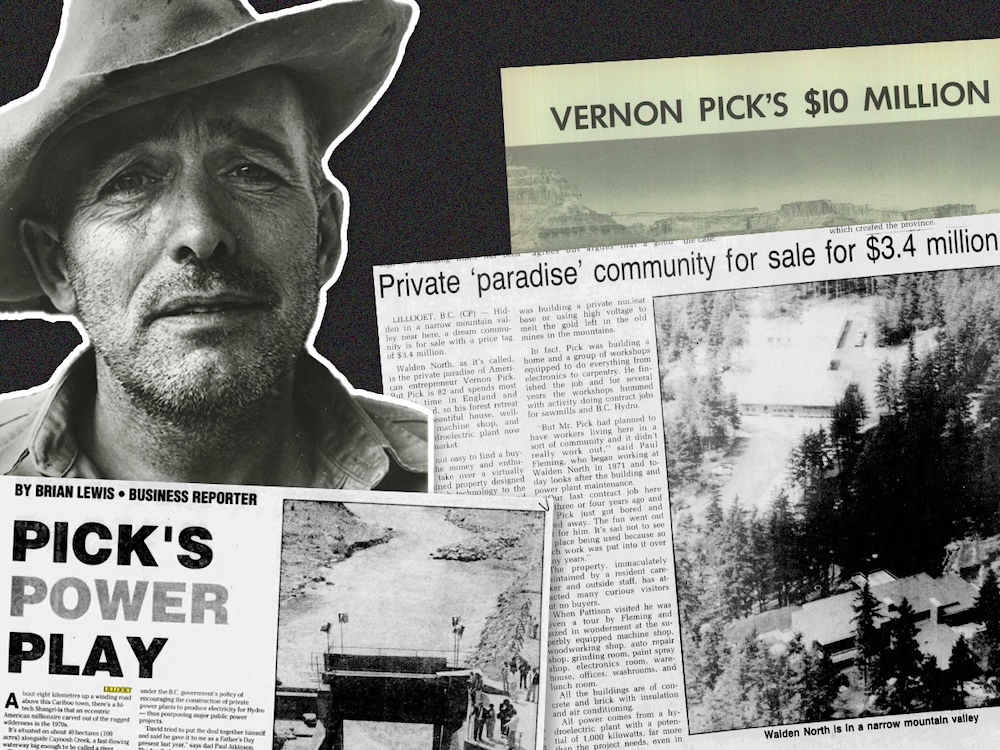
Word gets around fast when a uranium tycoon moves to a small town and starts building his own dam to power an off-the-grid high-tech research facility.
Was Vernon Pick building a nuclear base? Or seeking his own Armageddon hideout? Surely, some thought, there was something nefarious going on at a property with a home accessible only by an electric-powered railway.
North America’s “Uranium King” has been gone from Lillooet for decades now, but his dream-fuelled canyon estate continues to energize hikers, historians — and maybe even your own home. In recent years, the legend of Vernon Pick has inspired a mini-industry of YouTube videographers, many of whom have caricaturized him as an eccentric prospector trying to hide away from a potential nuclear holocaust.
The real Pick was much more interesting. His story is one of curiosity, boredom, ambition, fear, optimism and hope. Uranium might have made Pick rich. But it was Henry David Thoreau, in part, who made him a legend.
‘Where’s a good area to look for uranium?’
“They have got to live a man’s life, pushing all these things before them, and get on as well as they can.” — Henry Thoreau, Walden
Vernon Pick was 51 years old when he became famous. But he had already packed several lifetimes into his first half-century on this planet.
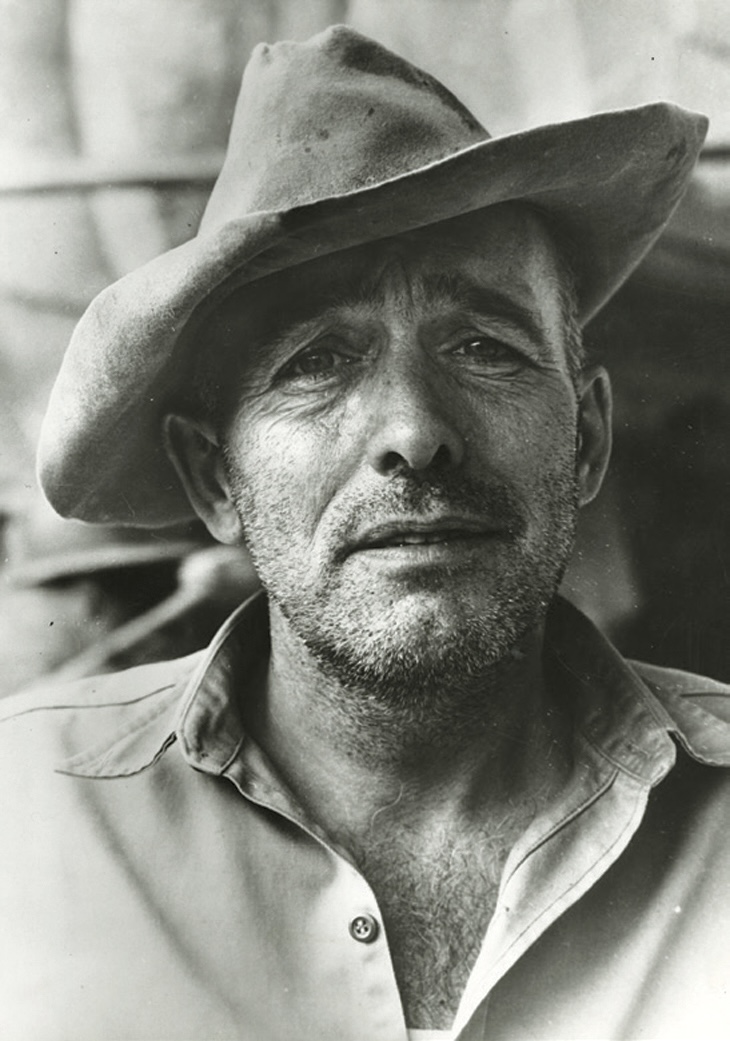
Born in 1903 in Wisconsin, Pick grew up in the U.S. Midwest, joined the Marines, was discharged for being of “bad” character, worked in a Manitoba mine, learned to fly airplanes and became a self-taught electrical engineer. He ran an electric company for 17 years, then a printing press. He built his wife her own loom, repaired electric motors and took all sorts of university courses, including a writing class apparently taught by Sinclair Lewis.
And he dreamed of the type of personal independence that his idol, Henry Thoreau, wrote about in Walden, his enduring memoir about self-sufficient living.
By 1940, Pick had made enough money to buy a large plot of land in Minnesota where he imagined he could create something of a self-sustaining community. Crucially, the land had its own rundown hydro dam that could power the site. Pick rebuilt the dam, fixed up one of three houses and moved in with his wife in 1946.
But five years later, the mill burned down. Pick received $13,500 in insurance money, but it wasn’t enough to rebuild. And in a sign of restlessness to come, Pick seemed ready to move on. So he and his wife bought a truck and a trailer and headed south, toward the sunnier skies of Mexico.
They got only as far as Colorado Springs, where everyone seemed to be talking about the search for uranium. Between the nuclear arms race and the growing potential for atomic energy, a resource with a previously niche set of uses was suddenly in high demand. Pick bought a book about uranium prospecting, decided Mexico could wait and instead drove to Grand Junction, Colorado, a hub of uranium refining. According to a 1954 article published in the Buffalo Evening News Magazine, Pick walked into the offices of the Atomic Energy Commission, met its mining head and asked him: “Where’s a good area to look for uranium?”
Pick was told to head west, to a remote area in nearby Utah. And it was there, instead of lounging on a beach in Mexico, that the 48-year-old Pick went exploring. He would drive into a promising area as far as possible, load a backpack with 55 pounds of gear and start hiking. Pick would carry a heavy “scintillometer,” a device that can pick up radioactive material from a hundred metres or so away.
For months, he found little of value.
“He would drag himself in, hungry and dehydrated and tired,” his wife Ruth told a reporter. “For a couple days he just ate and slept, and then he was ready to go out again.”
Having started his prospecting with around $6,000, he was down to about $300 when he walked four days into the wilderness, stopped to rest under a cottonwood tree, spotted a promising strata of rocks on a cliff face and started climbing. When he got to the site, he turned on his scintillometer and watched its needle go wild.
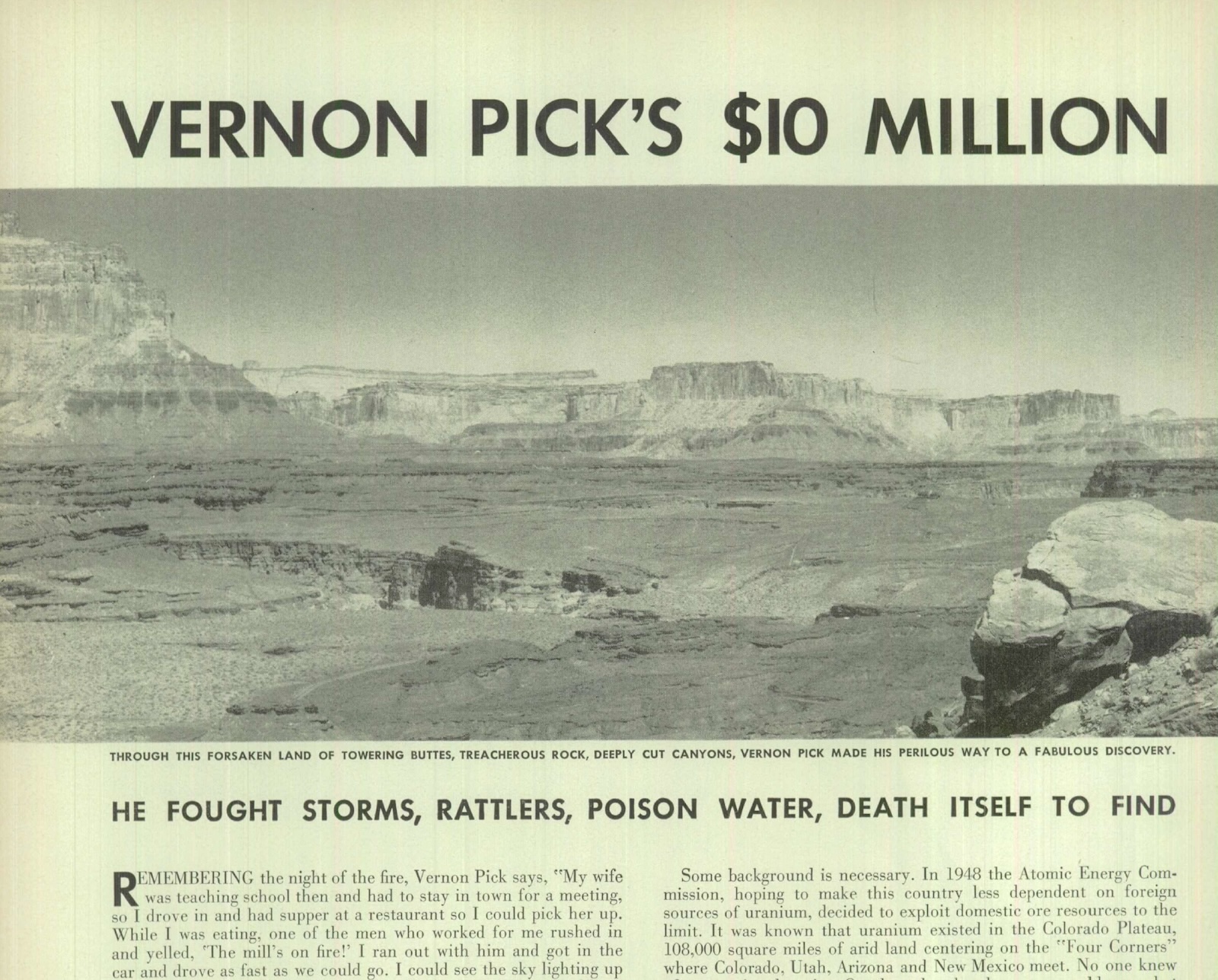
Two years later, Pick would sell the land he prospected for $9 million — the equivalent of about US$100 million today. It was a fortune by any measure, even if today’s lottery winners regularly pocket more, and the developers of niche apps can rake in far more with relatively little notice.
Pick, though, won his fortune at a time and by a means that made him instantly famous. He had struck it rich in a way that, hypothetically, anyone could make millions. He had dug into the ground and found a fortune. A bonanza. A treasure. Pick’s was one of the last great public prospecting treasures, and it came at the tail end of a century of prospecting fever across western North America. Dime store books, penny press newspaper articles and western movies had enshrined the idea that one could become fantastically rich by unearthing undiscovered treasure. Pick had proven it could still be done. And when he sold his plot, everyone wanted a piece.
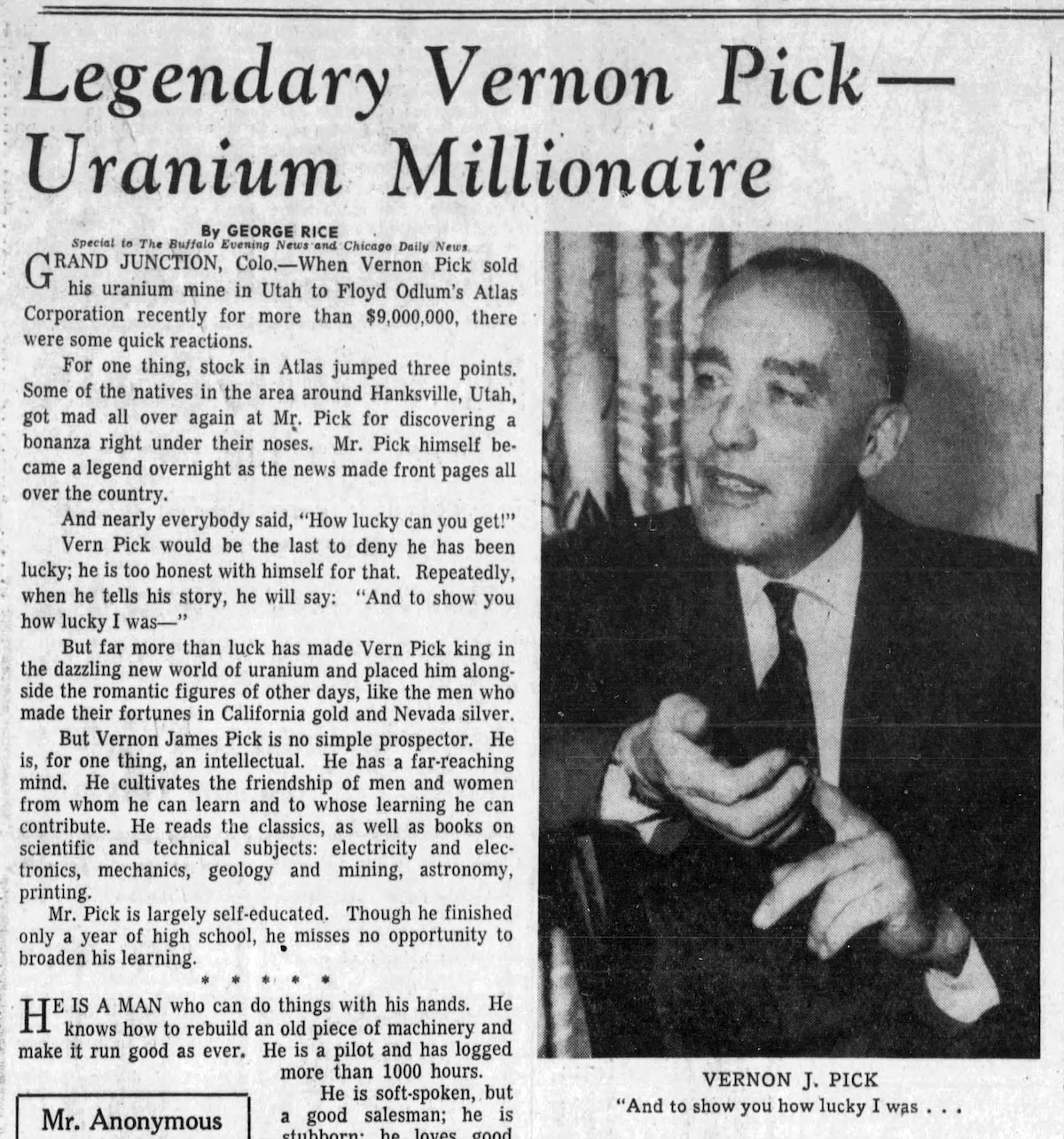
When Pick sold his mine in late August 1954, newspapers scrambled to talk to the millionaire and before long there were multi-part series in papers across the United States, along with an 11-page feature article in Life magazine.
The article notes that Pick lived in a “comfortable new home on the outskirts of Grand Junction.” He bought himself a Cessna airplane and a Jaguar, and Ruth got a Cadillac. He also got visitors, including, the article notes, people who were “ambitious to help him spend his money in ways helpful to themselves.”
But Pick, it would turn out, harboured plenty of his own dreams for his money.
Airplanes, prospecting and Walden West
“What everybody echoes or in silence passes by as true today may turn out to be falsehood tomorrow, mere smoke of opinion, which some had trusted for a cloud that would sprinkle fertilizing rain on their fields.” — Henry Thoreau, Walden
Pick wasn’t the type to settle down and live out a life of sedentary comfort. The same mid-century scientific optimism that had inspired him to build his off-the-grid mill, then take up uranium prospecting, didn’t disappear when Pick made millions. It just became more refined.
Pick invested in mineral concerns and Arizona real estate. (The mines lost money, the Phoenix land made money, Pick told a reporter for the St. Louis Post-Dispatch in 1961.) But he felt weird about suggestions that he let his money do the work.
In interviews with reporters, he talked about buying things it turned out he and his wife didn’t end up wanting. They built storerooms. Then they sold all the useless junk.
“Money seems to bring on a change of identity,” he told the St. Louis Post-Dispatch in 1961. “Before we had it, we knew what roles we played in society. We were plain, middle-class people trying to make a living, trying to get ahead. Now we don’t know.”
Having gotten ahead, Pick had to find another reason to carry on. He found inspiration in science — and literature.
Soon after selling his mine, he sold his house in Grand Junction and bought a large property and rustic lodge in the Santa Cruz Mountains. The property cost $110,000. There, amid redwood trees, Pick started building a new research laboratory.
He dubbed the new facility Walden West, naming it after Thoreau’s Walden Pond, where the writer exercised his curiosity and imagination.
One of his first reported projects tried to combine his two passions: flight and prospecting. According to a 1955 story in the Los Gatos Times-Saratoga Observer, he enlisted scientists to try to create a new radiation detector that would enable prospecting from an airplane, rather than on foot.
Other projects investigated the use of radiotherapy for cancer patients, aerial photography and space exploration. In another article (the Corpus Christi Times, 1961), he spoke about his hope that energy would help undeveloped nations progress beyond hunger, disease, war and communism.
Alas, Pick’s Walden West did not bear the immediate fruit he had hoped, and the prospector grew restless — and, seemingly, a little worried. He moved to Switzerland and started pulling his money out of the United States. The Walden West property was offered to the local county as parkland, but they didn’t want it, according to a 1965 newspaper account.
He continued to dream, but he also seemed to have darker visions of the future.
‘Just because you’re paranoid, doesn’t mean they’re not after you’
“The light which puts out our eyes is darkness to us. Only that day dawns to which we are awake. There is more day to dawn. The sun is but a morning star.” — Henry Thoreau, Walden
If you have heard of Vernon Pick today, it’s likely because you came across a YouTube video with a title like “Vernon Pick's DOOMSDAY Bunker in the Mountains” or “Abandoned DOOMSDAY BUNKER Hidden in the Mountains of B.C.!” or, maybe, “NUCLEAR BOMB Proof Abandoned Millionaire's Mansion.”
The videos have proliferated in recent years and racked up more than a million views. Combining drone footage with on-foot explorations, they take viewers into a vandalized and abandoned home that feels plucked from the 1970s (though is less impressive than “mansion” would suggest).
The videos are heavily informed by sombre post-apocalyptic shows like The Last of Us, and several speak to the “paranoia” on display in the desire to create a nuke-proof home. One can watch a tour of a house and imagine a guy retreating from the world, hoarding his millions in a dark and secluded canyon and irrationally fearing what his uranium may have wrought.
Today, Pick might be pigeonholed as a “doomer.” But the apocalypse didn’t seem far-fetched during the Cold War.
“Just because you’re paranoid, doesn’t mean they’re not after you,” Joseph Heller wrote in Catch-22, a book published the year before Pick sold his mine and its tons of uranium.
Pick was a futurist at a time when many people thought the world would be lucky to escape a nuclear exchange. So for his contemporaries, it was barely worth a mention that a newly minted millionaire thought it best to invest some of his money in surviving a nuclear apocalypse.
At his California property, Pick had built “one of the best-equipped air-raid shelters in the nation,” according to the St. Louis Post-Dispatch story. That article briefly noted that Pick “feels sure an atomic war is coming.” Then it moved on to more interesting tidbits.
The Tyee hasn’t found any clear proof that Pick left the western United States because of his fears of nuclear war. The best evidence is circumstantial: Saratoga’s close proximity to San Francisco was less than ideal if one did believe a large-scale nuclear exchange was likely. But nothing suggests Pick went overboard with his apocalyptic worries.
After leaving California, Pick had spent much of his post-fortune time visiting friends and relatives in Britain and going on “safaris and hunting trips,” a 1977 story in the Province said.
But Pick could even grow restless with restlessness. After a few years of not doing much of anything, he became bored and began searching for a remote property where he might build an off-the-grid community with his remaining millions.
A book later published by a former associate paints a picture of an old prospector having a hell of a time finding a spot for his new home.
In The Prospector and His Protégé, Jack Langton wrote about flying with Pick over northern B.C. and making camp next to Thutade Lake, a remote alpine lake 160 kilometres from Hazelton. Langton wrote that the pair spent three weeks camping next to the frozen lake, sipping cognac and talking about Thoreau. From Thutade, the pair flew into Smithers and entered a pub full of geologists, mine promoters, sex workers and bush pilots.
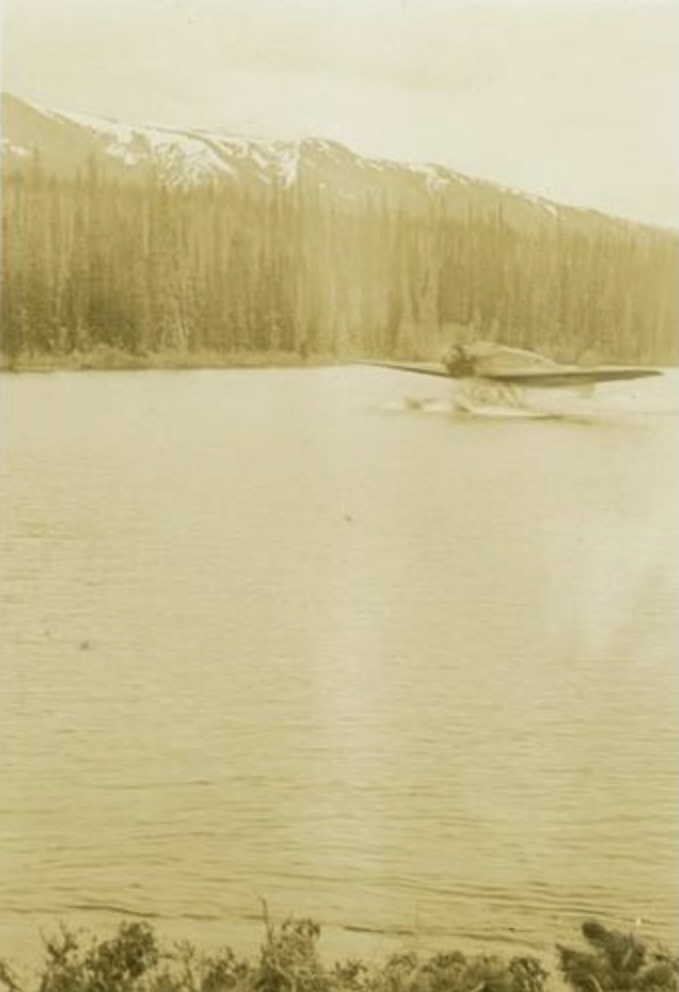
Langton said Pick was tired of California and its earthquakes and was considering building a “Walden North.” The memoir, which you can find at Lillooet’s community library and very few other places, is unreliable and the specific date of the pair’s northern B.C. escapade is not clear. But around 1970, when Pick would have been entering his late 60s, he did find his perfect spot.
A waterfall-powered headquarters for an inventor-engineer
“The life in us is like the water in the river. It may rise this year higher than man has ever known it, and flood the parched uplands; even this may be the eventful year, which will drown out all our muskrats. It was not always dry land where we dwell.” — Henry Thoreau, Walden
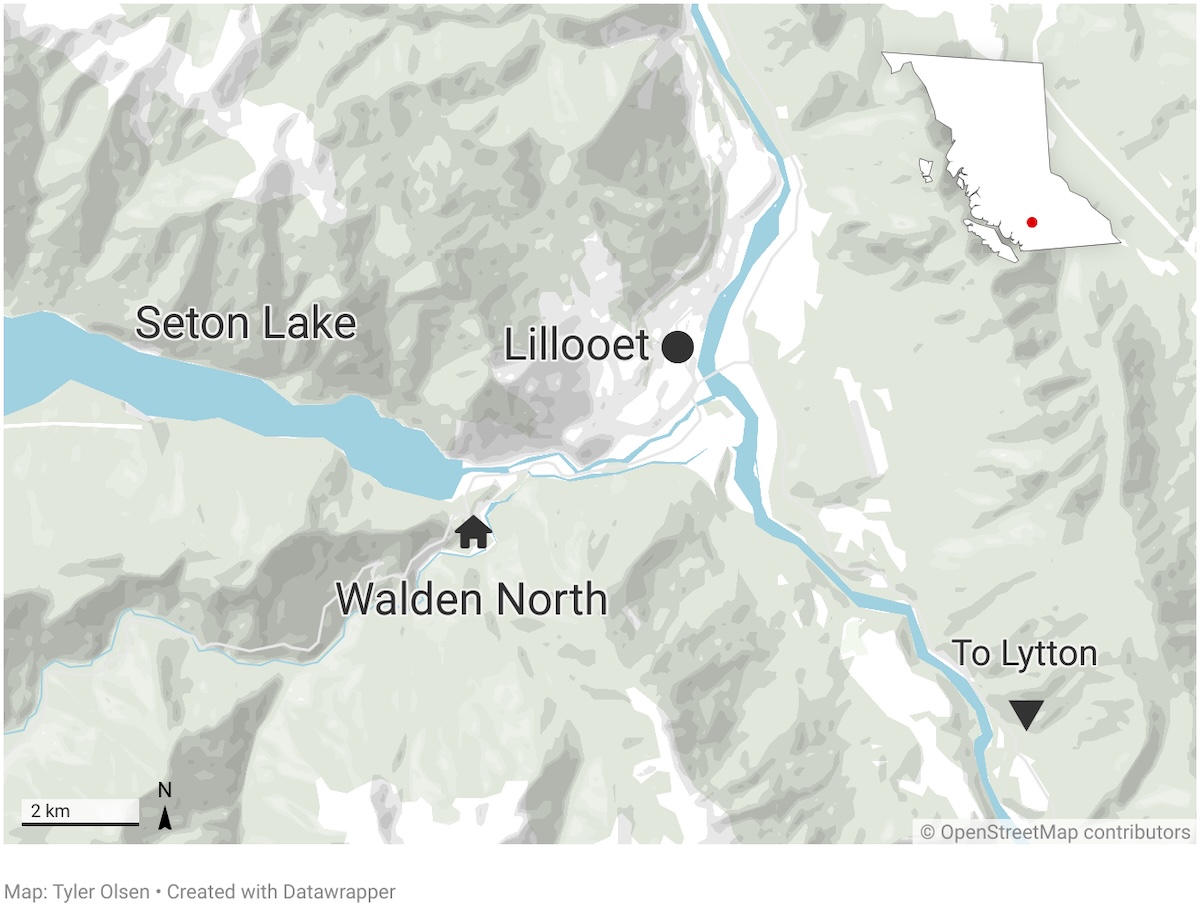
After scouring northern British Columbia, the U.S. northwest and Switzerland, Pick landed on a property next to a waterfall on Cayoosh Creek, just outside of Lillooet, B.C.
It seemed like a decent place to escape a nuclear blast, without having to actually live alone in a remote place like Thutade Lake.
Pick’s 60-acre Cayoosh property was four kilometres outside of Lillooet, a town remote enough to likely avoid the worst of a nuclear exchange, and small enough to sustain itself following civilization breakdown — but busy enough to have people to talk to.
But most important were the hydroelectric possibilities, and the fact that Lillooet was the one place where he could get government permission to dam a creek and create his own generating facility.
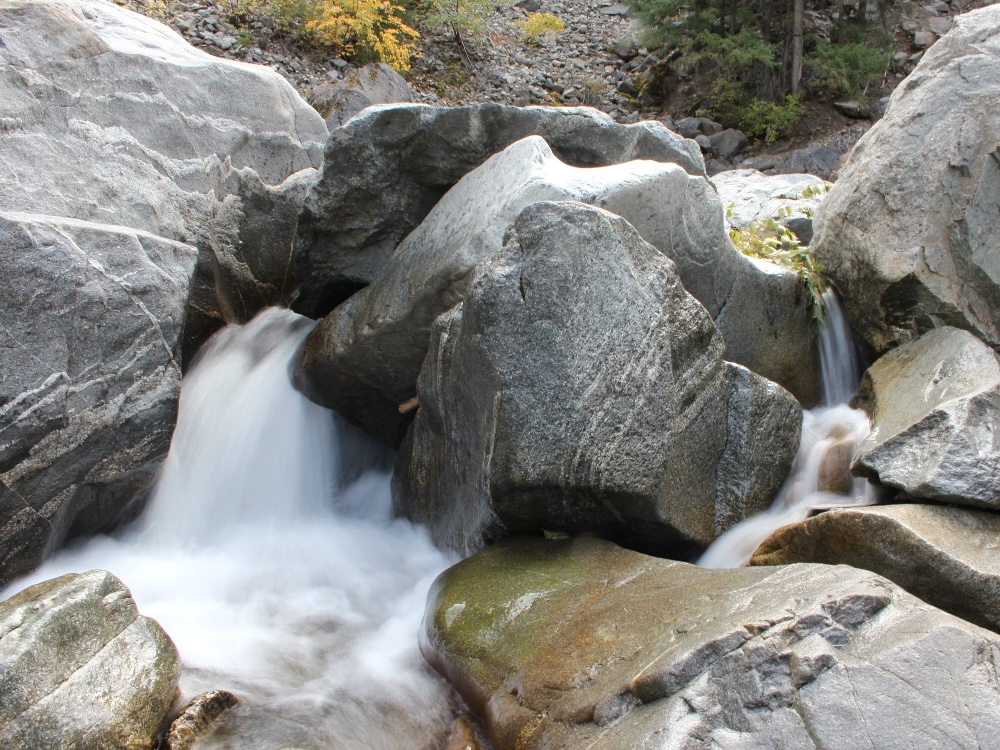
At his core, Pick was an engineer who loved the idea of creating and harnessing his own supply of electricity. At his new property, he dammed the creek at the site of an existing waterfall and drilled a 747-foot tunnel through a mountainside. Water flowed through the tunnel to a 550-kilowatt generator farther down the creek. Excess water made its way through the dam’s spillway and over what became locally known as Pick’s Falls. (He convinced authorities that the dam wouldn’t affect local fish because the existing waterfall already impeded their progress.)
The dam was classic Pick, though the project may have seemed a little redundant if post-doomsday sustainability was the goal: the Lillooet area is home to one of B.C.’s largest and most complex hydroelectric systems. The Bridge River hydroelectric complex supplies the province with nearly 500 megawatts of power — roughly 1,000 times the energy created by Pick’s new generator.
In Lillooet, Pick tried to realize his largest dreams, building machinery, electronics and woodworking shops. He hoped to specialize in “microwave communications” or, maybe, revolutionize transportation.
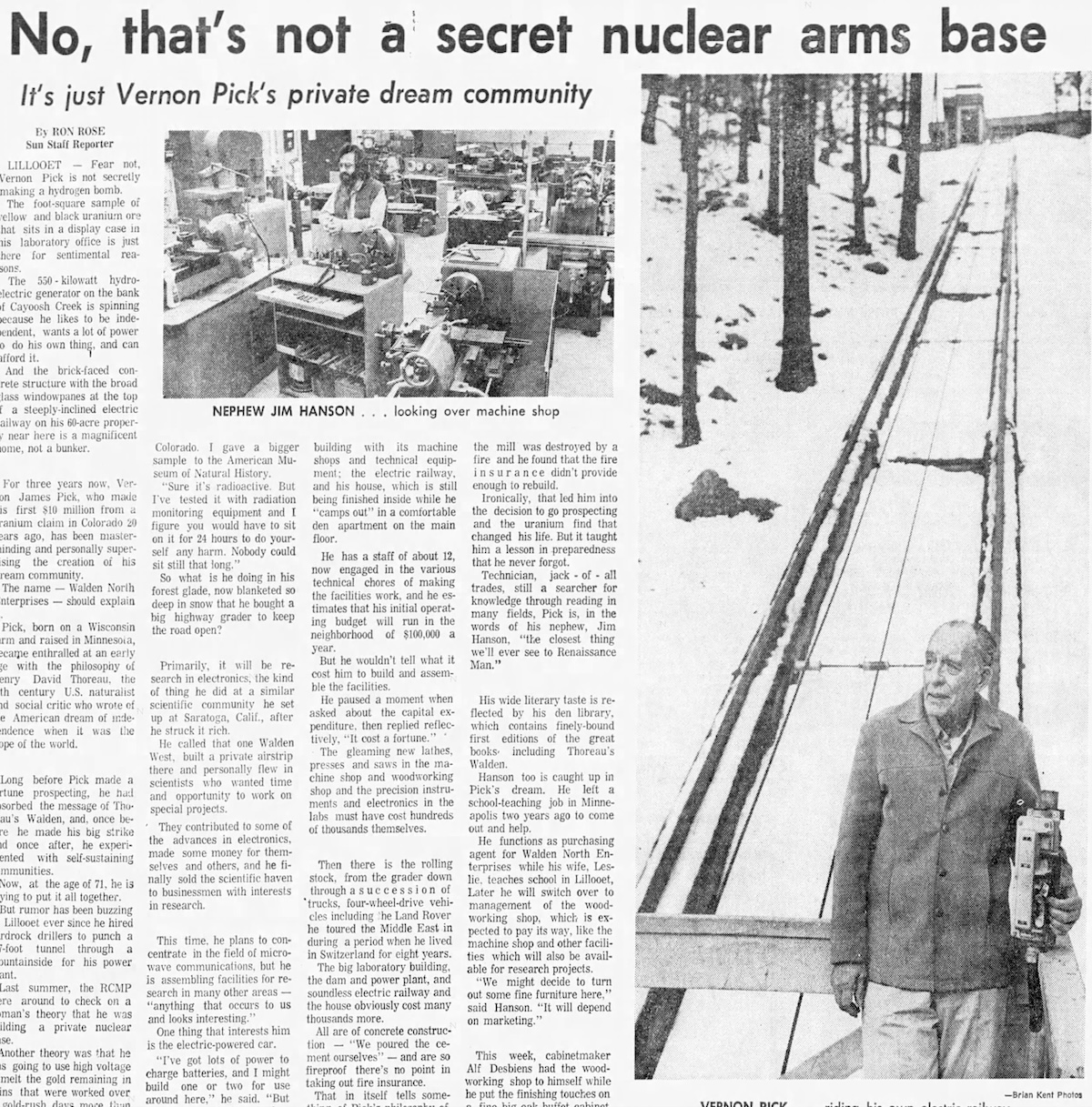
In a 1975 interview with a Vancouver Sun reporter, he speculated about creating an electric car.
“I’ve got lots of power to charge batteries, and I might build one or two for use around here,” he said.
He noted that the batteries run down too quickly for long-distance travel but mused that maybe he could develop lighter and better batteries “that would make them feasible as the transportation of the future.” In another story, he revealed a custom lathe that created beautiful (and commercially worthless) spiralled columns, and talked about working on a computer program for loggers.
But, as now, some people couldn’t imagine that Pick’s main reason to be in Lillooet was electrical research. This was the era of James Bond films depicting the suave British spy infiltrating the remote mountain labs of evil doctors. Word quickly got around that a guy linked to uranium was doing... something.
In 1974, the Mounties showed up at Walden North after one local suggested Pick was building his own “private nuclear base,” according to the Vancouver Sun article. Another theory, the paper wrote, was that the electricity would be used to melt gold contained in the veins of local mountains.
Pick declared that “people don’t seem to understand,” while trying his best to stamp out the speculation, inviting a series of reporters, columnists, seniors and school kids to his mountain lair.
“I’ve brought busloads of pensioners in here to look around. But people can’t imagine why I came here, and they seem suspicious,” he told one person.
Perhaps they were confused because Pick, at his core, was a man of a million interests.
Yes, he was worried about nuclear war and wanted to be able to survive on his own.
“Pick wanted a retreat that was self-contained in case of a nuclear war,” Yale-Lillooet MLA Jim Rabbitt said in 1991. One reporter who visited in the ’70s noted that the entry hall to his home “boasts a cabinet of rifles that would arm the Vancouver police force’s Emergency Response Team.”
But he was also a man who, his nephew told a reporter in a 1987 Vancouver Sun story, “lived his life by some sort of aesthetic, of things done right, good design and beauty.”
From one prospector to another
“A simple and independent mind does not toil at the bidding of any prince.” — Henry Thoreau, Walden
To understand a prospector, it helps to be a prospector, or at least meet one.
Vernon Pick died in the mid-1980s, but you can still meet some people who knew him.
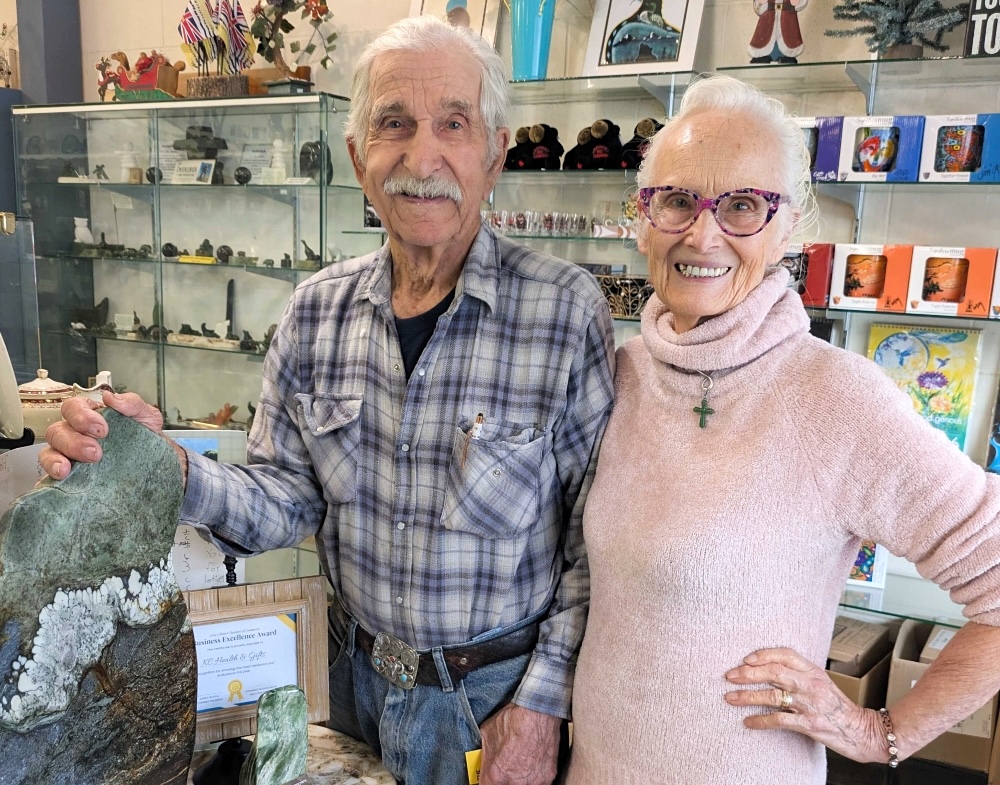
On a recent cloudy Lillooet morning, I wandered into KC Health & Gifts and asked for George Vanderwolf, who I had been told might have some personal insight into what Lillooet was like 50 years ago.
Vanderwolf is 91, seemingly going on 35, with a handshake like a vise. He wore jeans, sturdy boots and a blue flannel shirt. If he looked like a retired prospector, it was because he was a retired prospector. Vanderwolf discovered and operated B.C.’s first jade mine in the 1960s. Today, he buys knives from Pakistan, replaces the wood handles with jade and sells the things for $300 a pop to tourists who venture into his wife’s gift shop.
Vanderwolf ended up meeting Vernon Pick on three occasions and got a first-hand tour of the man’s home. The Walden operation, Vanderwolf said, wasn’t a fly-by-night affair. As Lillooet boomed in the ’70s and ’80s, Pick’s shop was known locally and abroad for its unique and highly specialized capability — Vanderwolf said Pick was one of three operations in the world that could create a certain specialized ultra-thin print drum demanded by Xerox.
Once, when his Caterpillar broke a specialized gear and his equipment dealer was unable to find a replacement, Vanderwolf went to Walden, where he was told he could get a replacement immediately, so long as he paid a little overtime. He still marvels at the quality of the gear. Later, Vanderwolf helped Pick expand the reservoir for his dam so the generating station could create more electricity when water flows were low.
“To me, the whole outfit was impressive,” said Vanderwolf, whose uncle was a guard at the entrance to the site.
As a fellow prospector, Vanderwolf saw in Pick the fierce desire for independence shared by many of those who head to the hills seeking minerals. That independence was why Pick likely wanted to be able to generate his own electricity and produce his own tools, Vanderwolf said.
“He didn’t want to depend on anybody for anything,” he said.
But while newspapers and YouTubers have painted Pick as an eccentric, Vanderwolf saw the opposite. Many prospectors, he said, would move up to the hills to flee society and other people.
“They were eccentric; they didn’t want anything to do with anybody,” Vanderwolf told me. But Pick stuck around, made friends and welcomed acquaintances like Vanderwolf to his house.
“From what I knew of Vernon, he was a very sociable person.”
Who owns Pick’s mansion now?
“What old people say you cannot do, you try and find that you can. Old deeds for old people, and new deeds for new.” — Henry Thoreau, Walden
Eventually, Walden North failed to meet Pick’s grand dreams. As the ’70s came to a close, Pick began to pull back from the site. In the early 1980s, as Pick entered old age, he moved back to Switzerland and England. The site was left to a reliable caretaker who, when the property was listed for sale for $3 million in 1985, said his boss “just got bored and moved away.”
The property was still for sale when Pick died the following year.
The property sat on the market for years. At one point, Jimmy Pattison visited and considered the site’s potential uses. But he never sealed a deal, and the site lingered into the 1990s, until it was bought by a father-son duo.
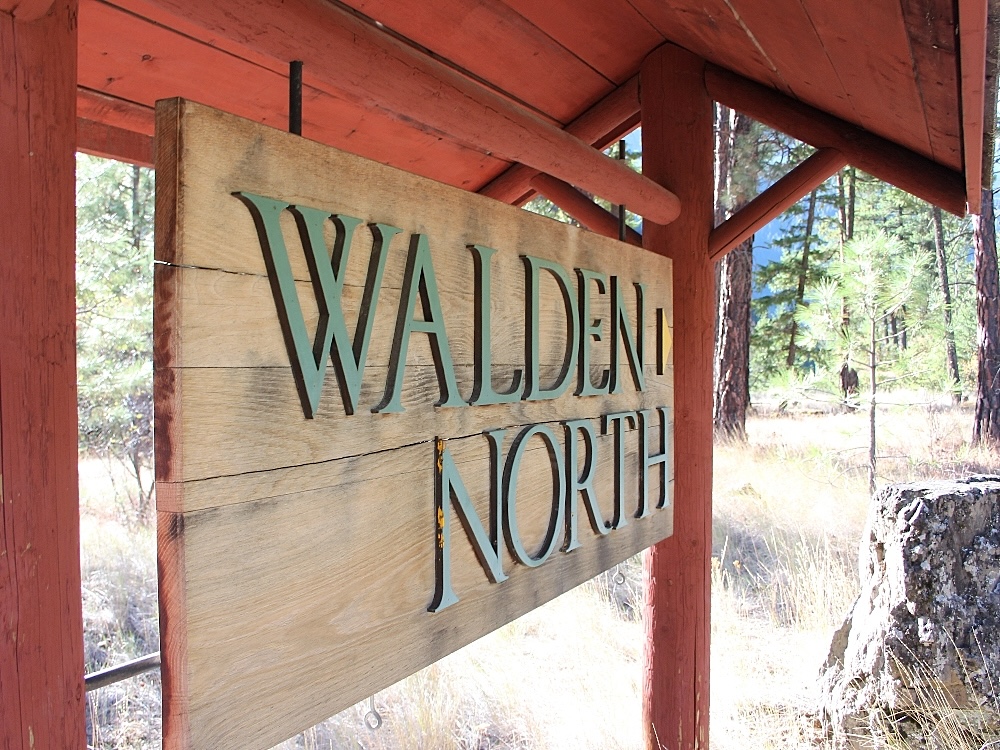
Like Pick, David and Paul Atkinson purchased the Walden property because of its ability to generate electricity. But unlike Pick, they didn’t want the power for themselves. Having bought the site for $2.5 million, they spent more than $10 million blasting a new tunnel through the rock wall and building a larger, 12.8-megawatt generating station. BC Hydro then signed a deal to buy power from the project, the first such partnership in the province.
The project came with a positive side benefit — the new, wider tunnel was expected to help fish that had been confused by water flows created when BC Hydro had dammed the Seton River decades earlier.
The Atkinsons later sold the facility to FortisBC. But the Pick-private-public partnership still had one more twist.
In 2011, several Lillooet-area First Nations signed a massive compensation agreement with BC Hydro to settle damages linked to the Crown corporation’s building of dams 60 years prior. Five years later, one of those bands, Cayoose Creek Indian Band, took some of its share of the money and used it to buy the Pick property alongside Innergex Renewable Energy.
The pair continue to operate the site, with the dam one of several Lillooet-area projects contributing revenue to the First Nation. B.C.’s thirst for hydroelectricity had left the First Nation reeling a half-century ago. Today, Cayoose Creek is a partner in power that helps light homes around the province.
Vernon Pick’s BC legacy
Today, you can apparently hike down a dirt road and wander through Pick’s old abandoned home. But you’re probably going to be trespassing. The various YouTube videos show Pick’s old home littered by debris and detritus. The presenters sombrely intone about the impact wrought by vandals, while marvelling at the spooky nature of the place. (Although Lillooet is famously sunny, hot and dry, the videos are almost all shot on gloomy fall days that give the sight a creepy vibe.)
You might have noticed that this story doesn’t include any photos of Pick’s house. That’s because there’s currently no legal way to get photos: the present-day owners told The Tyee that it never granted any permission to the YouTubers to access the site, and they weren’t able to facilitate access for The Tyee either. Because Pick chose to build his home surrounded by trees, rather than on a precipice with a stunning view, there aren’t really any legal viewpoints of the estate.
But visitors can access a trail that leads to the bottom of the waterfall that fuelled Pick’s home.
Pick’s property sits at the northern edge of a tangle of rivers and roads created to harness the power of the adjacent Seton River. At one point, a canal overpass carries water from the Seton over Cayoose. (The canal ends four kilometres to the east, where it rushes down a tunnel, through a generator and into the Fraser River.)
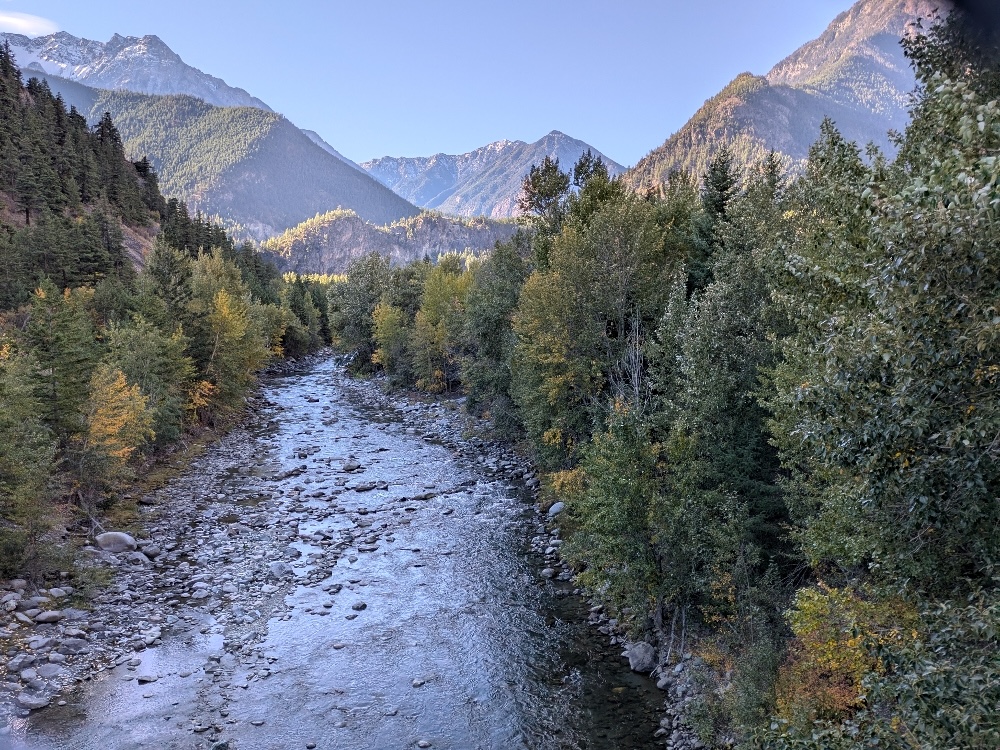
There’s a small parking area next to the canal-over-river aqueduct, and you can use a walkway next to the canal to cross the creek. From there, it’s a 20-minute walk mostly through ponderosa pine forest to the bottom of Pick’s Falls (sometimes spelled Pix Falls).
From the right angle, you can see water falling 50 metres or so through a narrow slot canyon that has been eroded over centuries by the rush of water. At the bottom of the falls, you can scramble over massive boulders, gouged by swirling rocks, to dip your feet in the water.
You can’t see Pick’s home on the cliff above. Nor can you see his dam or his version of Walden Pond. But as water falls, collides with rock and reverberates through the valley, you can hear and feel the raw energy that motivated Pick throughout his life. Pick’s curiosity (and recurring spells of boredom) inspired him to try to harness the power of water to create community and progress and a better future.
Did he succeed? A visitor might pause and consider that question as Pick himself might have.
He did not invent an electric car. He did not send people to the moon. He didn’t cure cancer.
His bomb-proof “doomsday” shelters were unnecessary and a relic of a time when they seemed completely rational.
Left to fall into disrepair, his house now seems “creepy.”
But, like Thoreau, he tried. He probed his own curiosity, travelled the world, got bored, drank whisky in Smithers, stayed sane, went on safaris, got bored again and welcomed visitors to a nice home above a waterfall. And today a power system he first built has done that rarest of things: help fish harmed by previous dams.
Not a bad second act for a guy who was once down to his last $300. ![[Tyee]](/design-article.thetyee.ca/ui/img/yellowblob.png)
Read more: Energy










Tyee Commenting Guidelines
Please note that email notifications for replies are not currently working due to a software issue which may be resolved in a future update.
Comments that violate guidelines risk being deleted, and violations may result in a temporary or permanent user ban. Maintain the spirit of good conversation to stay in the discussion and be patient with moderators. Comments are reviewed regularly but not in real time.
Do:
Do not: