


 SHARE:
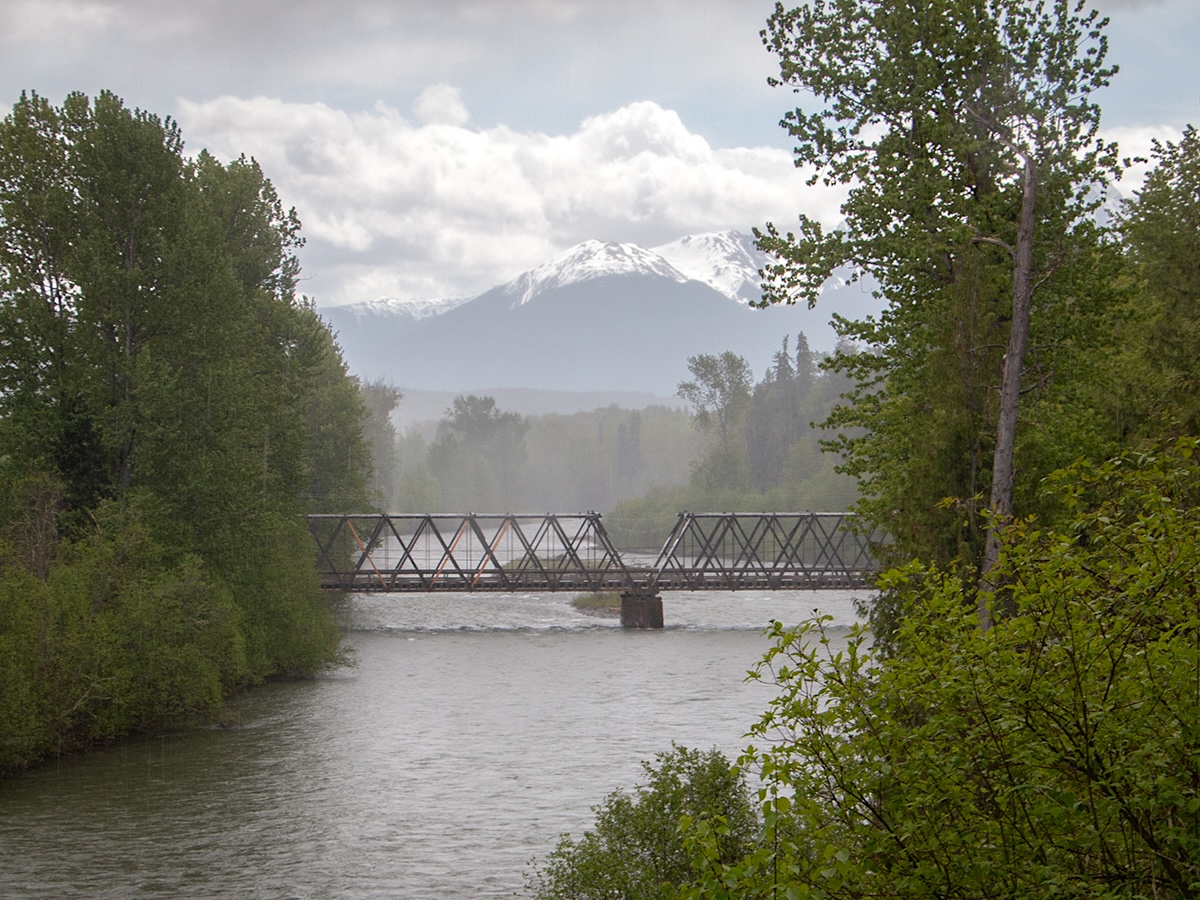
Sim’oo’git Geel sits in her living room and gazes out the window at Sdiky'oodenax̱, the commanding peak whose name means “big brother” or “stands alone mountain” and rises above Gitanmaax, a Gitxsan community in northwest British Columbia.
Geel, who also goes by Catherine Blackstock, grew up just down the road in Old Hazelton, a vibrant village nestled on the shores of the Skeena River. Her mother ran several small businesses and her father drove a logging truck.
But with local industries like fishing and forestry on the decline, the community has changed, she says.
“Hazelton is the most economically depressed town that I can think of across the province,” she says. “We have to do something different. We did our best to turn over every stone to make sure that, before we said, ‘OK, we’ll allow you to trespass,’ we’re taking care of those things.”
Geel is among the Gitxsan hereditary leaders who signed agreements more than a decade ago supporting the Prince Rupert Gas Transmission pipeline, or PRGT. The proposed 750-kilometre pipeline would carry gas from northeast B.C. to an LNG export facility on the coast, passing through 130 kilometres of Gitxsan territory on its journey.
PRGT presents a “tremendous opportunity for the Gitxsan,” Geel says.
She says the Chiefs who agreed to the project have been working to balance the potential economic benefits with environmental and other community concerns.
But nation members who oppose the project say it received consent through agreements signed behind closed doors and without broad consultation. They fear that pipeline construction would dramatically alter the region and affect salmon watersheds.

In a recent statement issued by the Gitxsan Huwilp Government, some hereditary leaders also expressed broad concern about the LNG industry, including the fast-tracking of major projects and health concerns related to excessive flaring at the LNG Canada plant in Kitimat.
And having watched their neighbours to the south, the Wet’suwet’en, grapple with the Coastal GasLink pipeline, the Chiefs say they won’t accept court injunctions or militarized police used against Gitxsan who oppose the project.
“We don’t want that here,” Geel says.
Despite the concerns, she says she still supports PRGT. She says the decision wasn’t an easy one. But as Head Chief for her wilp, the name for a Gitxsan house group, she says decisions over what happens on her laxyip, or territory, are ultimately up to her.
“We have conflict in our community. We have opposing opinions to whether the pipeline should go through or not, by Chiefs and by young people,” she says. “But only I can make a decision on Wilp Geel laxyip. Nobody else. People may not like it, they may not agree, but that’s our law, our ayookw.”
Waiting on an LNG boom
The Gitxsan share many similarities with the Wet’suwet’en.
The nations are longtime allies and jointly fought Delgamuukw v. British Columbia, a landmark Aboriginal rights case that determined that the nations’ titles had never been extinguished.
The 1997 Supreme Court of Canada decision also affirmed that Wet’suwet’en and Gitxsan hereditary leaders, as the plaintiffs, represent the nation when making decisions about what happens on their traditional territories.
Despite the declaration, Coastal GasLink agreements signed with Wet’suwet’en band councils — which were created under the Indian Act to govern reserves — were used as evidence of the nation’s support for the pipeline by the company and government.
In the case of PRGT, the company signed agreements with the Gitxsan hereditary leaders.
“When it comes to doing land-based activities, anything off-reserve, the process is the Hereditary Chiefs are the rights and title holders and the ones that get consulted,” says Chaz Ware, whose Gitxsan name is Baa'm Goot.
Ware, who grew up in northern B.C. and is now based in Calgary, is the chief operating officer for the Gitxsan Development Corp., or GDC, the nation’s economic development arm. The Gitxsan Development Corp. was incorporated in 2011 to capitalize on what appeared at the time to be a wealth of LNG opportunities, he says.
Ware describes the “gold rush of LNG,” when nearly 20 export terminals and half a dozen pipelines were proposed for B.C.’s north coast.

But those projects were gradually whittled down to just a few.
Enbridge-owned Pacific Trail Pipelines, which would follow a more southerly route parallel to Coastal GasLink, was considered substantially started a decade ago, but the project has been largely inactive in the years since. Enbridge also proposed the Westcoast Connector Gas Transmission pipeline, which would have followed PRGT’s route. But the company quietly allowed its permit to expire in 2024.
PRGT received its provincial authorizations in November 2014, just one month after Coastal GasLink. Both projects were initially proposed by Calgary-based TC Energy Corp.
But while Coastal GasLink moved ahead, PRGT languished.
The pipeline’s more northerly route was originally meant to connect with the proposed Pacific NorthWest LNG facility on Lelu Island near Prince Rupert. When that project was shelved in 2017, it left PRGT without an export terminal.
Although the pipeline is still permitted to end in Prince Rupert, PRGT is now slated to connect to Ksi Lisims LNG, a proposed facility 80 kilometres to the north on Nisg̱a’a Nation territory. The export terminal is backed by the Nisg̱a’a and Texas-based Western LNG. The partners also signed a deal two years ago to purchase PRGT from TC Energy.
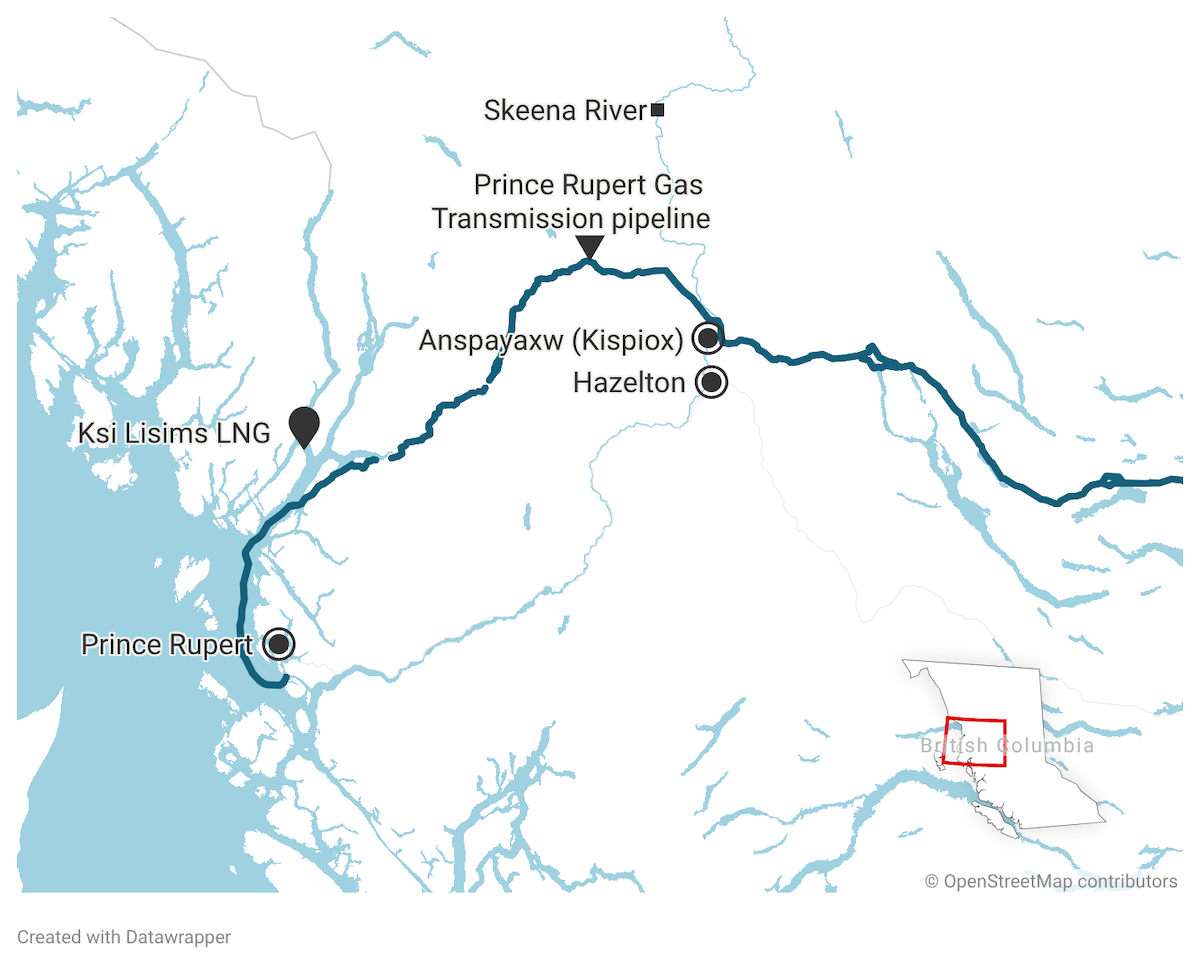
While both projects have all necessary approvals, their financial backers have yet to decide whether to proceed with construction. On May 27, the B.C. government announced that Ksi Lisims had struck an export agreement with Germany, nudging the facility — and the pipeline — toward a positive final investment decision.
That decision might come later this year, Western LNG told attendees during an online information session last week. Western LNG and the Nisg̱a’a Lisims Government did not respond to interview requests.
PRGT’s environmental certificate received a five-year extension in 2019 but expired in November 2024. Just as the certificate was about to expire, the company made a last-minute push to clear a portion of the right-of-way on Nisg̱a’a territory. It then applied to the B.C. government for a “substantially started” determination, which would lock in the project’s authorizations indefinitely.
The province granted that designation in June 2025. The decision now faces a court challenge by a coalition of local community groups and opposition from First Nations, including some Gitxsan and neighbouring Gitanyow.
Opponents say that changes — including updates to B.C.’s Environmental Assessment Act, greater recognition of Indigenous rights and amendments to the pipeline route — since the project was first approved 12 years ago should require the project to undergo a new assessment.
Benefits could include housing and other infrastructure
In December 2014, nearly two dozen Gitxsan hereditary leaders signed an agreement with the province supporting PRGT in exchange for compensation paid to affected wilps.
The Chiefs who agreed to the project represent 12 of the nation’s roughly 60 wilps. Nine of the supporting Chiefs represent territories directly along the pipeline’s path. Three more oversee territories within two kilometres of the right-of-way.
In total, there are 10 wilps along the pipeline route. A space for the signature of Sim’oo’git Gutgwinuxws, Head Chief for Wilp Gutgwinuxws, is left blank. Sources say the wilp has not engaged in discussions, and a wilp spokesperson contacted by The Tyee declined to comment.
The provincial agreement promises nearly $7 million in payments, administered to the wilps through Gitxsan Development Corp. beginning when the Chiefs reach an agreement with PRGT and continuing through project construction. It also commits to “ongoing benefits” for as long as the pipeline is operational.
GDC says additional benefits, many in the form of contracts for related work, will bring hundreds of millions of dollars into local First Nations. A project agreement signed with PRGT will also provide “significantly larger long-term economic benefits to the Nation,” it says. That agreement has not been made public.
The Chiefs say they have agreed to place half the funds into a trust to benefit the entire Gitxsan Nation.
The Lipgyet Trust is managed by a four-person board representing each of the four Gitxsan clans. The same board governs the Lax Yip Society, which oversees GDC and appoints its board of directors.
So far, GDC hasn’t generated sufficient revenue to contribute to the trust, Ware says. Instead, the corporation has subsisted on smaller contracts. Its environmental, security and medical services can be spotted working at everything from music festivals to highway construction across B.C.
But if PRGT gets the go-ahead, revenue from the benefits agreements will begin to flow into the trust, he says.
The corporation is also poised to provide labour to PRGT, Ware says. The hope is that GDC will be contributing Gitxsan workers and expertise to the project — everything from water-quality monitoring to sediment control and reclamation work.
Once it begins contributing to the trust, the money will go toward “nation-building projects,” Ware says. “That could be an old folks’ home, it could be a new aquatic centre, it could be housing. That part hasn’t been quite flushed out yet.”
But while Ware says GDC works “for every Head Chief, ultimately,” he acknowledges that the corporation is only dealing directly with the dozen leaders whose territories lie along the pipeline route. He says that during early consultations, Gitxsan hereditary leaders gave “broad consent” for LNG proponents to speak directly with affected wilps.
“Are we actively working with every single Chief? No. There’s not land-based activities that are happening on every single Chief’s laxyip,” he says.

‘They signed as the Gitxsan Nation’
When the Chiefs agreed to the project, they signed as “the Gitxsan Nation, as represented by the Gitxsan Hereditary Chiefs and the Gitxsan Development Corp.” Some Gitxsan say the Chiefs shouldn’t have agreed to the sweeping measures on their behalf.
The agreement with the province commits the Gitxsan to not bring any court actions against the government over a lack of consultation. It also says the nation must avoid “any acts that frustrate, delay, stop or otherwise physically impede” the pipeline.
While a second agreement signed with TC Energy has not been made public, a leaked Coastal GasLink agreement with the same company was similarly restrictive, discouraging First Nation members from hindering the project or taking part “in any media or social media campaign.”
“They signed as the Gitxsan Nation,” says Kolin Sutherland-Wilson, who holds the Gitxsan name Hooxi’i and is former Chief of the Kispiox band council. “We have very strict rules within Gitxsan law that you don’t talk on behalf of other people, that you stay in your lane and in respect to your own house and territory.”
Sutherland-Wilson belongs to Wilp Git’luuhl’um’hetxwit. The wilp’s laxyip and the Gitxsan village of Anspayaxw, which is governed by the Kispiox band council, sit on an access road about 15 kilometres south of the pipeline route.
They aren’t considered directly affected by the project. But Sutherland-Wilson says construction traffic and a nearby work camp that is expected to host more than 1,000 people will dramatically alter life in the quiet valley.
“Our village only has 900 people in it,” he says. “So, it’s a huge demographic shakeup.”
More broadly, he worries that sediment runoff from the project — a chronic issue during Coastal GasLink construction — could affect salmon and other wildlife.
He adds that allowing the project to proceed without consent from the 10th wilp with territory on the pipeline route “flies in the face of Gitxsan law.”
“Not even all of the directly affected have provided their consent, and yet there was still an agreement signed,” Sutherland-Wilson says.
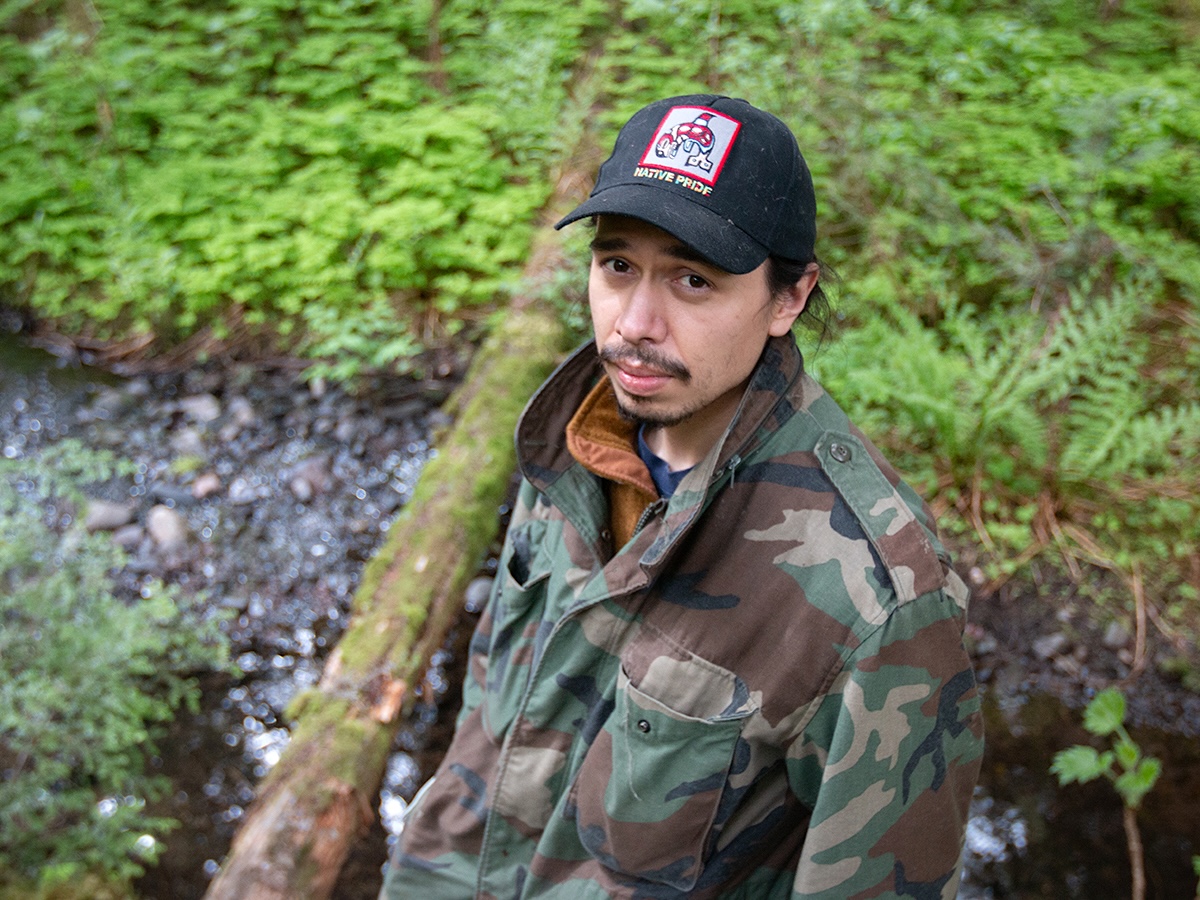
In 2024, the Kispiox band council joined two local organizations, the Skeena Watershed Conservation Coalition and the Kispiox Valley Community Centre Association, in a court challenge to PRGT’s permit. The groups argued that by limiting a cumulative effects assessment to Nisg̱a’a territory, the BC Energy Regulator had allowed the project to proceed without due process.
But the judge overseeing the case determined that the parties did not have standing to bring the case.
While the decision granting Coastal GasLink’s injunction five years earlier gave weight to Wet’suwet’en band council support for the project, Justice Michael Tammen — who had presided over the trials of those charged under the injunction — found that the Kispiox band council’s role was limited to governing the village and it was “not a rights or title holder for the Gitxsan people.”
It was the Gitxsan Hereditary Chiefs who “assert an interest in the overall pipeline construction,” Tammen determined in dismissing the claim.
Both PRGT and Ksi Lisims LNG have faced additional court actions, from both Gitxsan and neighbouring First Nations, including Nisg̱a’a members who say they weren’t adequately consulted on the export terminal.
Members of another wilp, Luutkudziiwus, are also challenging the project’s authorization in court. They say that the person who signed on their behalf, Gordon Sebastian, was not authorized to represent the wilp.
In a statement of claim filed in September, Charlie Wright, who claims the hereditary title Luutkudziiwus, says that the province was aware of an internal dispute over the name but repeatedly declined invitations to meet with the house group and “witness the wilp’s support and recognition” of him in the feast hall. A spokesperson for the wilp declined to comment on the case while the application is before the court.
Wright has never seen the PRGT agreement signed on behalf of the wilp, according to the group’s statement to the court.
In a response filed in January, B.C.’s Ministry of Environment and Parks describes the Luutkudziiwus dispute as an “ongoing and long-standing matter” and says it consulted with both individuals. The wilp members filing the claim say that the province shouldn’t have accepted Sebastian’s signature, given its knowledge of the internal dispute.
Sebastian told The Tyee he can’t explain the conflict and doesn’t know why Wright disputes his right to the name. He denies that the Chiefs are holding closed-door meetings without consulting wilp members.

Among the nearly two dozen signatures on the provincial benefits agreement, one name stands out.
A decade ago, the Delgamuukw title that gave its name to the landmark court case was held by Earl Muldoe, who inherited the name as the trial got underway. He was the last to sign the PRGT agreement with the province, penning his name in early January 2015.
His nephew, Kirby Muldoe, believes Earl, who died in 2022, signed reluctantly.
“I don’t think he wanted it because it would affect the salmon. I think a lot of people feel the same way,” says Kirby, who holds the Gitxsan name Hup Wil Lax A.
Earl expressed misgivings in an interview with Discourse Media in 2017, when he described payments from the project as “bribery, more or less.”
When Earl died in 2022, George Muldoe — Earl’s brother and Kirby’s father — inherited the venerated title. George died last year. Gitxsan ayookw requires that a name remain vacant for about one year, and the next Delgamuukw has not been announced, Kirby says.
But last year, about one month after his father’s death, Kirby says, he was “shocked” to see a news release apparently authored by the 12 Hereditary Chiefs who signed the pipeline agreements — including the Delgamuukw name recently held by George.
“That’s just so disrespectful,” he says. “My dad isn’t here to speak for himself, yet they’re using his name.”
He describes poor communication from Gitxsan Development Corp. and says the corporation has rebuffed his requests for a town-hall-style meeting to allow the entire nation to have a voice.
“Our ancestors fought so hard for our right to know what’s going on — for free, prior and informed consent — in the Delgamuukw case,” he says. “When you are crossing streams and rivers that host salmon, that are salmon spawning and rearing creeks and rivers, you’re affecting the entire nation.”
But he says he doesn’t blame the Chiefs who signed the agreements.
“A lot of them were fishers and loggers, and those industries have died, so I don't blame them,” he says. “I do, however, wish that they would think of the entire nation.”
‘They’re trespassers’
The Chiefs who spoke with The Tyee say they see the project as an inevitability — and they want to ensure that Gitxsan benefit and have a role in monitoring its construction.
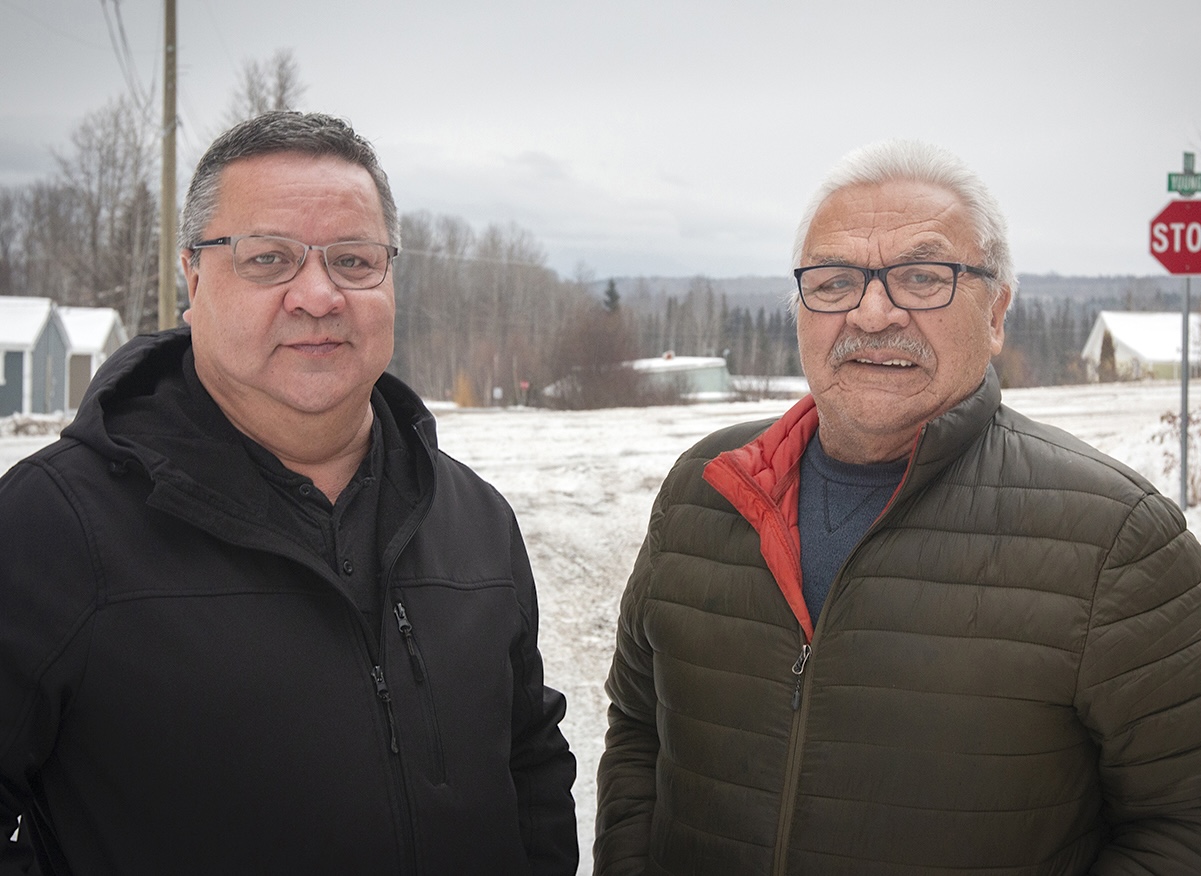
“It’s a project that probably needs to happen and we want to make sure that all the concerns are addressed,” says Sim’oo’git Gwiiyeehl, who also goes by Brian Williams. “We don’t want to cause any harm to any Gitxsan. We’re definitely autonomous, but we work together. This is our way of life.”
The Chiefs say their support for the project remains conditional.
“There’s going to be hundreds and hundreds of permits that they have to consult with us on,” Sebastian says about the detailed planning that lies ahead. He expects the Chiefs will be consulted every step of the way.
“If there’s any permits that we say no to, it’s no. They’re not going to be able to go get an injunction to get us out of the way, because it’s our land,” he says. “They’re trespassers. When the trespassers are coming onto your property, they’ve got to be clear what they’re up to.”
The Chiefs have been renegotiating a “modernized” agreement with PRGT’s new owner, Western LNG. They’ve asked for a clause to ensure the company won’t obtain a court injunction to remove Gitxsan who object to the project.
The company refused, Sebastian says.
Discussions with the RCMP are ongoing. In 2022, the Gitxsan Huwilp Government signed a memorandum of understanding with police meant to address the “burgeoning safety crises between the RCMP and members of the Gitxsan people on their lands.”
The hereditary leaders have also formed a response management team, which includes representatives from the Chiefs, PRGT and RCMP. The team is meant to head off conflicts before they arise.
Internal communications obtained by The Tyee through a freedom of information request show that the RCMP’s Critical Response Unit-British Columbia, or CRU-BC, a controversial unit formed to police opposition to resource projects, is already watching for potential protests against PRGT.
According to a Jan. 12 meeting report, the RCMP told the Critical Incident Secretariat, a provincial government “hub for situational awareness,” about protests related to resource extraction, that “CRU-BC Intel is actively monitoring developments and community dynamics” related to the pipeline.
More than a decade after she first signed the agreement to support PRGT, Geel says she still believes the project is the best way forward for the nation and her wilp.
“We want to be that vibrant community again,” she says.
She hopes that revenue from the project could be used for cultural purposes and language revitalization. She says the pipeline will not only put some Gitxsan to work, but also put them back on the land, monitoring pipeline construction.
“That’s what it takes to take care of our land in today’s world,” she says. “We’ll be on the land through our monitors, so we'll be able to see first-hand if anything does go wrong.”
She hopes that speaking about the Chiefs’ support for the project will foster understanding within the nation — and quell division.
“It’s not an easy decision, and it’s important to stand together, even if we don’t always agree,” she says. “I don't have any quarrels with anyone of the Gitxsan Nation. I will sit down with anyone. I’ll talk to them. But we have to be respectful to each other. That’s our way.”
*Story updated on June 3 at 2:15 p.m. to correct Chaz Ware’s role at Gitxsan Development Corp. and to add context related to the benefits promised to local First Nations. ![[Tyee]](/design-article.thetyee.ca/ui/img/yellowblob.png)
Read more: Indigenous, Energy












Tyee Commenting Guidelines
Please note that email notifications for replies are not currently working due to a software issue which may be resolved in a future update.
Comments that violate guidelines risk being deleted, and violations may result in a temporary or permanent user ban. Maintain the spirit of good conversation to stay in the discussion and be patient with moderators. Comments are reviewed regularly but not in real time.
Do:
Do not: