



 SHARE:
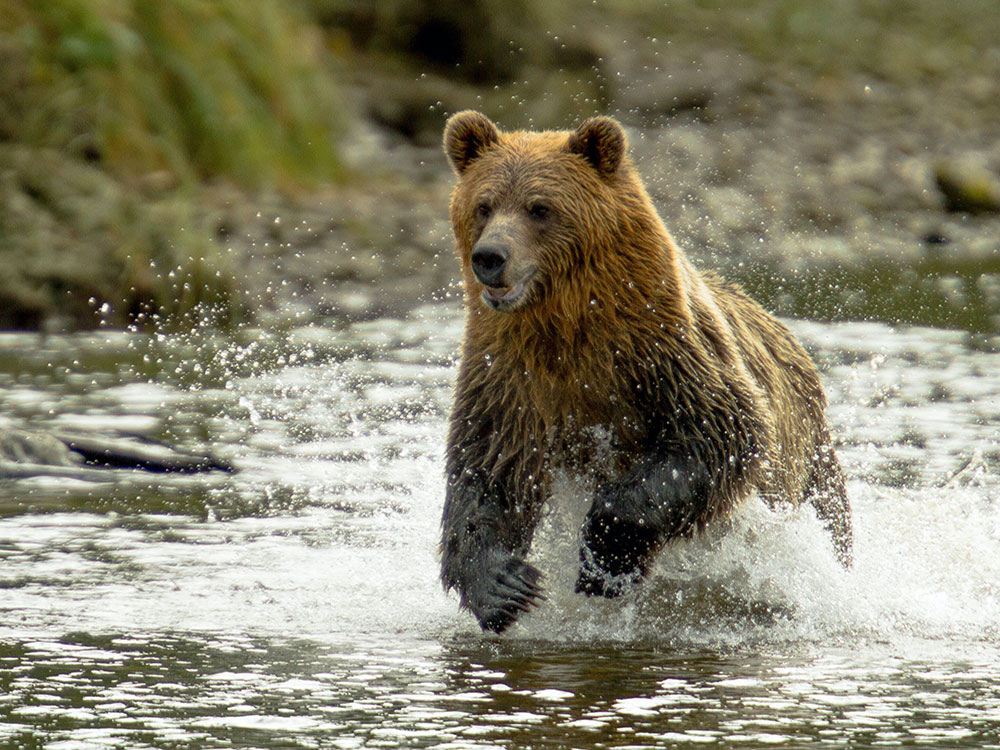
Highly publicized grizzly bear attacks have ignited calls to reopen grizzly trophy hunts across Western Canada.
The most recent push came from the BC Wildlife Federation, a conservation and hunting advocacy organization that called for a hunting season on grizzlies after a bear attacked a group of schoolchildren in Bella Coola, B.C., leaving two people critically injured and two others seriously hurt.
The federation made the call while the circumstances of the attack were still unknown. Conservation officers now believe the attack involved a grizzly sow and her cubs.
This does not dismiss or mitigate the traumatic nature of the incident, but it raises questions about why the federation would amplify this call during the early stages of an investigation.
Amid calls for British Columbia to revisit its grizzly hunting ban, Todd Loewen, Alberta’s minister of forestry and parks, has indicated he’s considering lifting his province’s ban in response to a growing number of grizzly attacks.
Alberta banned sport hunting of grizzlies in 2006. A similar ban was imposed in B.C. in 2018, drawing criticism from hunters and support from First Nations and the public.
In 2024, Loewen introduced a framework allowing grizzlies to be killed by wildlife responders, rather than conservation officers, and some have questioned whether the right grizzly was euthanized in the program’s first kill.
The current debate about hunting grizzlies is being increasingly driven by emotion and political pressure.
Grizzly encounters are rare
A moral panic is a period marked by widespread, often exaggerated, concern about a perceived threat to a community. It relies on typically sensationalist media reporting echoing the claims of “moral entrepreneurs,” like advocacy groups, to induce public support for policy changes.
The recent grizzly attacks are already being used to fuel such a panic. Yet grizzly encounters are rare and often stem from surprise encounters, people encroaching on grizzly territory or sow grizzlies defending their cubs. The context of these incidents must be considered.
Every year, thousands of people encounter grizzly bears at national and provincial parks, including wildlife photographers, hikers and other naturalists, without incident.
Some people have expressed concerns that grizzlies are venturing away from their traditional habitats. But these observations may be the byproduct of a bumper crop season, which leads to a greater dispersion of berries that are crucial for hibernation foraging.
Predator control claims don’t match the evidence
Some hunters cite grizzlies and other predators as a contributor to declining elk populations across the Rockies. However, data from Alberta largely demonstrates that elk populations have trended upward, not downward.
Some evidence suggests elk population declines in mountainous hunting zones. It remains unclear as to why hunting interests would take precedence over natural ecological processes.
Hunting predatory animals is also a space that capitalizes on conspiracy theories and pseudoscience, despite the sector’s desired public image of science-based management and conservation.
For example, the BC Wildlife Federation has stated grizzly hunting was banned in B.C. with “no scientific rationale.”
This framing ignores substantial scientific evidence, including non-hunting-related mortalities, continued habitat loss, climate change that’s affecting denning patterns and increasing the risk of human conflict, and the fact that many grizzly populations are classified as “threatened.”
The claim there is no science to warrant a ban on grizzly hunting oversimplifies an inherently complex ecological issue.
Economic arguments miss the larger picture
The hunting industry has long noted the economic value of trophy hunting. However, grizzly bear tourism creates more jobs and generates more revenue than trophy hunting. New research from the Greater Yellowstone Ecosystem has found that a single grizzly bear generates US$46,000 annually for the local economy.
Beyond this, framing wildlife solely through economic value reproduces a colonial dynamic in which natural resources are assigned value based on their economic and extractive potential.
There is also growing and widespread concern that changes to hunting policies in Alberta are spearheaded at the behest of the hunting industry itself. Loewen’s portfolio involves making decisions surrounding wildlife management, and some critics have raised concerns about his previous ownership of an outfitting business.
Loewen’s family owns Red Willow Outfitters, a hunt-guiding business. While the minister has indicated he’s working with lawyers and the province’s ethics commissioner over potential conflicts of interest, he has implied he doesn’t see any cause for concern.
Colonial dimensions of wildlife management
Grizzly bears, like wolves and bison, have tremendous cultural significance to many First Nations, including the Blackfoot people.
This connection that many First Nations communities have to native wildlife and their knowledge structures was disrupted by settler colonialism.
These knowledge structures and world views are re-emerging. Examples include Indigenous-led stewardship of grizzlies in the Great Bear Rainforest in B.C. and the signing of the Grizzly Bear Treaty, led by the Piikani Nation, in Alberta.
Reopening grizzly hunting would result in substantial cultural harms to many Indigenous communities. A comparable case unfolded in Wisconsin in 2021, when hunters killed almost one-quarter of the wolf population. Beyond its ecological harms, the hunt caused tremendous socio-cultural harms to the Ojibwa.
Conservation and safety are not at odds
Calls to reopen grizzly hunting overlook the need for greater investment in public education and conflict mitigation to protect a threatened species. They also ignore that poaching is a driving cause of grizzly mortality and is likely underreported.
Many recent attacks have involved sows with cubs, raising questions about how killing grizzlies could bolster conservation when the species is one of the slowest-reproducing mammals. While sow grizzlies with cubs would likely be exempt from any hunt, they are responsible for many recent attacks. It is unclear how a hunt could reduce these incidents when the bears most likely to be involved would not be targeted.
The argument for reopening grizzly hunts is not about conservation or public safety. Trophy hunting remains tied to long-standing colonial practices and ideas about establishing masculine dominance, rather than ecological necessity.
Rural communities have demonstrated that existence with grizzlies and wolves is possible. Therefore, the question is not whether coexistence is achievable, but whether there is the political will to facilitate it.
![[Tyee]](/design-article.thetyee.ca/ui/img/yellowblob.png)
Read more: Indigenous, Alberta, Environment










Notice about commenting changes
The Tyee’s commenting system will be moving to a new platform on Nov. 12. If you’re already a Tyee commenter you must register with the new system on or after Nov. 12 with your preferred username.More information can be found here.