


 SHARE:
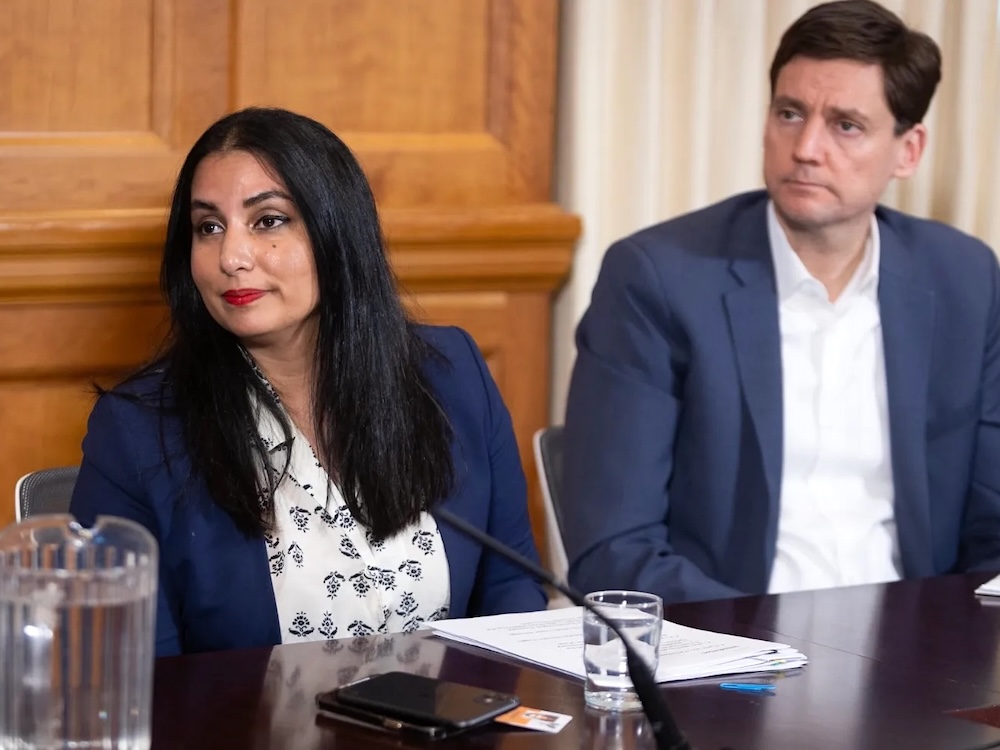
Even as he acknowledged defeat in his long battle to amend or suspend elements of the Declaration on the Rights of Indigenous Peoples Act, or DRIPA, Premier David Eby insisted Tuesday he had the votes to impose his will.
It was only a “tap on the shoulder” from Attorney General Niki Sharma, he revealed, that finally deflected him from his determination to introduce legislation.
It was a tap with momentous consequences for Eby, the government and the future of reconciliation with First Nations.
From the moment Eby announced he would amend DRIPA in response to a December Court of Appeal decision in the Gitxaala case, he encountered intense opposition from First Nations.
Eby steadily retreated. From proposing “non-negotiable” amendments, to demanding a three-year suspension of elements of DRIPA, to a one-year suspension with a confidence vote, to a regular vote of the legislature that was uncertain to pass, Eby tried to find a way to impose his will, adamant that the province faced an existential risk from new litigation.
It was an aggressive strategy for a premier with a one-vote majority and three Indigenous members of caucus, each from a First Nation that firmly opposed amendments. Despite Eby’s claims that his caucus was “strong and united,” media reports said at least 10 members had expressed concern about his direction.
A preliminary but near-fatal tap on the shoulder came April 10 when Grand Chief Stewart Phillip, president of the Union of BC Indian Chiefs, announced that his wife Amshen, Joan Phillip, MLA for Vancouver-Strathcona, would not support suspension even on a confidence vote. Apparently caught off guard, Eby said it would not be a confidence vote after all.
Too late. Once a government rings the confidence bell, it cannot be unrung. The vote — whenever it takes place — might not force an election, but a defeat would mark a turning point in the life of this NDP government just 18 months into its mandate.
On Monday morning, visibly drained, hemmed in by reporters in the doorway of the government caucus room, Eby tried to explain his latest change of heart, searching for words to make his defeat seem like a positive outcome.
“I was prepared,” he began, “government was prepared, to move the amendments, pardon me, I was prepared to introduce legislation today, that would put a hold on the declaration act provisions so that we would have the space to negotiate a more permanent outcome.”
“You backed down again,” barked Vancouver Sun columnist Vaughn Palmer, who was parked, scowling, at Eby’s elbow.
The premier soldiered on, revealing that it was only the intervention of Attorney General Niki Sharma “late last week” that had diverted him from legislative action that had the potential to do fatal damage to B.C.’s relationship with Indigenous Peoples and take down the government.
Sharma, who had been working the phones with Indigenous leaders to find a solution, “came to me and told me she believed there was a route to reach an agreement like this.... We had conversations over Saturday and Sunday.”
Sharma did not prevail easily. Despite her advice, Eby forged ahead. On Saturday, senior public servants called their counterparts in B.C.’s leading Indigenous organizations to confirm that legislation would be tabled in the house Monday.
In response, the First Nations Leadership Council issued an open letter that was a blistering indictment of the government’s actions, revealing for the first time their confidential offers to find an off-ramp for the government to avoid legislation.
What happened next is unclear. By midday, the council’s letter was racing around social media. At some point, Sharma delivered her tap on the shoulder.
Within hours of the open letter’s wide release, Eby was in a Zoom call with First Nations Leadership Council leaders to work out the details of his surrender — he might prefer “ceasefire” — which included a pledge that no legislative action would occur in this session while the government and the council pursue further discussions. An urgent caucus meeting sealed the deal.
“I want to thank the attorney general for tapping me on the shoulder,” he told reporters, “and creating space for the conversation to happen with the First Nations Leadership Council.”
Did the premier actually have the votes? Despite their desire to avoid an election, the BC Greens have used the crisis to forge a much stronger relationship with the First Nations Leadership Council. It is hard to imagine Green Leader Emily Lowan directing her two caucus members to prop up the NDP administration in a confrontation in the legislature.
That left the Independent MLAs, all former Conservatives and all in support of repeal of DRIPA. Only Independent Elenore Sturko, MLA for Surrey-Cloverdale, has indicated she considered supporting Eby’s suspension strategy. Amelia Boultbee, MLA for Penticton-Summerland, had also been approached.
Was the premier prepared, over the heated objections of First Nations, to test the house without the support of Phillip, one of his most esteemed MLAs, herself Indigenous, while relying on members who were elected with the Conservative Party of BC?
If so, Sharma’s “tap on the shoulder” saved the government from a black day.
Except for legislation approving two treaties with the K’ómoks and Kitselas First Nations, the government’s legislative agenda is thin. Once those treaty bills are passed, the Eby team should shut down the legislature and regroup.
Since Sharma, who is both attorney general and deputy premier, was able to save the government from disaster on the DRIPA file, the premier should let her take the wheel and seek to restore the government’s relationship with First Nations. He should turn his attention to the economy.
The DRIPA debate has been pumping oxygen into the furnace of the Conservative Party of BC leadership race. Leading candidate Caroline Elliott, who is campaigning almost exclusively on the DRIPA issue, has been promoting the idea that the legislative standoff shows that B.C. is being “co-governed with an elite group of Indigenous leaders without a public mandate who represent less than three per cent of the province’s population.” Repeal of DRIPA is the only way, Elliott says, to reverse this terrible, imaginary threat.
Columnist Palmer develops this theme further, suggesting that the First Nations Leadership Council’s open letter so intimidated Eby that the premier retreated for the last time, ushering in “a new era where the governing of B.C. is increasingly shared among the province and Indigenous nations.”
“Already the province has learned that it cannot amend its own laws without the consent of First Nations,” he wrote.
It will be a shock to First Nations Leadership Council Chiefs to learn that they are co-governing the province, given the events of the weekend.
It took months of advocacy and unprecedented unity to achieve consultation on amendments to a bill, passed unanimously by the legislature in 2019, that touches directly on their Aboriginal title and rights.
Whoever wins the Conservative race — and Elliott is considered a prime contender, endorsed by former premier Gordon Campbell — the debate over B.C.’s relationship with First Nations will continue.
The BC NDP needs to be a leader in that debate, not a fretting bystander. Sharma has her work cut out for her.
“Moving forward together is my No. 1 priority,” the premier declared, “finding a way to resolve government’s concerns in partnership, rather than in conflict — that is what is best for the province and that is what is best for us going forward.”
“I’m really pleased we have this agreement.”
No doubt. ![[Tyee]](/design-article.thetyee.ca/ui/img/yellowblob.png)
Read more: Indigenous, BC Politics






Tyee Commenting Guidelines
Please note that email notifications for replies are not currently working due to a software issue which may be resolved in a future update.
Comments that violate guidelines risk being deleted, and violations may result in a temporary or permanent user ban. Maintain the spirit of good conversation to stay in the discussion and be patient with moderators. Comments are reviewed regularly but not in real time.
Do:
Do not: