


 SHARE:
Last December, a cohort of leading Canadian linguists sent a letter to Prime Minister Mark Carney, criticizing his government’s pivot away from Canadian English.
Utilise. Globalise. Catalyse. Each of these three verbs is typically spelled with a z in this country. But under Carney, documents coming from Ottawa have undergone a subtle, transatlantic shift.
Many Canadians may not have registered Ottawa’s embrace of British English (or its passive-aggressive rebuke of U.S. English.
But the signatories of this letter were the very people guaranteed to notice.
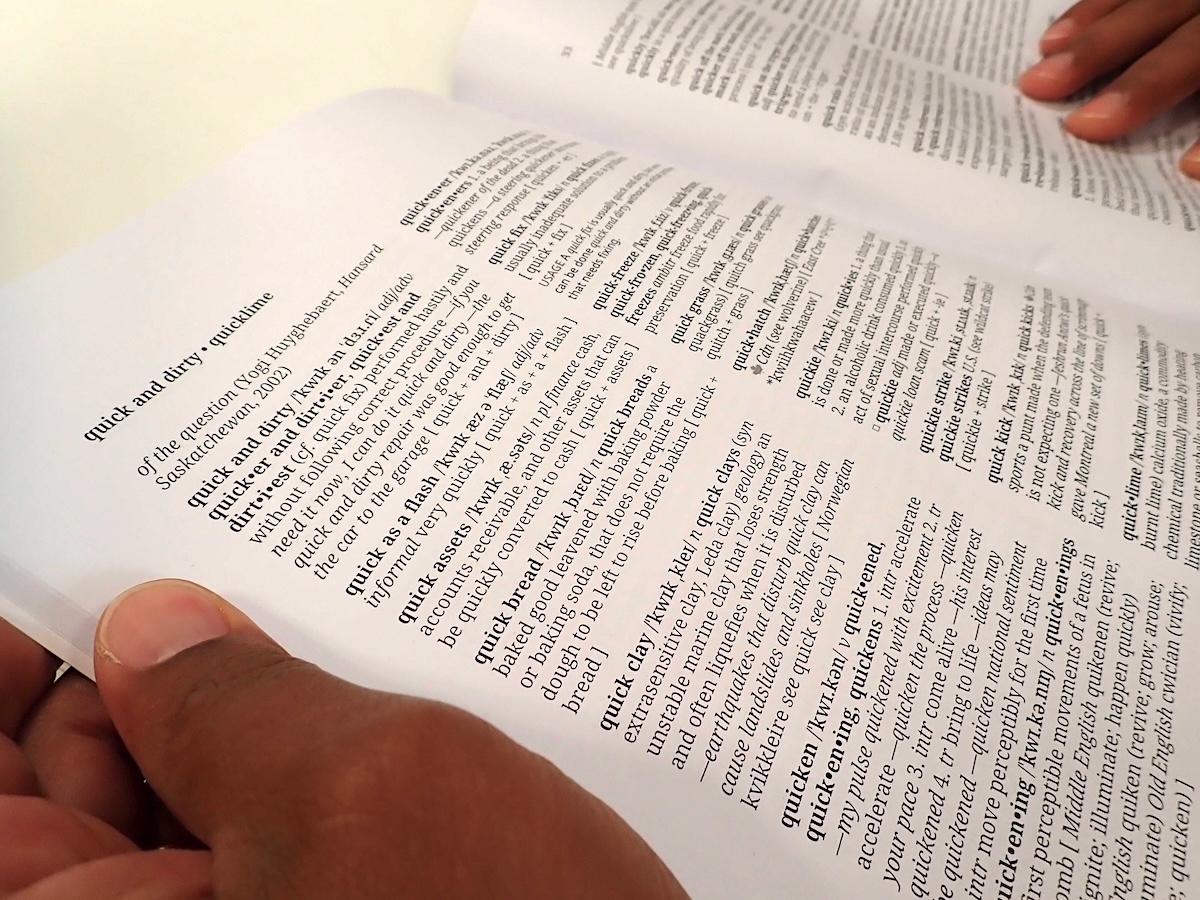
They are four linguistics professors and two editors, all of them members of the not-for-profit Society for Canadian English, whose primary purpose — beyond “understanding, researching and promoting the use of Canadian English as a vital sign of Canada’s unique identity” — is the development of a modern Canadian English dictionary.
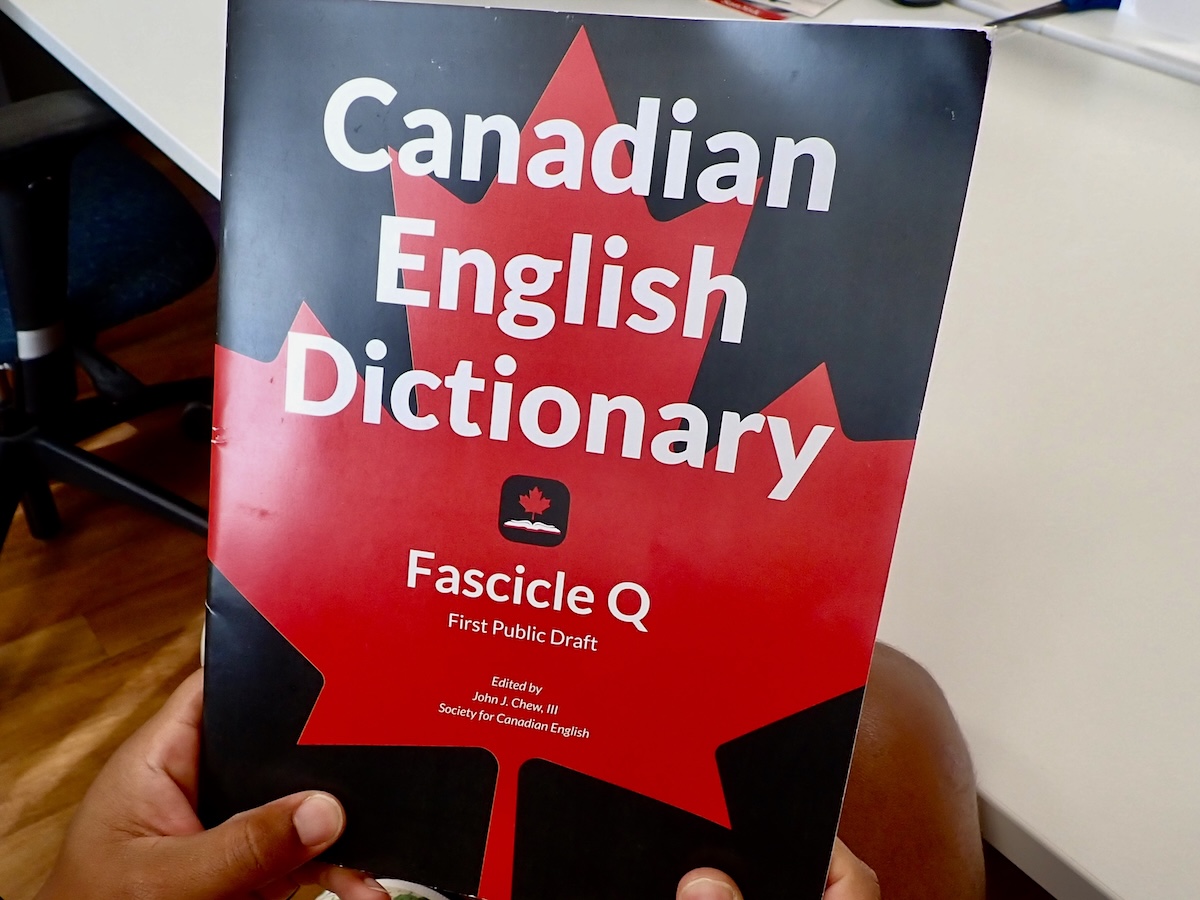
When The Tyee last spoke to John Chew, the editor of the new Canadian English Dictionary, he and the society were working their way through the project’s first letter, or fascicle: Q.
That was over a year ago. Where are they now? Getting started on fascicle R, meaning Q is complete, at long last — and it’s even for sale, if you know who to ask.
The document debuted to muted fanfare at the Methods in Dialectology and Language Diversity international conference, held at the University of British Columbia last month, where I purchased the project’s first issue — basically, Oops! Only Q — without hesitation.
As soon as I saw it, while waiting for the panel I was part of to get started, I picked up a copy to skim.
Chew looked over my shoulder.
“It’s 25 dollars,” he said.
What a bargain. I might have paid more.
As the foreword explains, “the first public draft of the first edition of the first fascicle of the Canadian English Dictionary is a milestone in Canadian lexicography.”
Mileage on this milestone may vary, especially in light of all those qualifiers, let alone the use of “fascicle,” a $10 word for “instalment” or “chunk” that evokes a portmanteau of “fascist popsicle.”
I’d have called it CED: QED.
But it really is a notable accomplishment. There hasn’t been a comprehensive Canadian English dictionary in over two decades, and the damage to our national identity is clear, as our own government no longer speaks the language.
‘A favourite among Scrabble players’
So why is Q the proof of concept? Why not A?
“Q is a short fascicle, but not as trivially so as X, and it’s a favourite among Scrabble players,” its quintet of authors explained, in an article published in Dictionaries: The Journal of the Dictionary Society of North America.
“Q has plenty of quite quintessentially quirky and quotable words that are useful in attracting attention to our project.”
Attention is vital at this stage for finding a publisher, financing what remains volunteer labour for many contributors, building a following, raising awareness and growing support for the project.
Beyond that, Q is useful for the problems it creates right off the bat.
“In Canadian English, Q is both a significant letter due to the number of lexemes beginning with Queen (Queen’s printer, Queen’s Counsel) and those of northern Indigenous origin (qajaq, quinzhee),” the authors explain.
“Q has a significant number of words whose early 21st-century definitions need rewriting (queen, queer, quad and many Queen’s lexemes since the end of the reign of Queen Elizabeth II).”
Suffice it to say, the definition of “queer” in the Canadian Oxford Dictionary, or CanOx, from 2004 doesn’t quite cover all the ways the word is used and what it means to us in 2026.
The same is true of “queen” and, strangely, “quilt,” the latter of which is defined by CanOx as “a bed cover.” To that, I say much the same thing I would say if you tried to make my king-size bed with any quilt I’ve ever owned: That doesn’t really cover it.
I would argue that this definition doesn’t meet the moment, as the modern quilt is non-utilitarian. You sleep beneath one only if you’ve hung it on the wall above your bed.
Someone in the room agreed with me.
“Our editors raised the examples of quilts that adorn sofas or car seats or quilts that are hung on walls as decorative art,” the authors explained. “Even if quilts were historically meant to go on beds, current usage would suggest that a genus that demands that quilts can only be used as bed covers excludes other types of quilts because it is too specific.”
The new Canadian English Dictionary defines “quilt” as “two layers of cloth with a layer of padding in between, stitched with cross lines through all three layers.”
Remarkably specific. Too specific? Or still insufficient, in your estimation? Either way, it’s something to discuss at your next quilting bee — a Canadianism included in “Fascicle Q,” signified with a little grey maple leaf, lifted from UBC’s delightful A Dictionary of Canadianisms on Historical Principles.
“Quilting bee” appears in the original pre-1967 edition, defined as a “social gathering of women at which quilts are made.” Perhaps a bit old-fashioned, that.
The modern Canadian English Dictionary is more inclusive by design and so defines it as “a social gathering where attendees collaborate on making a quilt.”
‘Do we list all possible fillings, or only the most common ones?’
Compiling a modern Canadian dictionary is a little like baking a quiche: you have to make conscious decisions about what goes in it. Defining a quiche is no different.
“When our definers initially probed the definientia of quiche,” explained the authors, “discussions arose as to which quiche fillings should be listed: cheese, vegetables, meat, fish, mushrooms, vegan cheese — the list goes on. Do we list all possible fillings, or only the most common ones, while using ‘etc.’ as CanOx does, or ‘such as’ as [Merriam Webster] and [Nelson Gage] do?”
How would you define a quiche? The Canadian English Dictionary’s first pass is this: “a savoury baked tart with a filling of eggs, milk, cream and usually other ingredients.”
It’s a meaningful question. Whatever precedent is set will have massive implications for how the dictionary approaches other foods and phrases — other Q words, even, such as “quesadilla”: “a Mexican dish consisting of a folded tortilla stuffed with cheese and sometimes other ingredients, cooked until the cheese is melted.”
“Is the ‘Queen’s Beaver’ in there?” a co-worker quipped when I mentioned this project, evoking a classic Canadian double entendre inspired by the nickel. Sadly, no.
But “Queen’s Bush” is, and rightly so, in reference to the former name for the part of southwestern Ontario established by many formerly enslaved Black settlers.
It’s not as amusing when you know its colonial history, admittedly, but that’s true of Canada, too.
Confronting complicated histories
The work of compiling a Canadian English dictionary inherently requires confronting and accounting for this complicated history. You can’t establish who we are without encountering the fact of who we’ve been.
Perhaps the best example is the longest among the 500-plus entries so far: “Queen Charlotte Island caribou.” As you may know, there is no such place. Not anymore. Its colonial name was renounced in 2009, five years after the final edition of CanOx, where Haida Gwaii doesn’t appear.
There’s also no such caribou. The species is extinct, like the Coast Salish woolly dog. But even so, the caribou's common name is well established within taxonomic circles.
“The problem with defining here has to do with the fact that this animal has been extinct since the early 20th century, and since it was a relatively rare caribou in the first place, there is little available information as to how we ought to decolonize the common name, in keeping with the reconciliatory renaming of Haida Gwaii,” said the authors.
Why not just call it the Haida Gwaii caribou? Apparently, they’re not allowed to do that. This is linguistics, not creative writing.
Popularizing new words is society’s job. To that end, the editors note that some sources, such as Wikipedia, call it Dawson’s caribou, but “a decolonial solution has yet to be popularized with any frequency.”
This is when it helps to be inclusive. You can simply ask around.
“The note also welcomes contributions from informed dictionary users, in the hope that a resolution can be found,” the editors added.
All communities should find themselves in these pages
I learned a new phrase at the UBC panel. They were throwing it around. “Linguistic justice.”
It may not surprise you to learn that the English language has been used as a tool of oppression, exclusion and marginalization, including among those who speak it.
The Canadian English Dictionary aims to be different. Inclusivity is crucial to this project and, likewise, it may not surprise you to learn that the dictionary’s editors were careful to define it.
“By inclusive, we mean that the CED should contain not only the Central-West Canadian urban variety, traditionally identified as standard, but that all Canadian communities should have their Canadian Englishes documented in the CED, as a matter of representation and equity,” the authors explain.
Any dictionary, after all, that fails to do so is a failure. This is meant to be a comprehensive resource. If it’s really just a catalogue of words and phrases used by white Canadians, congratulations on your racist dictionary.
What were those three verbs again? Utilize. Globalize. Catalyze. The point of this project is not to prioritize one way of speaking Canadian English or even to signify one way as proper and some other way as non-standard. It’s to produce a contemporary, comprehensive resource that captures and thus catalyzes our patchwork identity.
“Canadian English evolved here and represents a unique aspect of our culture,” the linguists told Carney in their letter, late last year. “It is one of the practices woven through our everyday lives that make us Canadian.”
In other words, a quilt is more than just a fancy blanket. It’s a metaphor for Canada, writ large. ![[Tyee]](/design-article.thetyee.ca/ui/img/yellowblob.png)
Read more: Media











Tyee Commenting Guidelines
Please note that email notifications for replies are not currently working due to a software issue which may be resolved in a future update.
Comments that violate guidelines risk being deleted, and violations may result in a temporary or permanent user ban. Maintain the spirit of good conversation to stay in the discussion and be patient with moderators. Comments are reviewed regularly but not in real time.
Do:
Do not: