

 SHARE:
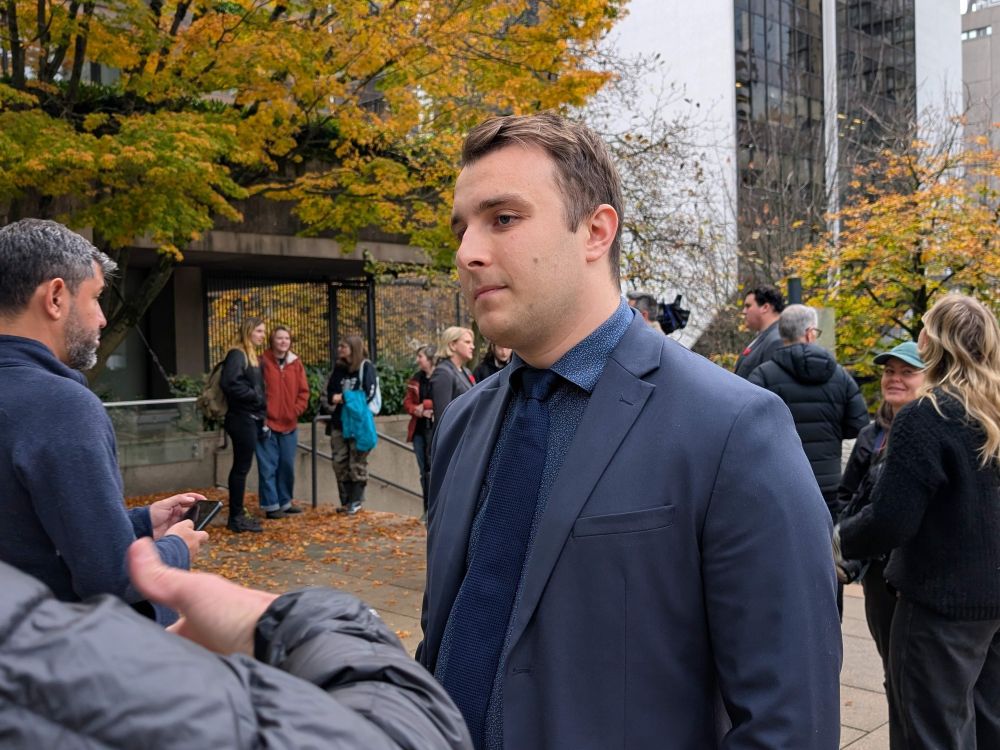
Eris Nyx and Jeremy Kalicum were found guilty of trafficking meth, heroin and cocaine this morning by Justice Catherine Murray.
The co-founders of the Drug User Liberation Front had been buying, testing and selling unregulated drugs at cost to compassion club members to reduce the harms and fatalities caused by the unregulated drug supply.
They argued they were allowed to do so under a Health Canada exemption that let public health officers set up drug checking and overdose prevention sites where people could get illicit drugs tested or be monitored while they used drugs.
But Murray said the exemption only covered the storage, testing and packaging of drugs, and not the selling or distribution.
The drugs seized from DULF’s headquarters on Oct. 25, 2023, during a police raid were intended for distribution and not covered by the exemption, Murray said.
“There is no question their intentions were and are good and that they wanted to save lives,” Murray told the full courtroom today.
The question was if they were exempt from criminal liability.
Which, she decided, they were not.
“What we got charged with doing, we thought we were exempt for that, so that’s a bit frustrating,” Kalicum said, speaking with media after the trial. “But if at the end of the day we can make some changes to drug laws that will ultimately be a good thing to come out of it.”
Murray said the convictions are suspended pending a constitutional challenge Nyx and Kalicum, and their lawyers Tim Dickson, Stephanie Dickson and Kaelan Unrau, are launching Nov. 24, where they will argue the Controlled Drugs and Substances Act is unconstitutional.
DULF is also awaiting the decision in a judicial review where they asked a judge to review Health Canada’s decision to deny them permission to buy, test and distribute unregulated drugs in the name of harm reduction.
During the court case defence lawyers never denied DULF was buying, testing and distributing drugs, but argued they had permission to do so as part of a harm-reduction initiative worked out with Vancouver Coastal Health.
This exemption covered the storing, testing and packaging of drugs, but not buying or distributing them.
VCH was not involved in buying drugs but did lease office space to DULF and provided funding for drug testing and to run an overdose prevention site.
DULF relied on donations to buy the drugs and did not make any money on sales.
Nyx and Kalicum bought drugs through the dark web and rigorously tested the substances before labelling and selling them at cost to their 47 compassion club members, who were adults with high-risk drug habits.
Nyx previously told The Tyee she was aware she was trafficking illegal drugs and could go to jail, but that she had to do something.
“This is the only sane response in an insane situation,” she said in 2023, adding that “everyone I know and love is dead,” because of the unregulated toxic drug supply.
In her judgment today Murray noted DULF’s approach was successful.
DULF produced a peer-reviewed study that showed after about one year none of its compassion club members had died. Members reported having fewer overdoses and engaging in less crime.
Unregulated street drugs often contain fentanyl, fentanyl analogues like carfentanil and benzodiazepines, xylazine and other substances, which hugely increase a person’s risk of overdose.
The BC Coroners Service started recording monthly fatalities from unregulated drugs at the start of 2014. Since then more than 18,600 British Columbians have been killed by unregulated drugs.
The province declared a public health emergency in April 2016 but drug deaths have soared since then, and remain high. In September, 158 British Columbians died.
The majority of the deaths have been caused by fentanyl, which was detected in 77 per cent of all drug-related fatalities so far this year. But toxicology testing often finds multiple drugs in a person’s system.
The BC Coroners Service reported that in 2024 85 per cent of fatalities involved fentanyl, 51 per cent involved meth or another amphetamine, 49 per cent involved cocaine and 48 per cent involved benzodiazepines.
According to Health Canada, from April 2016 to March 2025 more than 53,800 Canadians were killed after overdosing on opioids.
B.C. Provincial Health Officer Dr. Bonnie Henry and former chief coroner Lisa Lapointe have recommended the province explore expanding its safer supply program and explore using non-medical models.
Compassion clubs, like the one run by DULF, would be an example of a non-medical model for safer supply.
Currently people at high risk of harms caused by unregulated drugs can speak to their doctor about getting a safer supply prescription for some drugs like stimulants, benzodiazepines or oral hydromorphone tablets, sold under the brand name Dilaudid.
But requiring a prescription when many people don’t have a family doctor and requiring people to take their prescription in front of a pharmacist, sometimes several times a day, can create barriers to the program.
Two years ago the BC Centre for Disease Control estimated that less than four per cent of the estimated 115,000 people with an opioid use disorder where able to access the program.
This spring B.C. further restricted its safer supply program.
Another harm reduction strategy used by the province is allowing overdose prevention sites, where people can be monitored by peers while they use unregulated drugs so someone can step in if there’s an overdose or medical emergency.
Kalicum said anyone running an overdose prevention site should double check what they are and are not allowed to do to avoid a similar crackdown.
“I think people need to take a critical look at the exemptions they have, what they cover and take a look at this ruling and what the judge said,” Kalicum said. “I think it has implications for people who are selling or trafficking drugs and for people who are accessing drug checking services,” he added. ![[Tyee]](/design-article.thetyee.ca/ui/img/yellowblob.png)
Read more: Health






Notice about commenting changes
The Tyee’s commenting system will be moving to a new platform on Nov. 12. If you’re already a Tyee commenter you must register with the new system on or after Nov. 12 with your preferred username.More information can be found here.