


 SHARE:
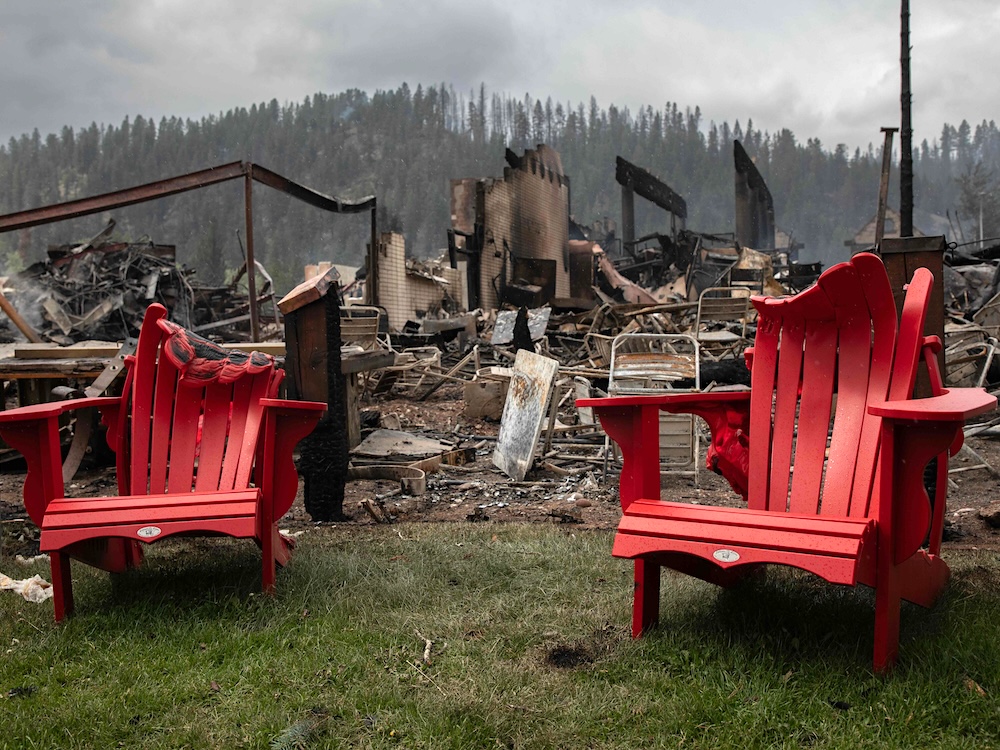
When Kelly Mitchell bought La Punta Norte Guest Inn in 2021, she and her husband thought it might be their retirement property. Even as the Bald Range wildfire approached, they kept the inn running right up until they evacuated all their guests on the night of Aug. 14.
Within hours, the wildfire destroyed the Mexican-inspired inn on the west side of Okanagan Lake.
Mitchell remembers heading back about a week later.
“It was gut-wrenching,” she said. “It looked like somebody dropped a bomb on it.”
Mitchell is still in disbelief. She said the disaster has thrown her future plans into disarray and she’s not sure what the path ahead will look like.
“I was kind of blank, to be honest with you,” Mitchell said. “It's so shocking what happened, and we just weren't expecting it.”
Now, she’s considering rebuilding — a challenge that’s becoming increasingly common as wildfires grow more intense and frequent. According to BC Assessment’s latest assessment, the buildings on Mitchell’s property are valued at about $2.7 million.
With the loss of the inn, Mitchell joins dozens of other British Columbians who have lost their businesses, jobs and livelihoods to extreme weather over the past decade.
But the road to reopening is bumpy.
Rob de Pruis, the Insurance Bureau of Canada’s national director, consumer and industry relations, said small businesses are often insured for less than the cost of rebuilding and restarting their business.
The provincial and federal governments offer some support.
Bernie Fandrich, president of the Lytton chamber of commerce, said that even with the needed money, getting shovels in the ground to replace small businesses can take years.
Five years after a wildfire destroyed most of the village’s structures — including a museum, part of his rafting company’s facility, the local grocery store and three hotels — only one business has reopened.
Fandrich said employers should expect years of delays.
“We’re going to rebuild,” he said. “Hopefully it'll be sooner rather than more postponing.”
The Bald Range fire was devastating. It has destroyed more than 150 buildings, displaced about 20,000 people and killed at least one person.
So far this year, wildfires have destroyed more than 500 structures in British Columbia.
According to de Pruis, it’s too early to estimate the cost of this year’s wildfire destruction.
But in 2023 wildfires destroyed about 600 structures. According to the Insurance Bureau of Canada, that amounted to about $720 million in insured damage. Meanwhile, the 2024 wildfire in Jasper, Alberta, caused $660 million in insured damage to commercial businesses.
And the cost of wildfires will continue to climb. Human-caused climate change will make extreme weather increasingly destructive and more likely.
About half of the structures lost this year are homes. Others include farms, hotels, shops and other small businesses.
For towns affected by wildfires, the loss of local business is costly. Fiona Anderson, secretary at the Lytton chamber of commerce, said that five years after a wildfire devastated their village, it remains largely vacant.
That’s partly because the fire destroyed essential businesses in town, she said, including AG Foods — an independently owned grocery store that supported the community.
“People were asked, ‘Do you want temporary housing?’” Anderson said. “And a lot of them said, ‘Well, not if there's no grocery store. Where will we shop?’”
According to de Pruis, the first place business owners turn after a wildfire is often their insurer. When he spoke to The Tyee, he had just returned home from Penticton, where he had been meeting with residents affected by the Bald Range wildfire.
“The insurance industry is the primary funder of the recovery for the homes, businesses and vehicles that were impacted by any type of a wildfire,” he said.
Still, insurance payments often fall short of the total cost of getting a business back up and running. That’s partially because owners underinsure their businesses, de Pruis said.
Unlike with home insurance, which often offers clients the cost to replace a home, insuring the physical capital of a business requires insurance buyers to estimate the cost of their property and everything inside.
The cost of replacing a business can also rise drastically in the time it takes to rebuild, de Pruis said. As an example he looked to the town of Jasper, where he estimated that about half the businesses destroyed were insured for less than the actual cost it would take to replace them.
Plus, de Pruis said, many owners affected by wildfire insurance don’t have business interruption insurance, which can help ensure owners can replace lost income and cover payroll for key employees while recovering.
Outside of insurance, other support exists for businesses affected by wildfires. Some Summerland businesses have launched fundraising campaigns to help cover their losses.
Evan Brick, a spokesperson for federal Minister of Emergency Management and Community Resilience Eleanor Olszewski’s office, said in an email the federal government is committed to helping affected communities recover.
“Helping these businesses recover means helping people protect their livelihoods, reopen their doors, contribute to the community’s recovery and ensure Summerland remains a vibrant and welcoming place to live, work and visit.”
The federal government funds wildfire recovery through its Disaster Financial Assistance Arrangements program.
Provinces and territories can request such funding when recovery costs are higher than $3.84 per capita — for B.C., about $22 million.
Brick said that through the program, the government can reimburse provinces and territories for up to 90 per cent of the cost of eligible expenses, such as site cleanup, debris removal and restoring businesses.
B.C. Jobs and Economic Growth Minister Brenda Bailey said the province’s immediate priority is keeping people, businesses and properties safe.
“We are going to support communities as they get back on their feet, and we realize that a tremendous amount of work will have to be done across all levels of government,” Bailey said in an emailed statement.
The provincial government has regional teams available to help communities support businesses affected by disasters. It has also put together a step-by-step guide to recovering from the economic impacts of disaster.
But even with financial support, de Pruis said, restarting a business after a wildfire takes time.
“I think one of the biggest surprises, and we're experiencing this in Jasper right now, is that people have a tendency to underestimate how long it would take to rebuild a property,” de Pruis said.
He said it could take approximately three years after a wildfire to reopen, depending on the level of damage.
The fire left a significant amount of debris. According to de Pruis, once the site was safe to return to, cleanup took about nine months. Only then could businesses start submitting plans to rebuild and get shovels in the ground.
And that’s if nothing else delays rebuilding. In Lytton, rebuilding was partly delayed because of work at known Nlaka’pamux archeological sites in the village.
But Lytton’s recovery has also been slowed because of the 250-resident village’s small size and remote location.
Even after cleaning up contamination and archeological work, Anderson said, it has taken some businesses up to six months to get meetings with the federal agency helping the village with wildfire recovery. And civic infrastructure, such as the sewer system, has not yet fully been fixed.
So far, only one business within village limits has been able to reopen: the Lytton Chinese History Museum. The local legion is set to open soon, and shovels have only recently hit the ground to rebuild the local grocery store.
Two of Lytton’s hotels have sold their land, while a third is still trying to get the funding to rebuild. Still, Anderson says, Lytton residents are determined to rebuild the village.
“It’s a beautiful location, and many, many people have been there for generations,” she said. “It is still home to too many people that just wouldn’t know where else to go.” ![[Tyee]](/design-article.thetyee.ca/ui/img/yellowblob.png)
Read more: Environment









Tyee Commenting Guidelines
Please note that email notifications for replies are not currently working due to a software issue which may be resolved in a future update.
Comments that violate guidelines risk being deleted, and violations may result in a temporary or permanent user ban. Maintain the spirit of good conversation to stay in the discussion and be patient with moderators. Comments are reviewed regularly but not in real time.
Do:
Do not: