

 SHARE:
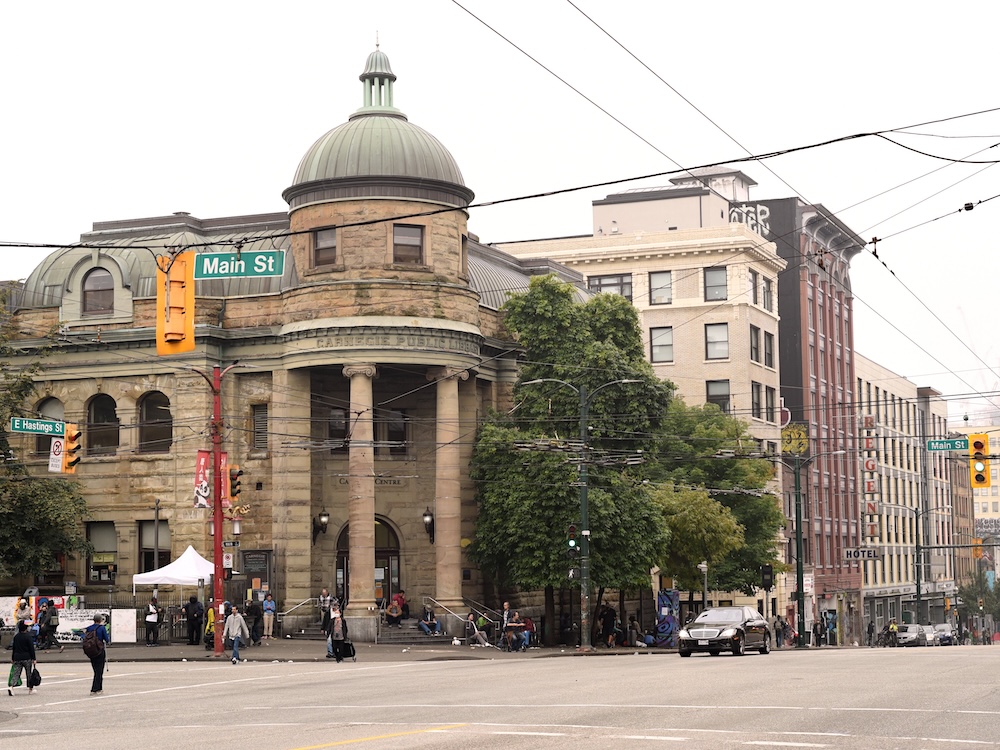
Around 260 people spoke against Vancouver city council’s plan to carry out the “Downtown Eastside Implementation Strategy” motion, which dramatically reduces the amount of social housing in new buildings and doesn’t work for Downtown Eastside residents.
Despite that strong opposition, council passed the new plan on Tuesday evening.
Much like the city’s “street sweeps” that brush aside issues affecting the neighbourhood, this motion radically changes Downtown Eastside zoning bylaws while ignoring complex affordability and health problems that affect all of Vancouver.
Former city councillor Jean Swanson criticized the plan, saying, “The uplifting motion does absolutely nothing to address homelessness and ignores the need to house 2,000 people with no fixed address in the DTES.”
The last homeless count in Metro Vancouver, conducted last March, found 5,232 individuals experiencing homelessness, a nine per cent increase over the previous year.
When the Balmoral and Regent, both single-room occupancy hotels, or SROs, were closed seven years ago, the city lost 300 rooms; we have yet to see any construction on those sites. In a community that has lost 1,200 affordable rooms in the last 10 years, the mayor has frozen future increases in building supportive housing.
Following pressure from business owners in the Granville Entertainment District, the city is now poised to close the Luugat (formerly the Howard Johnson Hotel) by June, and the province is also assessing the St. Helen’s and Granville Villa.
Closure of the three buildings will lead to the evictions of 269 people, many with mental health issues — a move likely to increase homelessness even further, as the Granville residents are moved to scarce social housing that is then not available to folks who are homeless.
Before redeveloping SROs, governments need to accelerate the construction of shelter-rate housing at the Balmoral and Regent sites, as well as at the former Salvation Army Temple at Gore and Hastings, and at the Keefer Rooms.
Current Downtown Eastside Oppenheimer District zoning allows private developers to partner with a non-profit organization and own 40 per cent of a new rental building, which they can rent at market rates, while the non-profit owns the remaining 60 per cent as social housing. Under the policy, 33 per cent of the social housing, or 20 per cent of the building, must rent at the shelter rate for rent, which is $500 a month for a single person.
This zoning stops condo development in the district, keeps property values more affordable for non-profits and government, and supports building the social housing the city needs. While these zoning protections have helped preserve affordability, the new policy threatens to undo that progress. The Downtown Eastside is the last option for people with low incomes.
The housing strategy report recommends allowing developers to own 80 per cent to 100 per cent of the building and either transfer or lease 20 per cent of the units to a non-profit or to the government to run as social housing. It also recommends that only 20 per cent of those units be rented at the shelter rate, with another 10 per cent rented at or below housing income limits. That means that for a 100-unit building, only four units would rent at the desperately needed $500 a month, as opposed to 12 units under the current zoning.
The changes to the Downtown Eastside plan are being proposed at the same time that Ken Sim and his ABC-majority council are pushing ahead with a zero per cent property tax increase budget. Critics have warned this budget will certainly come with cuts to vital city services.
Coalition of Progressive Electors Coun. Sean Orr introduced several motions to modify the 2026 “zero means zero” budget in an attempt to protect public services from cuts. He attempted to introduce a motion to “tax the rich” and refund resident homeowners with modest properties. His motions were all defeated by the ABC-dominated council.
The connection between social breakdown and income inequality has been well documented. Public services — community centres, libraries, good schools, parks and accessible medical care — all work to improve public health and soften the blow created by excessive concentrations of wealth. According to the book The Spirit Level: Why Equality Is Better for Everyone, in the United States, where the wealthiest 20 per cent are eight times as wealthy as the poorest 20 per cent, incarceration rates are 15 times higher than in Japan, which has a wealth discrepancy less than half of what exists in the U.S. Canada has three times as many people in jail as Japan, reflecting weaker social support.
These global trends of inequality are felt most acutely in the Downtown Eastside, where wealth disparity drives housing loss and social exclusion.
Austerity budgets only benefit billionaires. Ken Sim’s mentor, Chip Wilson, is a known figure in Vancouver’s real estate scene. He could solve Vancouver’s homeless problem with a small portion of his fortune, as could a wealth tax. Instead, this council seems hell-bent on gentrifying the Downtown Eastside Oppenheimer District, an area of about 20 city blocks, and displacing our most vulnerable citizens. It’s the only area in the city where careful planning has kept rents affordable for people living in poverty.
No one in the community wants more expensive rentals. Through the Carnegie Housing Project, local groups have identified what’s really needed. Residents want affordable, secure, purpose-built housing with private kitchens and bathrooms, at least 350 square feet per unit. They want strong maintenance and pest control standards; community spaces with kitchens, recreation rooms and gardens; limited police involvement; and restorative, peer-led safety models.
In this city that has one of the world’s most hopelessly pathetic urban landscapes of housing affordability, let’s at least protect this tiny piece of the city from land speculators, who have been operating in Vancouver ever since W.C. Van Horne, Canadian Pacific Railway executives and the Coal Harbour Land Syndicate, which included David Oppenheimer, ejected Indigenous people and made fortunes holding land in anticipation that the CP terminus would be moved from Port Moody to Vancouver.
Residents of the Downtown Eastside Oppenheimer District have faced displacement for generations, from the Coast Salish stewards of this land to the Japanese landowners during the Second World War.
We need neighbourhoods across the city that welcome everyone, not policies that keep driving people away and deeper into poverty and homelessness. ![[Tyee]](/design-article.thetyee.ca/ui/img/yellowblob.png)
Read more: Rights + Justice, Housing, Municipal Politics











Notice about commenting changes
The Tyee’s commenting system will be moving to a new platform on Nov. 12. If you’re already a Tyee commenter you must register with the new system on or after Nov. 12 with your preferred username.More information can be found here.