


 SHARE:

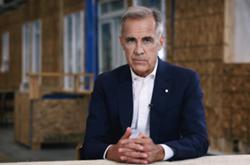
Sitting in a carefully lit room, with the top button of his shirt undone and the demeanour of a father speaking to his children after a long day at the office, Prime Minister Mark Carney addressed Canadians this week amid escalating trade tensions with the United States.
In doing so, he turned to Canadian history to explain his own policies.
“Our first prime minister, Sir John A. Macdonald, recognized the threat of an expansionist United States for what it was and raced to unite this land,” Carney calmly and slowly told Canadians in the YouTube video.
“Canada needed an economic and military corridor that could connect our peoples from east to west. And so, at an incredible human and financial cost, Canadians took what was a country on paper and made it real. They built an iron spine.”
Carney continued to extol the virtues of Macdonald’s major project.
“Almost 5,000 kilometres of railroad track from east to west, the Canadian Pacific Railway stitched together our country and made our presence undeniable and unbreakable,” he said.
While Macdonald’s rail project was undeniably momentous for Canada, Carney’s decision to invoke this particular man, framing him as one who “raced to unite this land,” was revealing — particularly given who paid the price for this unification.
Macdonald was such a virulent anti-Indigenous and anti-Chinese racist (even for the time, as historians have noted) that his statues have been pulled down and his name struck off of institutions across the country in recent years. Not only that, but the very project Carney extolled — the Canadian Pacific Railway — was achieved only because those same prejudices were put into action with the exploitation of Chinese labourers and the violent displacement of Indigenous people.
Carney has repeatedly proven to be someone who chooses his words carefully, from his use of the term “transformational” in his meeting with Donald Trump to his Davos speech heard around the world.
In this case, Carney chose to paint the history of a major project as one that may have had some vague “human and financial cost,” but that this cost was necessary in order to “unite this land” in the face of U.S. aggression.
It’s the same false compromise he’s asking Canadians to make in the face of Trump, while Carney relentlessly pursues an extractive agenda that impresses corporate investors but largely ignores Indigenous opposition and dooms future generations to climate catastrophe.
The implications of invoking Macdonald’s name
Macdonald is a controversial name for Carney to have invoked at all.
“What on earth does Sir John A. Macdonald have to do with Donald Trump? I mean, if you're going to mention struggles in Canada's creation, you literally cannot leave out the massive genocide committed against Indigenous Peoples,” said Pam Palmater, a Mi’kmaq lawyer.
In recent years, his statues have been removed and some institutions named after Macdonald have been renamed, given his key role as an architect of the deadly, racist residential school system.
A right-wing backlash followed these events — one that has increasingly seen Macdonald adopted as a key figure by both mainstream and far-right movements.
In May, the Dominion Society of Canada, a racist far-right group that advocates the mass deportation from the country of millions of largely non-white people, held a rally calling for the city of Hamilton to restore a statue of Macdonald. The group also quotes Macdonald on the home page of its website. For many of these far-right figures, the push for an honest conversation about Macdonald’s true legacy is emblematic of the kind of social progress they oppose.
Even for more mainstream right-wing figures, the reference Carney made to Macdonald in his recent video had significant meaning.
“It’s an inflection point: the end of the quasi-official cancellation of our founding Prime Minister,” wrote former Alberta premier Jason Kenney on X.
“Now let’s put the statues back, reverse [Parks Canada]’s appalling mistreatment of Sir JAM’s Kingston home, etc., and never again allow a fringe ideological faction to vandalize our history.”
Carney’s decision to compare Macdonald’s nation-building policies with his own comes as the Liberal party, under Carney, increasingly moves to the right — and becomes a palatable home for both conservative voters and former Conservative MPs.
But with his largely uncritical invocation of Macdonald, Carney simplified Canada’s history to the point of obfuscation.
When Carney referred to the “human and financial cost” of the project — lumping together two very different things — he glossed over the true atrocities committed in the name of building this “iron spine.”
Macdonald once said in Parliament that “the Aryan character of the future of British America should be destroyed” if Chinese immigrants are allowed into the country, and that the cross of white people with Chinese or African people, “like the cross of the dog and the fox, is not successful; it cannot be, and never will be.” But he was fine with exploiting Chinese labour to build his “iron spine.”
The 17,000 Chinese workers who built swaths of that railway were paid half the wages of their white counterparts and were “often assigned the most dangerous tasks,” according to the Asian Heritage Society of New Brunswick.
“Chinese workers were frequently injured or killed. Some died from exhaustion or from exposure during the long journey from their camps to their work sites; some were killed in explosions, or crushed when tunnels collapsed.”
The “human... cost” Carney referred to was the lives of hundreds of these workers. Not only that, but the railway united much of the country at the expense of Indigenous people who lived where the tracks were laid. Amid a devastating famine, thousands of First Nations and Métis people were displaced during the railway’s construction, and the influx of settlers into the West brought devastating illnesses.
“They had their lands stolen, and they were forcibly removed from their traditional territories, being forced onto reserves to make room for newly arriving settlers,” said Théo Martin, an archivist for Library and Archives Canada, in a 2024 podcast.
In a 2020 Maclean’s article, journalist Stephen Maher wrote that the rail line did unite Canada, created our country and prevented the United States from grabbing northern territory. But, he wrote, “some people — mostly Indigenous people — paid a terrible price, and we should not shrink from that.”
It’s clear there’s a dark underbelly to the story Carney wove. But it’s also an eerily familiar one, involving a prime minister pursuing major projects in the name of national unity at a time of U.S. aggression, even if there are devastating costs.
Carney’s Macdonaldesque compromise
In the video, Carney is comparing his own push to build pipelines, power plants, oil and gas and other industrial projects to Macdonald’s “iron spine.”
“The railway, [and the] Trans-Canada Highway, stitched us together from the Atlantic to the Pacific. Now we’re developing around that line, north and south, a new iron spine with an electric grid that connects each and every one of us, regardless of where we live,” Carney said in his video.
“Churchill Falls is powering communities and businesses with clean energy, enough to power every single car and truck in Canada. We’re going to build a new pipeline connecting Alberta’s resources to the Pacific ports and Asian markets.”
But as with the railway that knit Canada together in the 1880s, there’s a dark underbelly to this projects push — one Carney skirts as he describes the projects he’s pursuing.
Amnesty International has raised concerns about Carney’s Bill C-5, which allowed the government to fast-track major projects designated in the national interest. Amnesty International has warned that the legislation poses a “troubling threat” to “the rights of Indigenous Peoples.”
Then there’s the question of the environmental impacts, ones that will see Canada miss climate targets and careen into a worse climate crisis than the country had been on track to face prior to Carney taking office.
“The Carney government is cynically using the economic war with the U.S. to dismantle critical environmental regulations and pave the way for pipeline and fossil gas projects that will only deepen the climate crisis and its consequences,” said Muhannad Malas, the director of law reform for Ecojustice.
Carney is enjoying almost unheard-of popularity right now, with one recent poll showing his approval rating at 70 per cent. Following the breakdown of trade talks with the United States and almost daily insults from Trump and his officials, Canadians are overwhelmingly supportive of the Carney government’s stance to walk away from the trade talks and impose retaliatory tariffs.
But that doesn’t mean there hasn’t been backlash when Canadians learn of the alarming impacts of some of the policies the Carney government is charging ahead with.
For example, Carney proposed to give his government the power to approve projects even when there’s a real risk entire species could be driven to extinction — something that would pave the way for the port expansion that’s necessary if he’s going to build a new pipeline to the West Coast. However, public concern “has compelled the Carney government to withdraw its proposed amendment to the Species at Risk Act,” Malas said.
But this move doesn’t actually protect at-risk species such as orcas and spotted owls.
“Over the last month, Prime Minister Carney has quietly moved ahead with his plans to bulldoze through both an oil pipeline and a major port expansion. He plans to designate both of these projects as being in the ‘national interest.’ This will allow these projects to skirt environmental laws and rules that protect endangered wildlife,” Julia Levin, the associate director for national climate at Environmental Defence, explained.
“These projects will be disastrous for the endangered southern resident killer whale. By moving these projects ahead, Prime Minister Carney is choosing extinction.”
That’s not all.
Carney has admitted that Canada is abandoning its 2030 emissions reductions targets, telling Canadians we can’t afford to take the kind of bold climate action that would allow us to meet them. Carney is also actively embracing artificial intelligence — despite its thirst for water and energy — and peeling back protections that keep endangered species alive in the face of corporate greed. On top of that, one of his most-touted climate “solutions” is carbon capture, a snake oil solution to the climate crisis that is more often than not used to extract even more oil from depleted wells.
In one of his past “Forward Guidance” videos, Carney told us we couldn’t afford to restrain our oil and gas industry — and that we won’t meet our climate targets. Now, he’s using this same format to give us a fresh frame through which to view his own major projects — some of which could be environmentally catastrophic.
It makes sense that Carney invoked Macdonald’s “iron spine.” Both prime ministers pursued major projects in the face of U.S. aggression — and by framing Macdonald’s projects as a source of nation building and brushing over the harm they caused, Carney is handing Canadians the framework through which — it appears — he hopes they’ll read his present-day decisions.
Carney’s careful communications strategy
While it could be easy to brush this analysis off as reading too much into Carney’s analogy, Carney himself has told the public how carefully he chooses his communications.
At an event in Australia in March, Carney was asked about how he deals with Trump. In explaining how he communicates with the volatile U.S. president, the prime minister also provided insight into how he views all communication.
"You've got to choose your words — one chooses language for the audience, that's true in any circumstance, and [be] so careful in terms of the language you use with him," Carney said.
That’s why, when he provides us with the frame of reference through which he’d like us to see his actions, it’s worth a close analysis.
These slickly produced “Forward Guidance” videos are a form of propaganda. Carney has been using these fireside chats to lay out his vision — and his preferred framing of that vision — for how his government is addressing current issues. Although the laudatory comments on the videos show that many Canadians view Carney’s message positively, there’s also no chance for journalists to push back or ask for clarification.
Carney, meanwhile, is keeping Canadians afraid of U.S. aggression — repeatedly reminding us of this risk with every new potentially unpopular move, from undoing Senate reforms to announcing a new oil pipeline. In nearly all of his press releases, Carney regularly reminds Canadians the world is “changing,” “uncertain” and “dangerous.”
The prime minister’s agenda has currently set him on a path to trample on rights, destroy ecosystems and retreat in the fight against climate change. He wants this to be seen through a lens of doing what’s necessary to unite the country in the face of U.S. aggression — but who is left out of that vision?
The answer to that question bears striking similarities to those left out of Macdonald’s vision for Canada. Perhaps that’s why Carney, in his new video, seeks to frame Macdonald as a man who brought Canada together — even at great “cost.” ![[Tyee]](/design-article.thetyee.ca/ui/img/yellowblob.png)
Read more: Federal Politics



Tyee Commenting Guidelines
Please note that email notifications for replies are not currently working due to a software issue which may be resolved in a future update.
Comments that violate guidelines risk being deleted, and violations may result in a temporary or permanent user ban. Maintain the spirit of good conversation to stay in the discussion and be patient with moderators. Comments are reviewed regularly but not in real time.
Do:
Do not: