


 SHARE:

This fall, the high school class of 2038 will enter Grade 1. In British Columbia, the Ministry of Education and Child Care projects 37,971 pupils will enrol — down from 39,348 last September.
Across Canada, Grade 1 pupils will number about 358,000, fewer than in previous years, and most of the cohorts that follow them will be even smaller.
After these new Grade 1s leave high school in June 2038, many will go on to post-secondary; depending on the training they seek, they will qualify in 2039, 2040, 2042 or even later in the 2040s if they seek a PhD.
But that assumes that Canadian public and post-secondary education, a very conservative institution, still exists in its present form a dozen years from now. Forces both within and outside education will challenge the schools in ways they will be hard pressed to overcome. Here are five.

1. Fewer teachers to do the job
First of all, Canada’s present teacher shortage will continue and worsen. According to the website K12.careers, teacher education programs have faced declining enrolments since the 2010s, while teachers hired in the 1970s and ’80s are now retiring. Shortages are especially acute for early childhood educators, teachers of French as a second language, special educators and supply teachers.
But it’s not just retirements; as The Tyee reported in 2024, here in B.C. many teachers are simply quitting. This trend was strongest early in the COVID-19 pandemic, but it’s still there.
According to K12.careers, Metro Vancouver gets plenty of applicants for teaching jobs, but it’s a different story in rural and small school districts, which often need teachers in Indigenous languages as well.
Shortages affect U.S. schools as well as ours. In July the Learning Policy Institute reported that across the United States, “at a minimum, 425,412 positions were either unfilled or filled by teachers not fully certified for their assignments, representing about one in eight of all teaching positions nationally.”
So, the class of ’38 may find itself learning in very large classes, or from underqualified teachers, or both. Demand for special education and French immersion teachers will intensify. We might go back to the “shift” system widespread in the late 1940s and early 1950s, when kids went to school in the morning or the afternoon. That would not entice many potential teachers into entering the profession.
2. Eroding support for public schools
As I mentioned, this year’s Grade 1s are a smaller cohort than last year’s, and next year’s will be smaller still. One likely consequence will be merging rural districts and busing students to larger, more economically viable schools. The same could happen in city and suburban districts as well. In either case, the school as focus of the local community would cease to exist.
That in turn would encourage many parents to put their children in independent schools, in the belief that the kids will get a better (because more expensive) education. The parents could then lobby the government for subsidies.
The 1980s Socred government of Bill Bennett gave tax money to B.C. independent schools that met most of the standards of public schools. Forty years later, they’ve still got it, but parents will want more — very likely school vouchers that provide public money to fund tuition for religious and other independent schools, which at least 14 American states now offer.
Already a minority, the class of ’38 and their parents would lose still more political clout; government subsidies would go to larger groups, like seniors — who will certainly have legitimate demands for support.
But that support will eventually come from the class of ’38 and other youth cohorts entering the workforce. We’ve known for decades that we were going to have too few workers supporting too many elders (not to mention the workers’ own kids). Small school-age cohorts should have the value of scarcity, and we should be preparing them to be both active citizens and very productive workers.
3. Vying for disaster and health funding
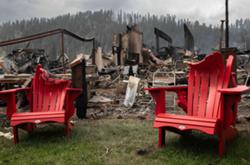
Governments will continue to boast about their commitments to education, but demands in the short term will likely take priority over funding excellent schools. More towns will have to be rebuilt from the ashes of more wildfires. More money will be needed to expand and maintain the energy grid, and to subsidize oil and gas as well as renewables. Military spending will be urgently required. Public health will find itself battling old enemies such as measles plus new epidemics of diseases migrating out of the tropics.
And speaking of public health, the class of ’38 will have health issues that will demand continuing attention. A 2023 report from the Conference Board of Canada estimates that 1.6 million children and young people have a mental health disorder, most commonly anxiety and depression.
The anxiety and depression rates are highest, the report says, among “children and youth who are Black, Indigenous, and people of colour,” as well as “youth coming into their sexual and gender identities.”
Such mental health issues, the report says, cost us $4 billion annually. The report warns that “without timely investments, the lifetime cost of just one cohort of children with onset of anxiety and/or depression at the age of 10 is close to $1 trillion.”
4. Curriculum culture wars
School curriculum is likely to be a turbulent issue throughout the schooling of the class of ’38. Should curriculum stick to “basics,” such as reading and writing, or should it create students who are media-literate, critical thinkers who understand the science and politics behind climate disasters and inequality? Spoiler alert: it should do both. It’s hard to be media literate if you can’t read or write well on paper or on screen.
Much of today’s K-12 curriculum is designed to prepare students for post-secondary study, with good reason: college or university was traditionally a path to upward social mobility, and now it seems necessary to avoid downward mobility. But a recent op-ed in the Globe and Mail asked if universities are worth the investment in time and money.
In theory, post-secondary is trade school for scholars and professionals; in practice, it’s become a subsidy to employers, who don’t have to invest so much in training new employees. The class of ’38 might not even need post-secondary if, for example, employers get a direct subsidy for hiring and training new workers.
If post-secondaries wane as a choice for students right out of high school, a few universities could go back to training the next generation of scholars and professionals. Alternatively, we might keep post-secondary as a tuition-free option for people of all ages; a “sabbatical year” on campus could recharge or retrain many older people.
Of course, sharply reducing our post-secondary system would cripple Canada’s ability to conduct its own research, not to mention its ability to attract foreign talent. And “enough” scientists and professionals might be grossly inadequate in the event of a political, economic or natural disaster. However we produce them, we will need a large population of educated people to provide resilience to such hazards.
5. Rewriting education’s promise
Given the prospects facing the class of ’38 as it enters the workforce in the 2040s, we can expect many students and graduates to be profoundly resentful and skeptical of their parents’ and grandparents’ values. They will hear about the idyllic life in the 1980s and 1990s, while they themselves must deal with food and water shortages, precarious work and political turmoil both at home and around the world.
If we can foresee their resentment, we may be able to minimize it by ensuring that schools teach the class of ’38 to be agents of their own salvation, able to bring political pressure to bear on governments, to detect and reject disinformation, and to judge their own success not by their relative personal wealth and status but by the equality and security of their community and country. It will be more than challenging to produce a class of 2038 with such capacities.
But we’d better be able to do it, because as soon as the class of ’38 leaves high school, we’ll welcome the Grade 1s of the class of 2050. ![[Tyee]](/design-article.thetyee.ca/ui/img/yellowblob.png)
Read more: Education









Tyee Commenting Guidelines
Please note that email notifications for replies are not currently working due to a software issue which may be resolved in a future update.
Comments that violate guidelines risk being deleted, and violations may result in a temporary or permanent user ban. Maintain the spirit of good conversation to stay in the discussion and be patient with moderators. Comments are reviewed regularly but not in real time.
Do:
Do not: