


 SHARE:
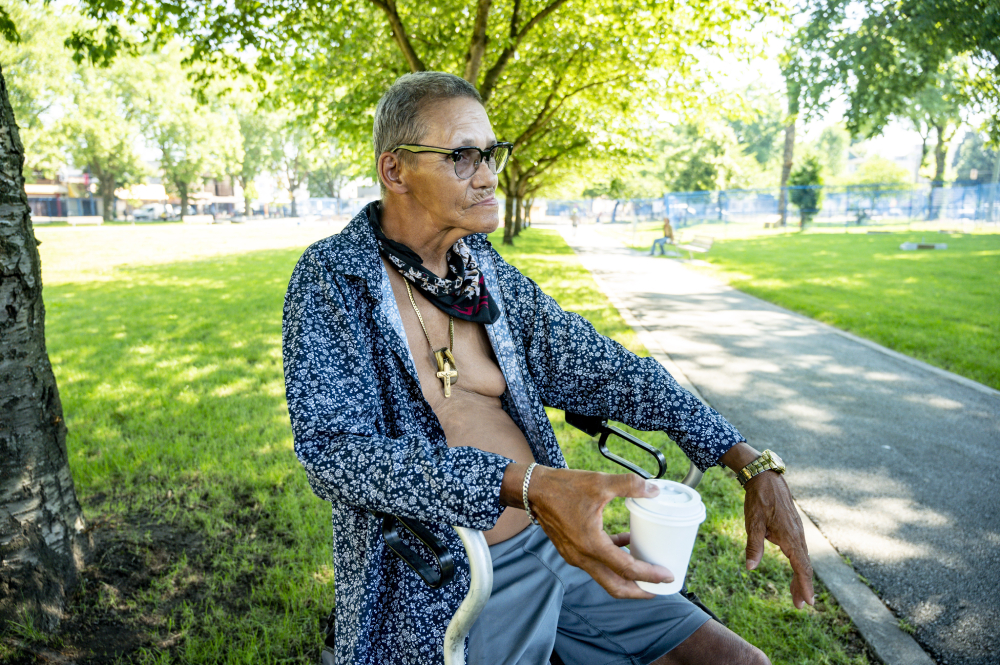
Vancouver organizations are banding together to help protect residents of the city’s poorest neighbourhood, which is at highest risk during extreme heat events.
The Summer Heat Resilience Project is run by the Vancity Community Foundation, Simon Fraser University and frontline non-profit organizations, who work together to support residents of the Downtown Eastside when temperatures soar.
The project aims to shift the way these organizations approach heat events, from emergency response to a state of coordinated preparedness, said Sean Condon, director of social and economic innovation at Vancity Community Foundation.
Condon said social service organizations are struggling to keep the communities they serve safe amidst the overlapping crises of toxic drugs, mental illness and affordability.
Government support is often offered in the form of grants, but endlessly applying for grants eats up organizational time and limits social services’ ability to plan long-term, he said.
“Communities always find a way, but if we don’t prepare ourselves properly for the next crisis and we get another serious emergency these systems are at risk of breaking,” Condon said.
The current social service industry is not set up for climate change, which will bring hotter summers, colder, wetter winters and long smokey seasons, he said.
If social systems collapse during a future extreme weather event, “that will make something that is already incredibly challenging and devastating that much worse,” he added.
The City of Vancouver’s Climate Adaptation Strategy for 2024-2025 calculates that over the next couple decades the average number of days above 25 C will triple, from 20 to 61 per year, and the average number of days above 30 C will increase from one to nine per year.
From 1981 to 2010 Vancouver hit 33 C or higher once every 20 years, but in the 2050s it will hit that same temperature once every other year, the report added.
During the 2021 heat dome, a weather station just south of the airport recorded 32.4 C on June 29, 2021 at 2 p.m., which felt like 39 C with humidity, according to Environment Canada’s historic records. There is no weather station within the City of Vancouver, but, as The Tyee reported during the heat dome, the Downtown Eastside, Marpole and parts of Vancouver’s southeast become the hottest places in the city during a heat wave.
During the heat dome emergency services were overwhelmed and help took hours to arrive, if it ever came.
One hundred and seventeen Vancouverites died, although there was a lower number of deaths in the Downtown Eastside than expected, according to the BC Coroners’ death review panel.
Working together
Non-profit organizations have experience responding to emergencies, so building capacity to coordinate planned responses to climate change doesn’t require reinventing the wheel.
Organizations can work together by pooling resources, buying in bulk and sharing storage space, Condon said.
The resilience project aims to distribute heat-response supplies, share procurement and storage of emergency supplies, create cooling and shaded spaces, organize neighbourhood outreach, set up peer-led misting and cooling stations, and distribute heat-safety information.
The project was launched earlier this summer and is still in its pilot stage, but the benefits are already showing up. By working collectively, the project has been able to buy 25 per cent more water bottles, 92 per cent more Gatorade bottles and 215 per cent more freezies, compared to when a single organization goes out and buys based on their individual budget, Condon said.
The resilience project also helped the Lookout Housing and Health Society open a misting tent at the Powell Street Getaway Drop-In Centre.
The Tyee sent an interview request to Lookout but they declined to be interviewed for this article.
Currently non-profits are expected to respond to a crisis after it has been declared, Condon said. For example, once the warning for a heat wave goes out, organizations can buy water and air conditioners and submit their receipts to senior levels of government for reimbursement.
But reimbursement isn’t guaranteed, which means it’s mostly large organizations with contingency funds that can access these government supports, he added.
If the government instead invests in preparedness, then organizations could train peers to check in on their neighbours in low-income housing when temperatures soar, have life-saving cooling equipment ready to distribute, or have contingency plans in place when staff are impacted by the heat and can’t make it to work, or senior staff aren’t able to sign off on expenses during the crisis.
Condon said he hopes the resilience project will show provincial and federal governments that it’s worth investing in community preparedness, rather than the current “Whack-a-Mole” response to emergency situations.
With the climate crisis it’s “just a matter of time” before the next extreme heat event happens, he added.
The resilience project builds on the Climate Resilience Roadmap for Non-Profits: From Crisis to Collective Power, which came out last year and emphasizes how marginalized populations and low-income neighbourhoods are disproportionately impacted by climate change.
This was horribly apparent in 2021, where over 90 per cent of the 619 British Columbians killed were over 60 years old, Vancouver City Councillor Lucy Maloney told The Tyee.
Heat is a “real problem with our growing senior population and the fact that we’re not investing in retrofitting the kind of accommodation that vulnerable seniors live in to include cooling,” she said.
Maloney also said provincial and federal funding is needed to help ensure communities are safe during extreme heat, but that recent actions by the ABC majority city council have severely limited small organizations ability to access that money.
During the 2026 City of Vancouver budget discussions, the ABC party cut the city’s non-market housing climate resilience retrofit program.
The program helped social housing providers install electric heat pumps, upgrade windows and install more effective insulation to keep homes comfortable, livable and safe during the summer, she said. It also helped those providers get enough capital to get into a position to apply for senior levels of government funding.
Without the municipal program it’s not clear how providers will access those larger streams of funding.
Vancouver’s older buildings need to be retrofitted because they are not designed to stay cool in extreme heat. In fact, many are even designed to retain heat, Maloney said.
In an emailed statement a spokesperson for the City of Vancouver said the city works with community partners to keep people safe during hot weather.
The spokesperson pointed to the 2010 Extreme Heat Response Plan, which was further updated with the 2022 Community-Led Extreme Heat Resilience program, which was developed in partnership with community organizations, a program that distributes cooling vests to Vancouverites with disabilities, the various water fountains and misting stations set up across the city and how landlords are no longer allowed to prohibit portable air conditioners.
But Maloney says more needs to be done.
In April the city discontinued a program that handed out cooling kits during extreme heat to help vulnerable residents stay safe. The kits included a cooling blanket, spray bottle, water bottle, cooling gel packs and an indoor thermometer.
A couple days later Maloney tabled a motion with several proposals to help vulnerable residents during high temperatures: including expanding cooling centre hours and locations, especially in high-risk neighbourhoods; expand tree canopy coverage; brining back cooling kits; and looking at using city vehicles or Translink busses as mobile cooling centres.
The motion passed, but only after “all the useful parts had been gutted” by Councillor Lenny Zhou, Maloney said.
The Tyee sent Zhou and ABC a request for comment on the bill but did not hear back by press time.
She ended up voting against what she viewed as a watered down bill.
Ultimately the city needs to focus on making homes safe for people, rather than responding to a situation that is already at a crisis point, she said.
In Maloney’s view, the city is moving in the wrong direction here.
In May, city council’s ABC majority voted to pause the ban on installing gas heaters in new buildings. Their arguments, reported by CBC, focused on improving affordability — despite BC Hydro calculating that heat pumps are more cost-effective than gas appliances.
If new buildings are installing gas furnaces then they’re missing out on how heat pumps can heat, cool and filter household air all in one appliance, Maloney said.
It’s important for young people, renters and seniors to get out and vote in the upcoming Oct. 17 municipal election to bring in a party that recognizes the risks of extreme heat in Vancouver, she added. ![[Tyee]](/design-article.thetyee.ca/ui/img/yellowblob.png)
Read more: Health




Tyee Commenting Guidelines
Please note that email notifications for replies are not currently working due to a software issue which may be resolved in a future update.
Comments that violate guidelines risk being deleted, and violations may result in a temporary or permanent user ban. Maintain the spirit of good conversation to stay in the discussion and be patient with moderators. Comments are reviewed regularly but not in real time.
Do:
Do not: