



 SHARE:
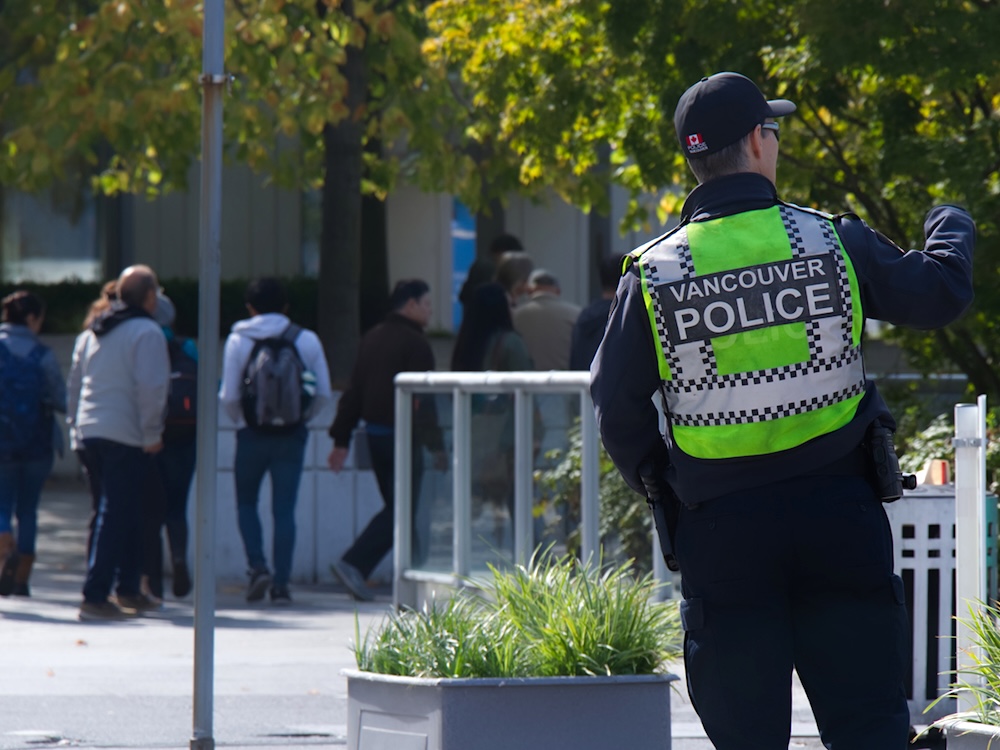
When the school liaison officer program returned to Vancouver’s public school district in September 2023, then-secretary-treasurer David Nelson told the district’s policy and governance standing committee the new liaison officers would undergo specific training.
“The Vancouver Police Department have made extensive commitments around the training that officers will receive and have received,” Nelson said, adding the training would be ongoing throughout an officer’s participation in the program.
A video recording of the Sept. 6, 2023, meeting was made private on the school board’s YouTube account earlier this year. The Tyee has obtained a transcript.
“The focus of the training will be in multiple areas, but specifically really looking at Equity Diversity and Inclusion training, how these officers will have specialized training in supporting youth and youth investigations, leadership, and communication,” Nelson said, adding this information is in the memorandum of understanding between the district and police department.
Earlier that year, The Tyee had revealed the Vancouver Police Department had not specially trained officers in the previous school liaison officer program — which operated in district schools from 1972 until it was cancelled by the board in 2021 — despite their claims to the contrary.
So on Dec. 6, 2023, when The Tyee filed three separate freedom of information requests with police related to the new school liaison officer program, we requested access to all training documents.
Nearly two years later, on July 30 and Aug. 1, 2025, The Tyee was granted in-person viewing access to webinars for two of the 43 courses, training modules and certifications the 15 police constables and two sergeants of the school liaison officer program must undergo.
We had initially agreed to a department offer of viewing three course webinars.
But on the first day we attended police headquarters to view the courses, we were told the cultural awareness and humility course was not part of the liaison officer training after all. We were also told the curriculum for that training module belonged to the RCMP, not the Vancouver Police Department as we had initially been informed.
Similar to the other freedom of information requests The Tyee filed with police, we were not able to access this information until we complained to the province’s freedom of information watchdog, the Office of the Information and Privacy Commissioner.
“As a criminologist, I think that public access to police materials — training, policy, procedure — is vitally in the public interest,” said Mike Larsen, a member of the criminology faculty at Kwantlen Polytechnic University. Larsen is also president of the BC Freedom of Information and Privacy Association.
Despite their reputation of serving the public, North American policing organizations have a long-standing culture of “opacity,” Larsen said.
“Often for really no good reason, when you get down to it,” he said, adding that policing relies on public trust, which can’t be achieved without transparency.
“In general, we want to know what our police are doing, so that we can have a serious democratic conversation about whether it’s appropriate.”
In contrast, the Justice Institute of British Columbia, which owns five of the courses, shared files for seven webinars just three months after The Tyee’s request, as well as two digital booklets and one page of disability categories.
A request for course materials from the Vancouver School Board, which controls four of the courses and training, was denied.
The school board cited Section 15(1)(c) of the Freedom of Information and Protection of Privacy Act, stating a public body may refuse to disclose information that could “harm the effectiveness of investigative techniques and procedures currently used, or likely to be used, in law enforcement.”
“Releasing operational methods, tactics and response protocols would make those tools less effective and could increase risk for the end user,” read an emailed statement from the school board’s communications department.
They did, however, provide the following high-level descriptions of the trainings:
“VSB Anti-Racism: four-hour training videos that focuses on anti-racism and cultural safety principles.
“VSB Neurodivergence: in-person workshop that provides strategies and interventions relating to neurodiversity, adverse childhood experiences, trauma informed practices and low arousal approach.
“Crisis Intervention and De-Escalation: information about staged de-escalation and duty of care. Trauma-informed practice and youth mental-health awareness.
“Secure and Hold Drills: roles and coordination with school administration during emergencies.”
The Tyee has since filed a freedom of information request with the school district for the training materials.
Indigenous training from human rights tribunal order
Over two days this summer, The Tyee sat in a conference room on the fourth floor of Vancouver Police Department headquarters and went through two webinars all department staff must undergo, including “School Liaison Officers: Indigenous Awareness 101: Promoting Culturally Safe Practices” and “Respectful and Inclusive Workplaces.”
“Respectful and Inclusive Workplaces” is a human resources webinar with four modules that cover diversity, equity, accessibility, belonging and inclusion in the workplace, from both a legal and a police department values’ perspective.
“Indigenous Awareness 101” was created to fulfil a condition implemented when the police lost a BC Human Rights Tribunal case in 2019.
The tribunal ruled the department’s officers had discriminated against Deborah Campbell, an Indigenous mother who attempted to question the police officers she witnessed arresting her 19-year-old son, in 2016.
The officers refused to answer Campbell’s questions and told her to go home. When she did not comply, they grasped her by the arms and physically dragged her for 35 to 40 feet.
“Police officers interacting with Indigenous people should come armed with a basic understanding of Canada’s colonial history and the collective and individual trauma this history has engendered among generations of Indigenous people, particularly Indigenous women and girls,” tribunal member Devyn Cousineau wrote in his decision.
But at the time — four years after the Truth and Reconciliation Commission of Canada released its final report, three years after the National Inquiry into Missing and Murdered Indigenous Women and Girls began, and a quarter-century after the Gustafsen Lake standoff — these five Vancouver police constables did not possess this understanding.
Myrna McCallum, who is Métis, was one of two lawyers representing Campbell at the tribunal. She had the opportunity to cross-examine the constables about their knowledge of First Nations and Indigenous people.
“It was pretty depressing and dismal,” she said, calling their understanding “negatively biased and ill-informed.”
“It was honestly really shocking.”
The hearing took place in September 2019, six months after the police department released “Breaking Barriers and Building Bridges,” their review and analysis of the department’s initiatives with Indigenous Peoples.
None of the officers McCallum cross-examined had heard of or read the report. Nor did they know why the Vancouver Police Department’s cars have sported a thunderbird, designed by xʷməθkʷəy̓əm (Musqueam Nation) artist Susan Point, since 2006.
Asked about their individual interactions and relationships with Indigenous people, McCallum said the constables spoke about Indigenous people having a “heavy” reliance on government housing subsidies and “disorganized family structures.”
“It was largely ill-informed, negative, stereotypical, wrong,” she said. “It was really horrible.”
McCallum has not seen the “Indigenous Awareness 101” webinar, which covers colonial history in Canada, from first contact between European settlers and First Nations to broken treaties, residential schools, potlatch bans and Indian agents, history of oppression by police, systemic racism, allyship and cultural appropriation, Indigenous resistance, and historical and ongoing child welfare apprehensions.
The webinar, which is supposed to take three hours to complete, includes videos and multiple-choice quizzes at the end of its four modules. A final multiple-choice test with 27 questions requires a score of 80 per cent to pass.
Created by the Vancouver Police Department and Kairos Canada, a social justice charity under the United Church of Canada, the webinar states both səlilwətaɬ (Tsleil-Waututh Nation) and the Metro Vancouver Aboriginal Executive Council reviewed a “comprehensive” course outline.
The Tyee was only allowed to take handwritten notes while reviewing the webinars and did not have the ability to fact check in real time.
However, we did notice the webinar relies on 2008 data for how many children in care in the province are Indigenous, saying it was 51 per cent.
When the BC Human Rights Tribunal decision that triggered the creation of the webinar was released in December 2019, Indigenous kids represented 66 per cent of kids and youth in care in B.C.
The latest data shows that ratio has increased to 68 per cent.
Disclosing training material could harm ‘economic interest’ of police, VPD argued
In response to our Dec. 6, 2023, freedom of information request, on April 10, 2024, VPD lawyer Darrin Hurwitz sent The Tyee a list of courses and certifications school liaison officers had to complete. But he did not provide documents related to the courses, as we had requested.
When we pressed for training materials, Hurwitz responded that not all the training material belongs to the police department. For the courses that did, he said via email that if The Tyee was interested in the materials for a specific course or two, “as 17(1)(b) is a discretionary exemption perhaps we can discuss what information you require and VPD can assess.”
Section 17(1)(b) refers to the section of the provincial Freedom of Information and Protection of Privacy Act regarding “disclosure harmful to the financial or economic interests of a public body.”
Specifically, a public body like the Vancouver Police Department could deny access to information that would “reasonably be expected” to harm their financial or economic interests.
But we weren’t just interested in seeing the training materials for a course or two. We filed another freedom of information request, seeking the number of sales, revenue obtained and documentation of the department’s course marketing efforts.
The results showed two courses brought in combined revenue sales of $8,315.95 between Jan. 1, 2010, and Jan. 1, 2025.
For another three courses, the department told us that they were “unable to compile records at this time,” despite acknowledging they had sold seats for two of the courses during that time period.
The third, a pistol qualification, we learned is an annual certification requirement and not a course.
We used this information in our complaint to the Office of the Information and Privacy Commissioner about the department not releasing any training materials.
The Tyee had elected to move into inquiry, the final stage of the office’s investigation process, before agreeing to the police department’s offer of viewing three webinars, later amended to two webinars.
Criminologist Larsen notes Section 17 of the Freedom of Information and Protection of Privacy Act is discretionary, meaning it is up to a public body whether the information can be shared.
“The school liaison officer program, in Vancouver of all places, is one that has been heavily scrutinized. There has been a history of lack of transparency and accuracy in terms of the description of the program,” he said.
“There’s public controversy as to the impacts, the merits of the program, and a lot of legitimate questions.”
Given this, one may think it would be in a public body’s “vested interests” to disclose the training materials, Larsen told The Tyee, for “maximum transparency.”
Whether you like the school liaison officer program or not, Larsen said, transparency regarding the training officers must undergo is in everyone’s interest.
“You can come at that issue from any different side and still regard having more comprehensive knowledge of what kind of training takes place there to be a benefit to the overall debate,” he said. ![[Tyee]](/design-article.thetyee.ca/ui/img/yellowblob.png)
Read more: Rights + Justice, Education









Notice about commenting changes
The Tyee’s commenting system will be moving to a new platform on Nov. 12. If you’re already a Tyee commenter you must register with the new system on or after Nov. 12 with your preferred username.More information can be found here.