

 SHARE:
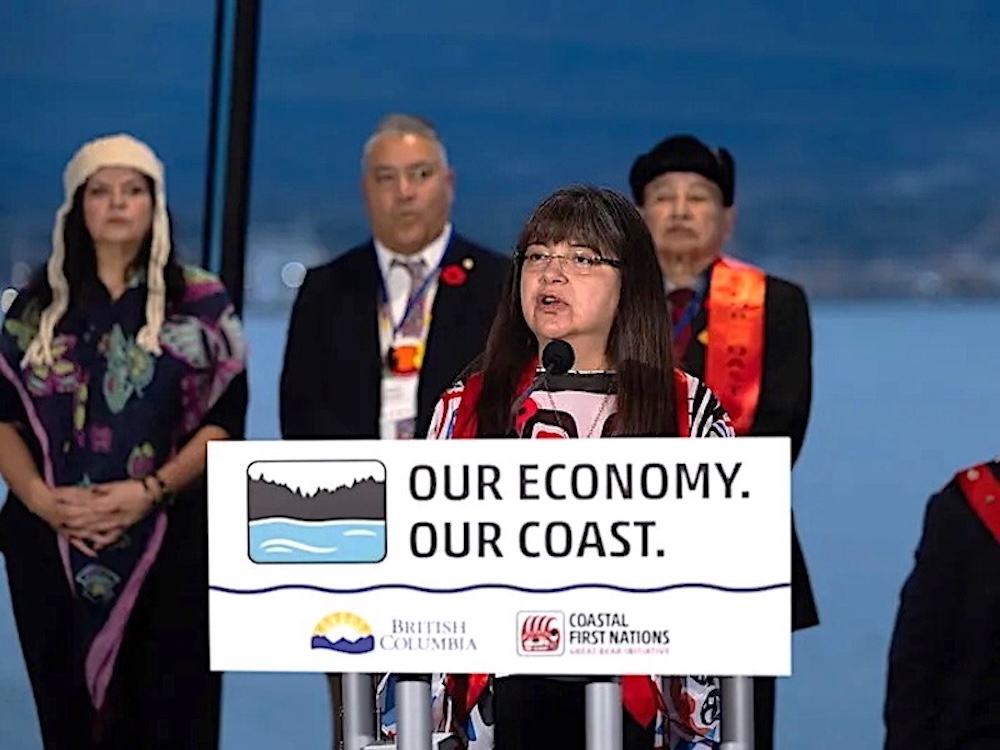
Alberta Premier Danielle Smith has probably never heard her name, but K̓áwáziɫ Marilyn Slett, chief councillor of the Heiltsuk Tribal Council on B.C.’s Central Coast, has emerged as one of the strongest voices opposing any change to Canada’s North Coast tanker ban.
If there’s one immovable obstacle to Smith’s dream of a new northern oil pipeline and terminal, it’s Slett.
Just to be completely clear, Slett says that the project is a “non-starter,” that it “will never happen,” that “a North Coast pipeline will never be built” and that “no offer of equity or ownership will change our position and no proponent is acceptable to us.”
While Premier David Eby insists that “our government’s opposition to any repeal of the North Coast tanker ban has not changed,” Slett and her allies in B.C.’s North Coast Indigenous leadership are creating facts on the ground that make the project politically and practically impossible.
They are forging ahead with far-reaching economic development and conservation initiatives of their own, none of which involve the risk of an oil spill.
An unprecedented agreement announced May 22 brought together leaders from Canada, British Columbia and six coastal First Nations to create a national marine conservation area reserve over 6,700 square kilometres of the Central Coast, an area larger than Prince Edward Island stretching from the north end of Vancouver Island to just south of Prince Rupert. The six First Nations simultaneously declared the same area an Indigenous Protected and Conserved Area.
Front and centre in the release was Slett, reminding us that “for countless generations, our Nations have cared for these waters.” The name of the reserve is Mia-yaltwa Ha’lidzogm hoon, or “Realm of the Salmon.”
While outside the likely routes of Prince Rupert-bound tankers, the conservation area underlines the importance of the multibillion-dollar-a-year fishery and tourism economies of the region that would be devastated by a spill.
Slett’s home community of Waglisla (Bella Bella) not only sits at the centre of the new conservation region, but is still recovering from the 110,000-litre diesel spill from the tug Nathan E. Stewart that devastated the territory in 2016. To put that into perspective, the 2016 spill was about 687 barrels of fuel. A mid-size tanker holds one million barrels.
“These collaborative agreements are an important step towards ensuring that future generations will continue to benefit from healthy oceans, thriving biodiversity, and strong coastal communities on the Central Coast,” Slett said. “For countless generations, our Nations have cared for these waters because they are inseparable from who we are as coastal peoples.”
The new protected area is embedded in the Great Bear Sea Marine Protected Area, announced in 2023 after years of negotiations. The goal is not to create a park, but to protect and enhance marine resources that feed their communities, support hundreds of jobs and offer long-term economic opportunity.
“These waters feed families, sustain jobs, anchor cultures and support businesses,” said Randene Neill, B.C.’s minister of water, land and resource stewardship. “We are safeguarding the long-term well-being of the Central Coast economically, culturally and ecologically.”
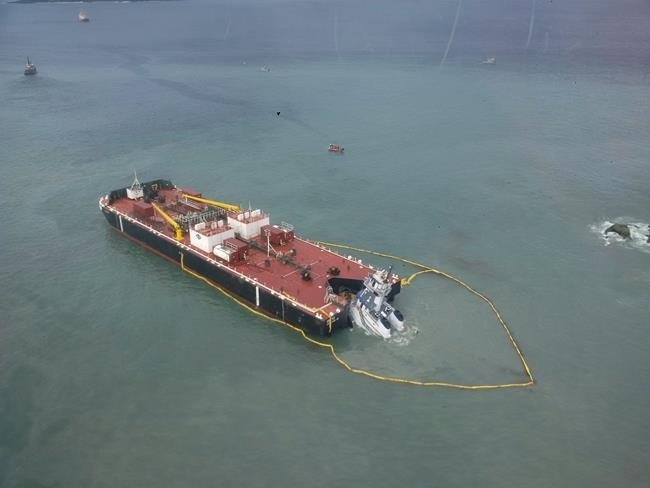
Slett first came to national attention as the Heiltsuk’s spokesperson during the Nathan E. Stewart spill response. Diesel fuel contaminated 350 kilometres of shoreline, forced the closure of a clam fishery with 50 jobs and cost the Heiltsuk $23 million in recovery costs, money it has not been repaid. (The full cost of the cleanup has not been reported, but the tug operator ultimately paid a $2-million fine.)
When Prime Minister Mark Carney sat down with Smith to sign a pipeline deal May 25, he promised to have construction underway as early as next year. As proof of his commitment, he rolled back the industrial carbon tax, eased the terms for a new carbon capture and storage project and slashed approval processes. The “tanker ban” remained untouched.
Just to be sure no one overlooked that last point, Slett issued a news release declaring: “We have heard directly from the Prime Minister and the Minister of Energy and Natural Resources, Tim Hodgson, that no project, and no route, will proceed without the support of affected First Nations and the province in which it is proposed.”
“We do not support a proposed oil pipeline and tankers route to the North Coast of B.C. and we, along with the Lax Kw’alaams Band and the province of B.C., have called on the federal government to uphold the North Coast Oil Tanker Moratorium Act in its entirety, with no exceptions or carve outs.”
(Despite Carney’s concessions, Smith confirmed a referendum on separation from Canada three days later, meaning an attempt to repeal the act would be doing a favour to a separatist-adjacent Alberta premier.)
Now 18 years into her role as chief councillor of the Heiltsuk, Slett is also president of Coastal First Nations, an alliance of First Nations stretching from Wuikinuxv at Rivers Inlet to Haida Gwaii and Metlakatla, near Prince Rupert. She is currently secretary-treasurer of the Union of BC Indian Chiefs and is a UBCIC representative on the First Nations Leadership Council. Slett is also on the board of Vancouver Coastal Health.
It was as chief councillor of the Heiltsuk that Slett warned Eby in February, in a Globe and Mail opinion piece, that he was headed down the wrong road with his plans to amend the Declaration on the Rights of Indigenous Peoples Act.
In words equally relevant to Carney, she wrote: “Reconciliation cannot occur when one party can decide whether it happens at all. It must occur between the Crown and Indigenous peoples, as legal and political equals.”
Slett was front and centre, however, in November, when Eby was joined by Indigenous leaders to sign a declaration that “protecting our coast is not a barrier to economic prosperity, it is the source of it.”
The united opposition of B.C. and Coastal First Nations has effectively slammed the door on any attempt by the Carney government to amend or repeal the Oil Tanker Moratorium Act, which was passed in 2019 to turn long-standing policy into law.
It was one of several measures, including the Oceans Protection Plan and the investment of billions of dollars in additional oil spill protection measures on the South Coast, that the Justin Trudeau government hoped would build public support for construction of the Trans Mountain pipeline expansion project.
That pipeline, which entered service early in 2024, is now running at full capacity, effectively tripling the flow of oil to tidewater to 890,000 barrels a day. Now B.C. has endorsed a further 30 per cent expansion of Trans Mountain to be achieved by dredging Burrard Inlet to allow larger tankers. Smith is still not satisfied.
A pipeline to the South Coast, while legally and technically feasible, has political perils of its own. If the proposed project is another doubling of capacity, which the Smith government is hoping for, the legal and environmental challenges are significant.
Can Burrard Inlet support the additional traffic? What are the consequences of a terminal at Roberts Bank, right on the Pacific flyway and in the mouth of the Fraser River, which saw 10 million sockeye return last year for the biggest run in 20 years? Would this require giving up on species at risk, such as the beleaguered southern resident killer whales?
Despite polls showing a majority of British Columbians support a pipeline, 34 per cent remain opposed. Many of those opposed will be federal Liberal voters. So far, no leader of Slett’s stature has emerged to be their voice.
The fight to protect the North Coast from a catastrophic oil spill has strong parallels with the grassroots Alberta campaign — led by rancher and country singer Corb Lund — of Corb Lund and the Hurtin’ Albertans to ban metallurgical coal mining in the eastern slopes of the Rockies. Selenium leaching from mine tailings can poison freshwater lakes and rivers, so Lund and his supporters are seeking to ban new mines.
Lund’s petition for a referendum against mining, which has 219 signing locations across the province, is designed to protect existing economic activities, including ranching, hunting and tourism. It does not seek to turn vast areas of the province into a park.
Is Alberta a hotbed of environmentalism? No, but everything has its place. And the eastern slopes are not the place for coal mining, any more than the North Coast is suitable for oil tankers. ![[Tyee]](/design-article.thetyee.ca/ui/img/yellowblob.png)
Read more: Indigenous, Energy, Alberta, Environment


Tyee Commenting Guidelines
Please note that email notifications for replies are not currently working due to a software issue which may be resolved in a future update.
Comments that violate guidelines risk being deleted, and violations may result in a temporary or permanent user ban. Maintain the spirit of good conversation to stay in the discussion and be patient with moderators. Comments are reviewed regularly but not in real time.
Do:
Do not: